New Year's Day. No hangover, no resolutions shouted at midnight, just a stone sign announcing that we're leaving the massif. The trip goes on, but something changes in nature that day.
1 January · morning
Leaving the Tadrart
The official sign of the Tadrart tourist site, set in a dry-stone wall, symbolically marks our exit from the massif. We pose in front of it, a little solemn in spite of ourselves: we've been living inside it for six days.
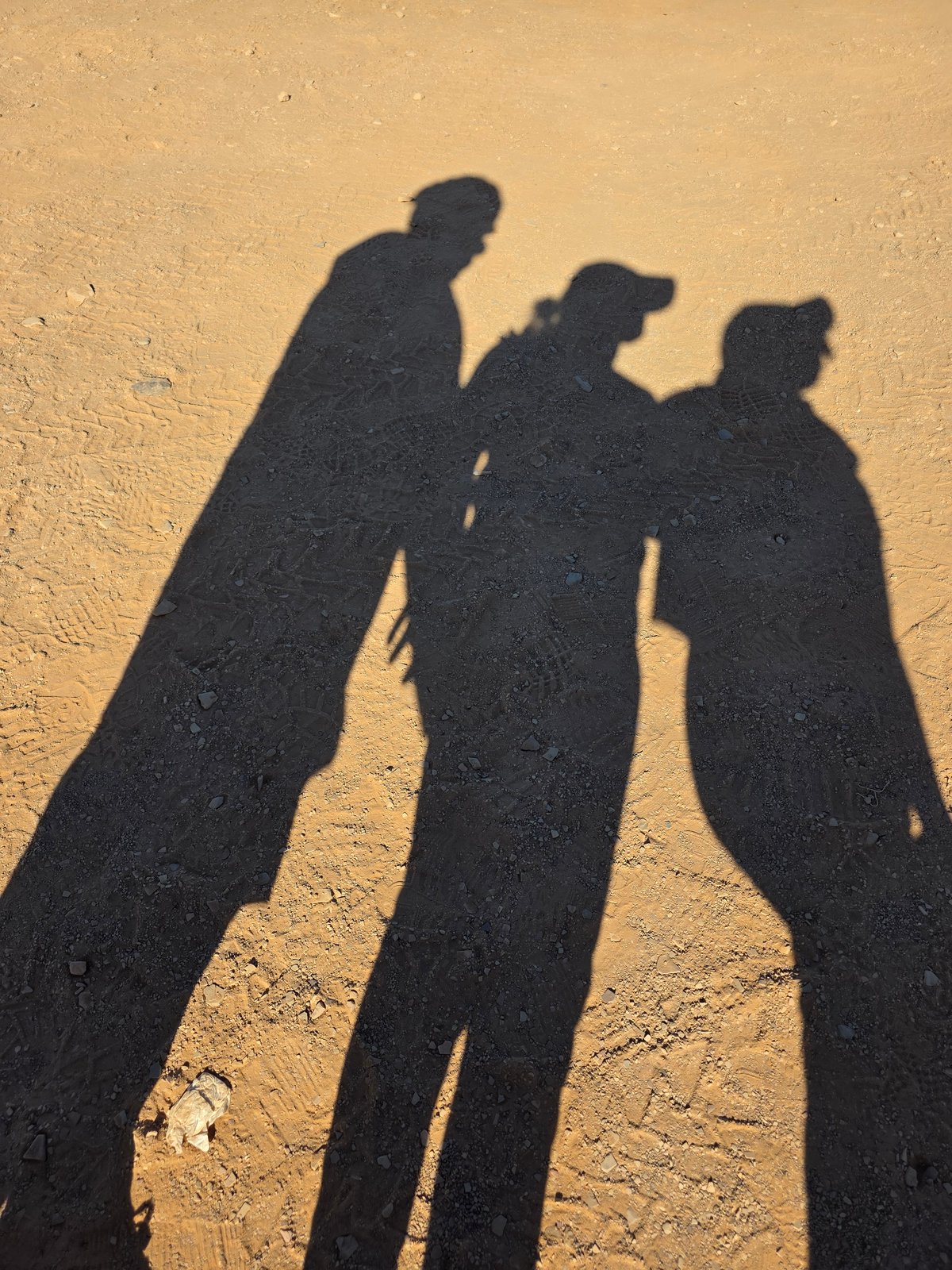
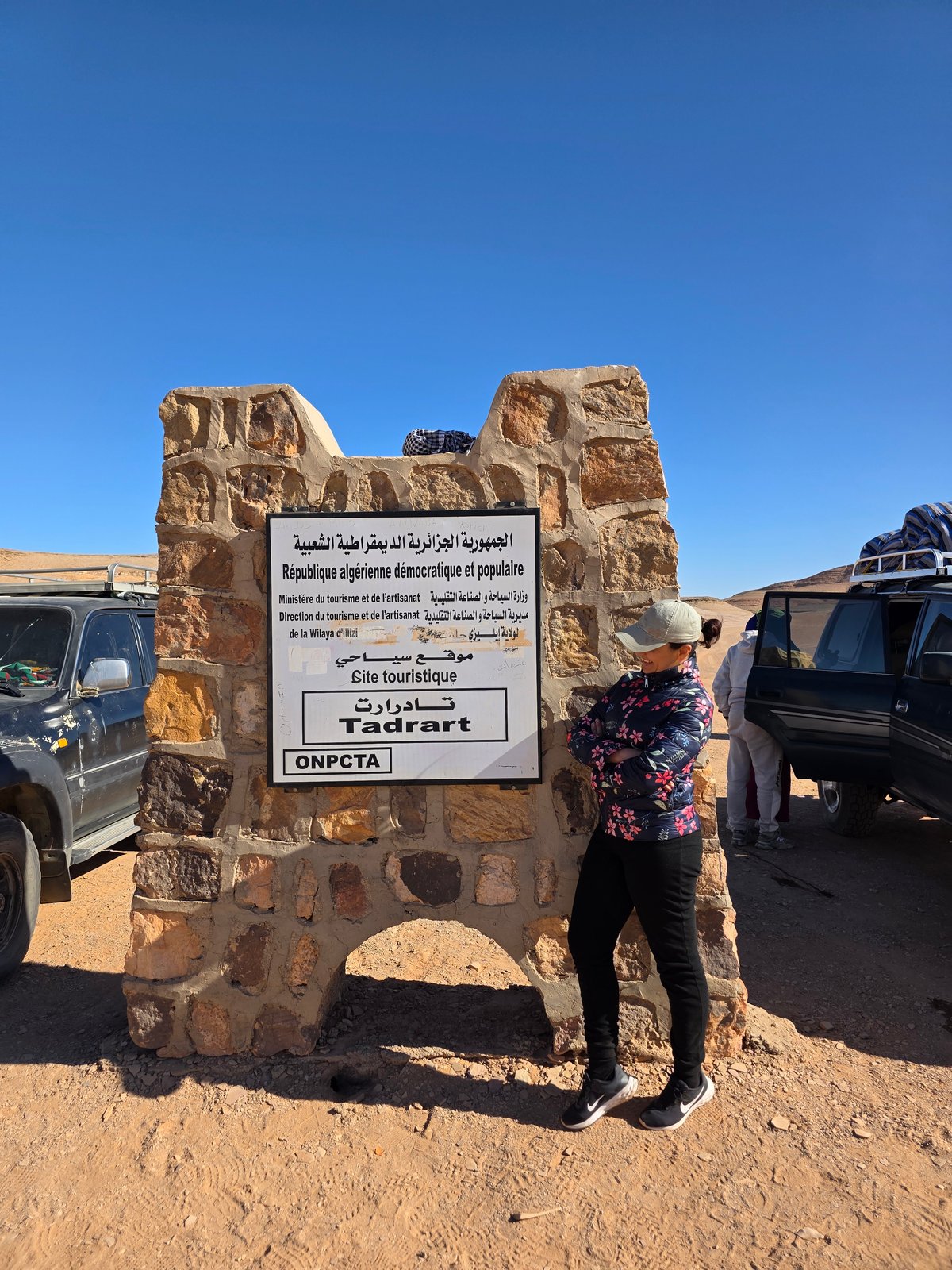
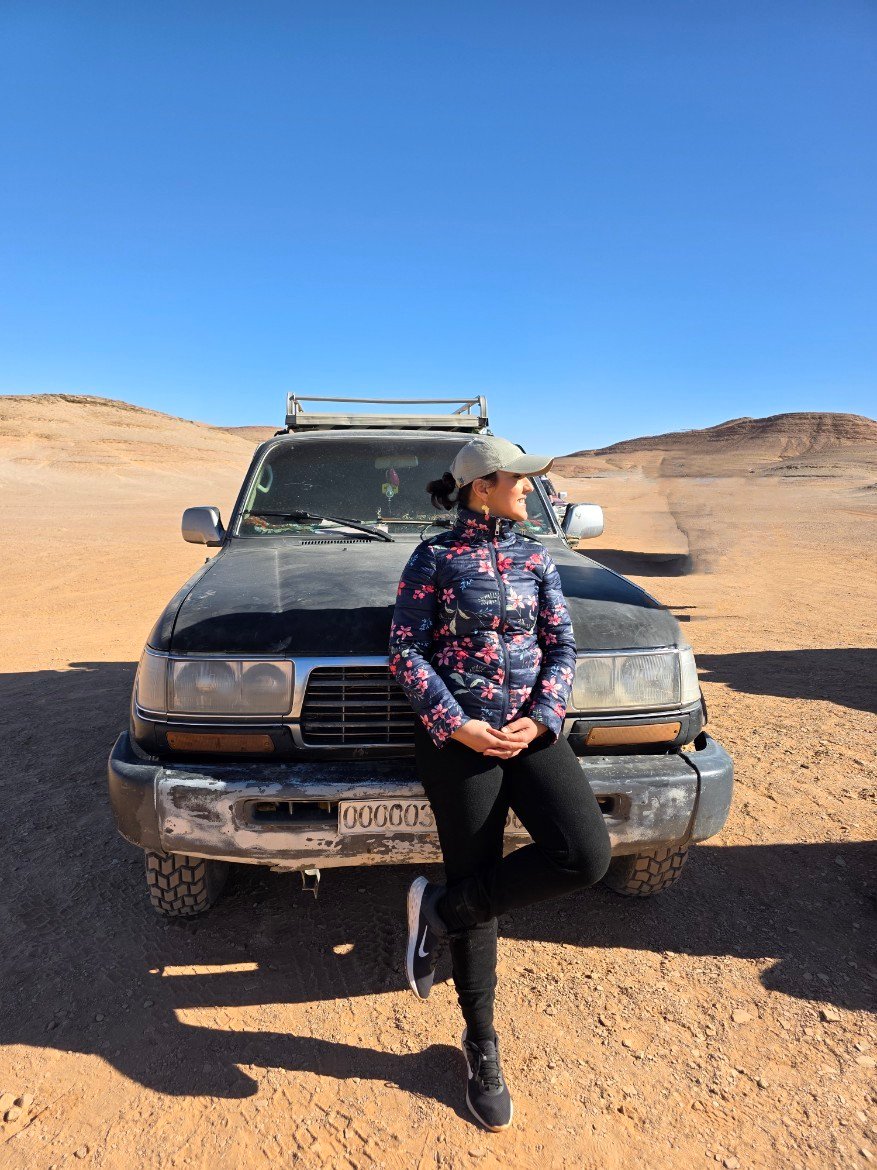
Our shadows, welded together by the morning light · The obligatory souvenir photo at the official sign · And back in the car!
Further on, our shadows stretch across the morning sand, welded to one another by the low light, three silhouettes that almost become one.
1 January · noon
The crying cow
On the way back, a stop in front of an engraving we had been told about: the crying cow. You have to look twice to see it, tiny on a huge wall, and then, once you've spotted it, you can't stop seeing it. The line running down from its eye leaves little doubt about its name.
Lunch follows soon after: macaroni in sauce, a few meatballs, set down on the ground not far from the site. Nothing extraordinary on the plate, but everything tastes good when you eat on the ground in the middle of nowhere.
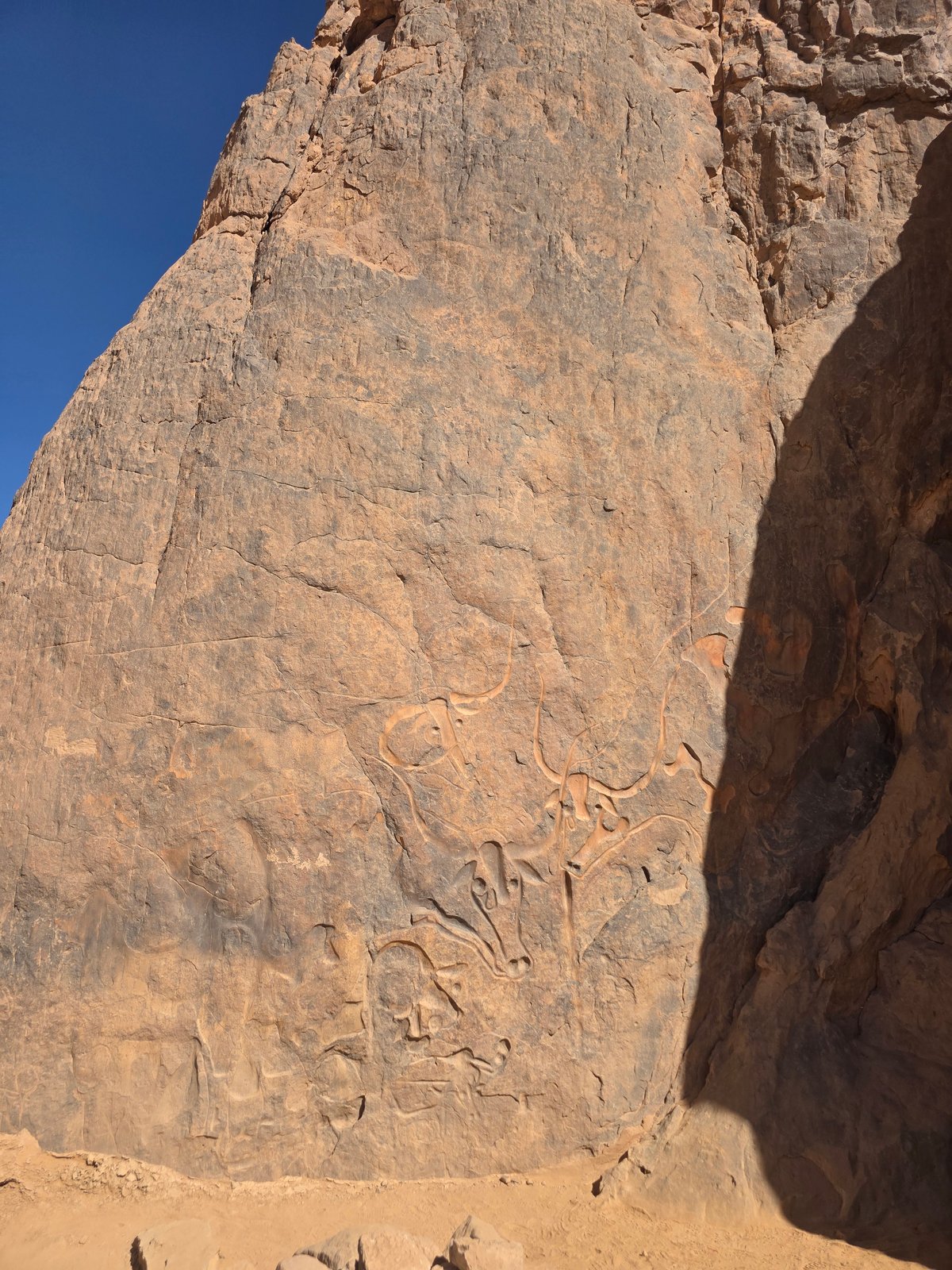
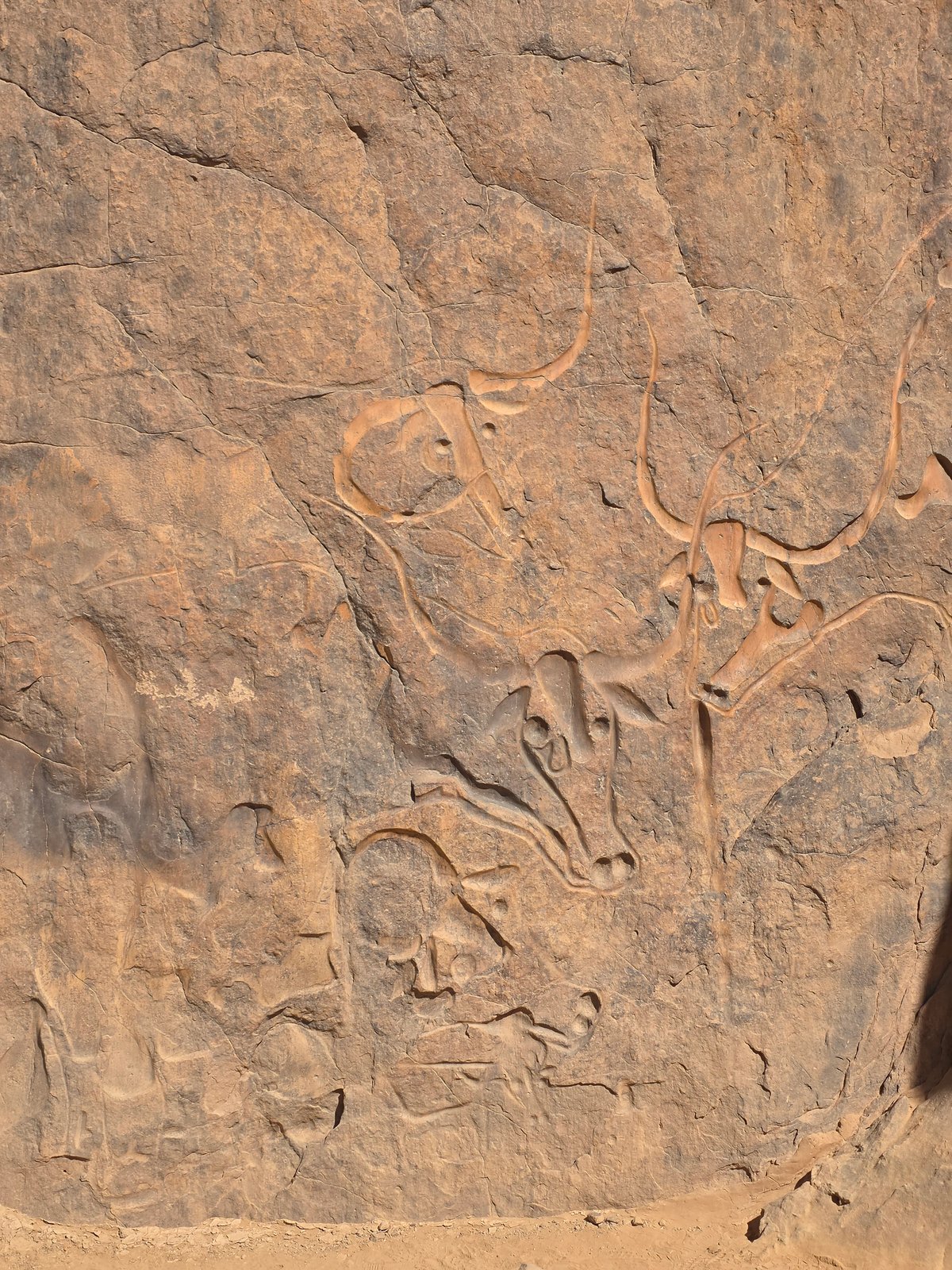

The cow, tiny on its huge wall · The close-up, with its tear · Macaroni and meatballs, right on the ground
The crying cow is carved on a monolith at the edge of the Admer erg, near Djanet. It is more than 7,000 years old: a masterpiece of Neolithic sculpture, cut in bas-relief, with deep grooves of incredible precision.
Why are these cows crying? Nobody really knows, and the tears have given rise to lots of legends. Every guide has his own; ask yours!
1 January · 2 p.m.
Signal hill
And then there's this hill. The 4x4s all stop at the same time, and at first we don't understand why, until we see the Tuareg climbing onto the roofs of their cars, phone in hand, arm stretched towards the sky. The first signal in five days.
It's almost comical: everyone lit up by their screen at the same time, balancing on a car roof in the middle of the desert. I switch mine on, send a quick message to my family to give some news, and then switch it off.
It isn't indifference. It's just that, for the first time in a long while, I wasn't missing anything on the other side of the screen. We lose the signal again almost at once, barely an hour in total, until the evening of the next day.
1 January · afternoon
Tikoubaouine, another desert
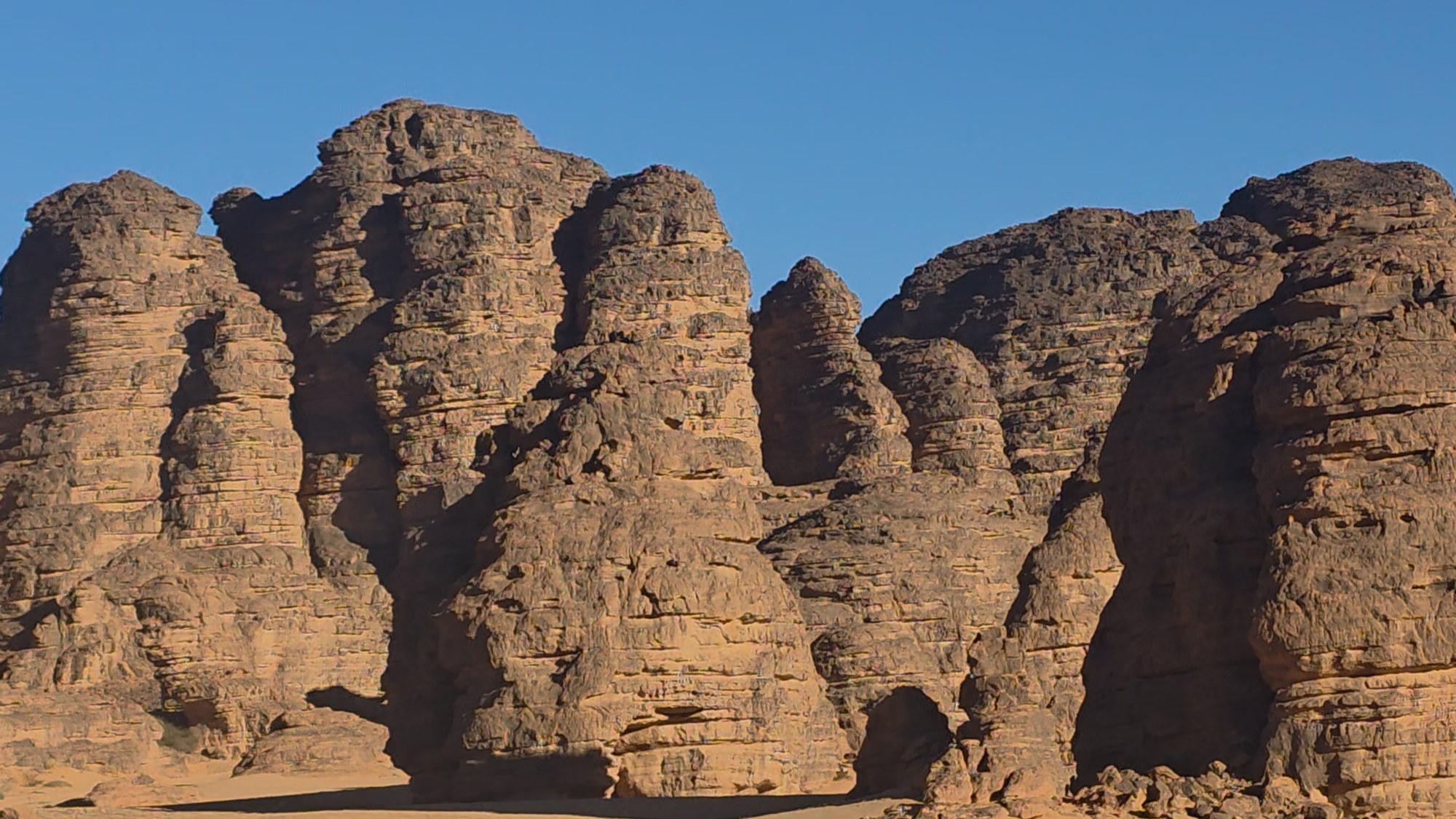
The landscape changes completely. No more Tadrart red: at Tikoubaouine, huge blocks of rock stretch as far as the eye can see, sculpted by the wind into almost architectural shapes.
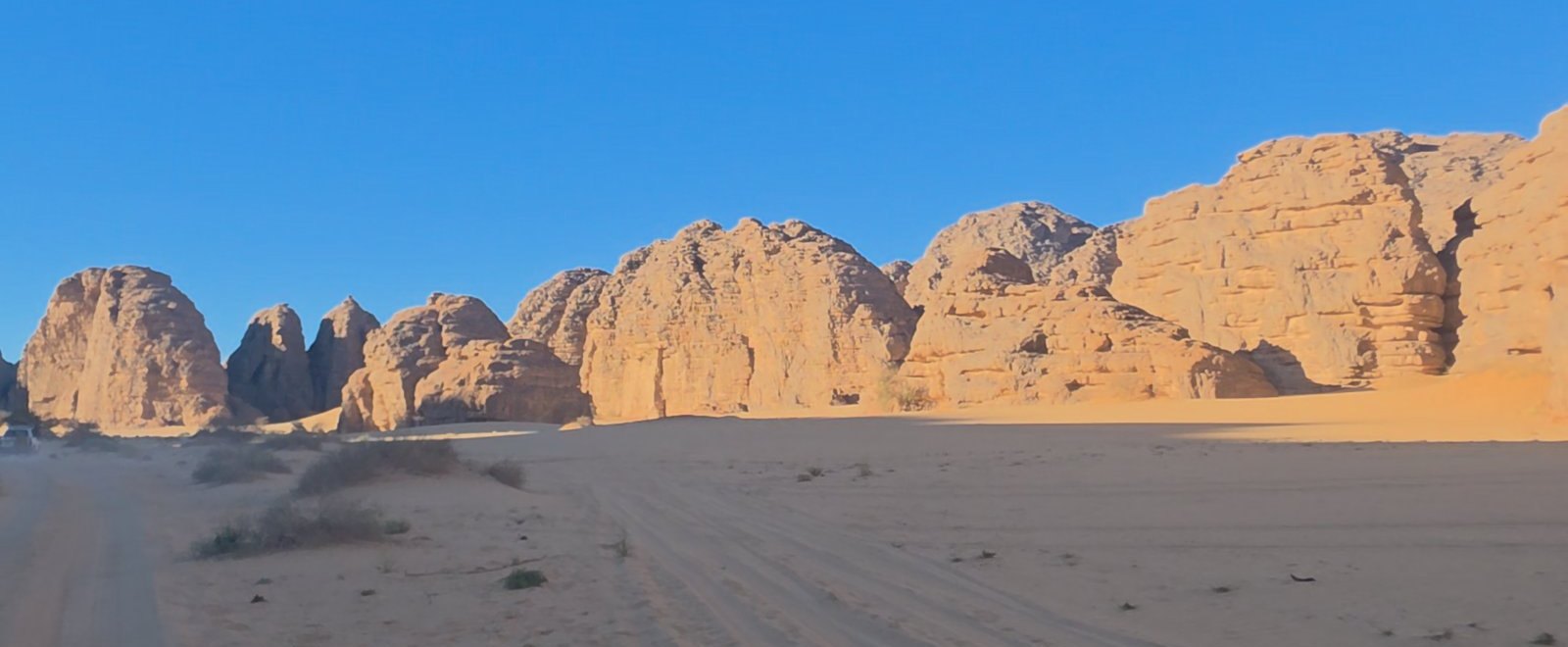
From the 4x4: sandstone blocks as far as the eye can see
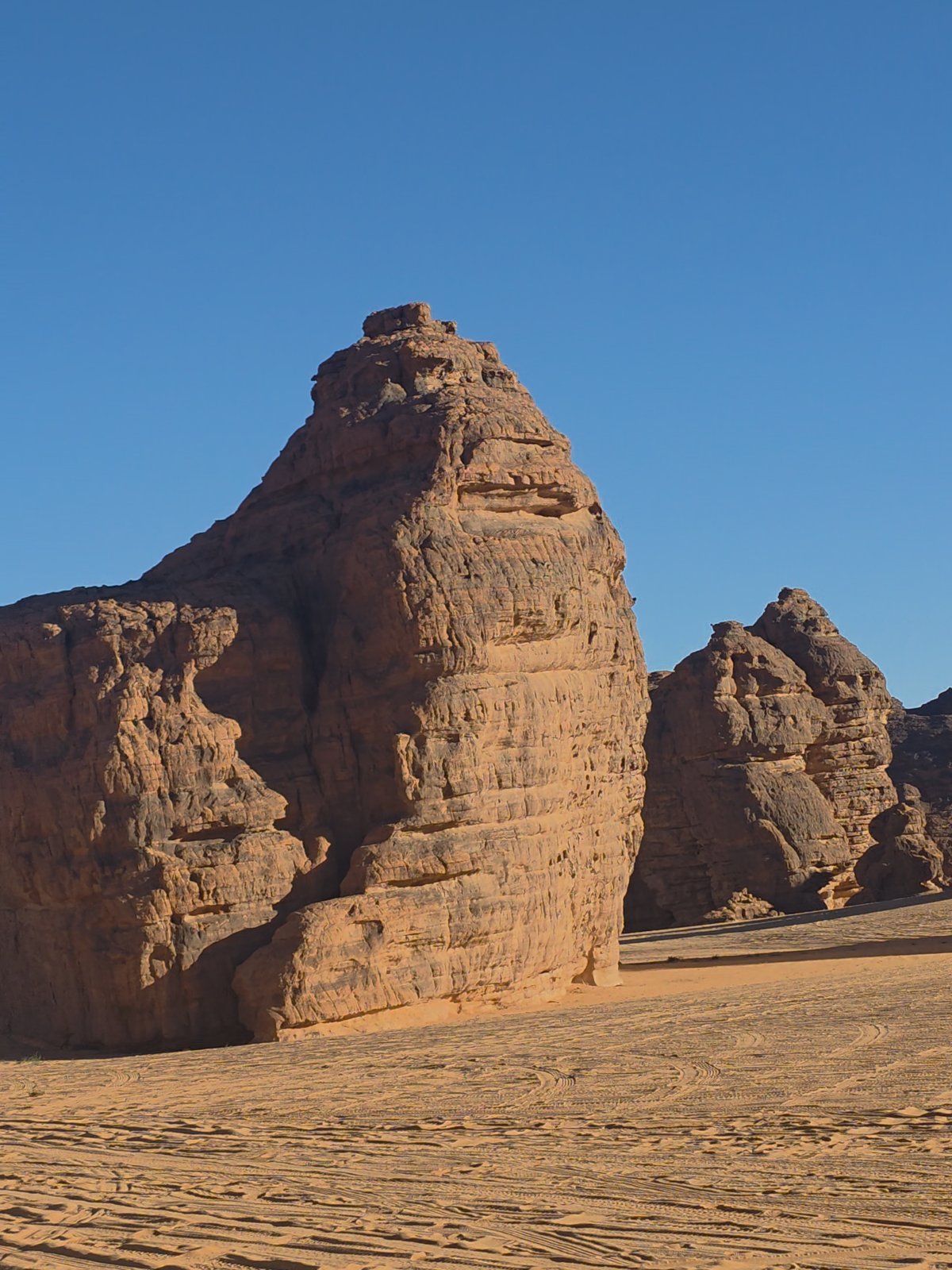
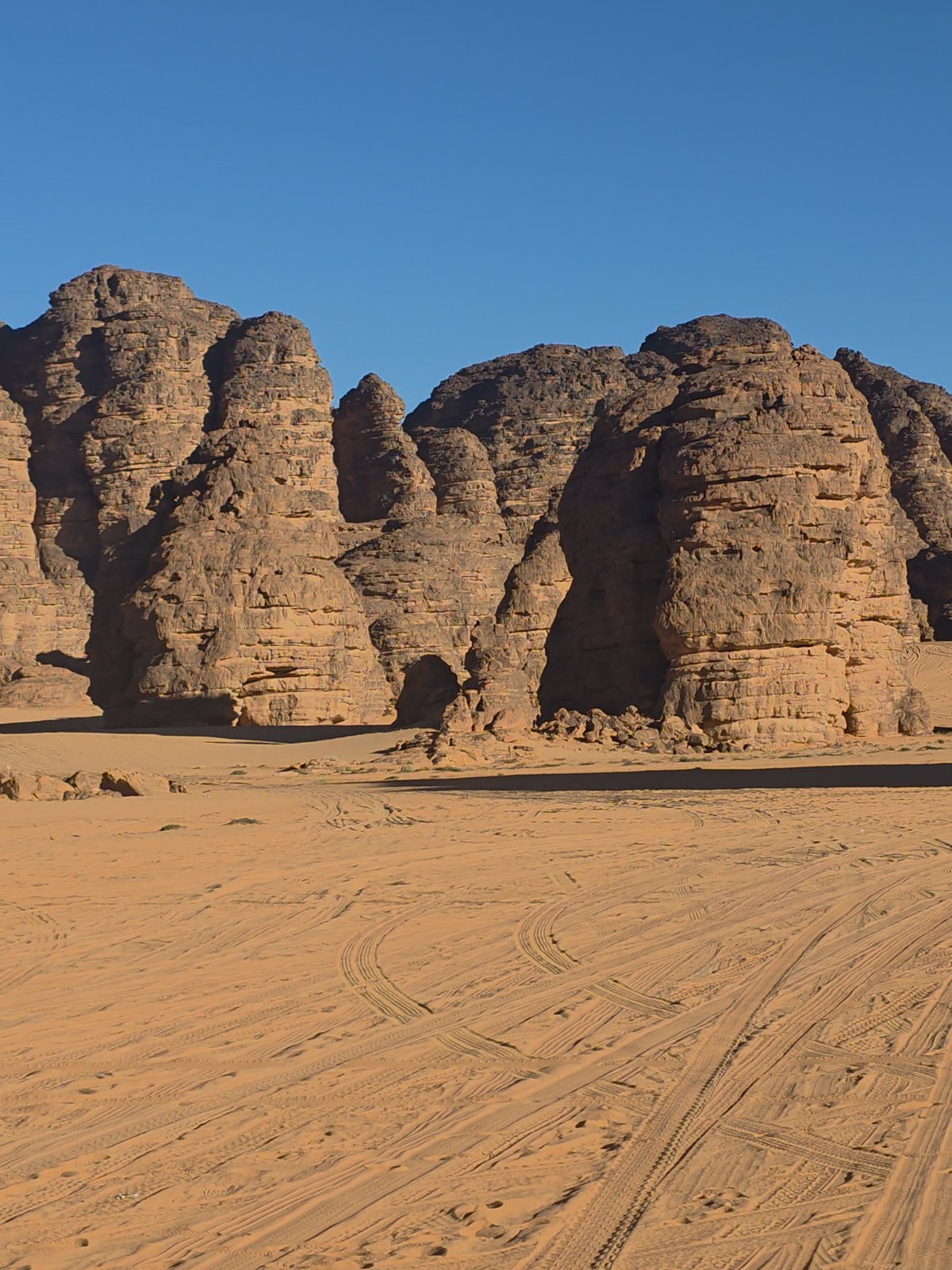
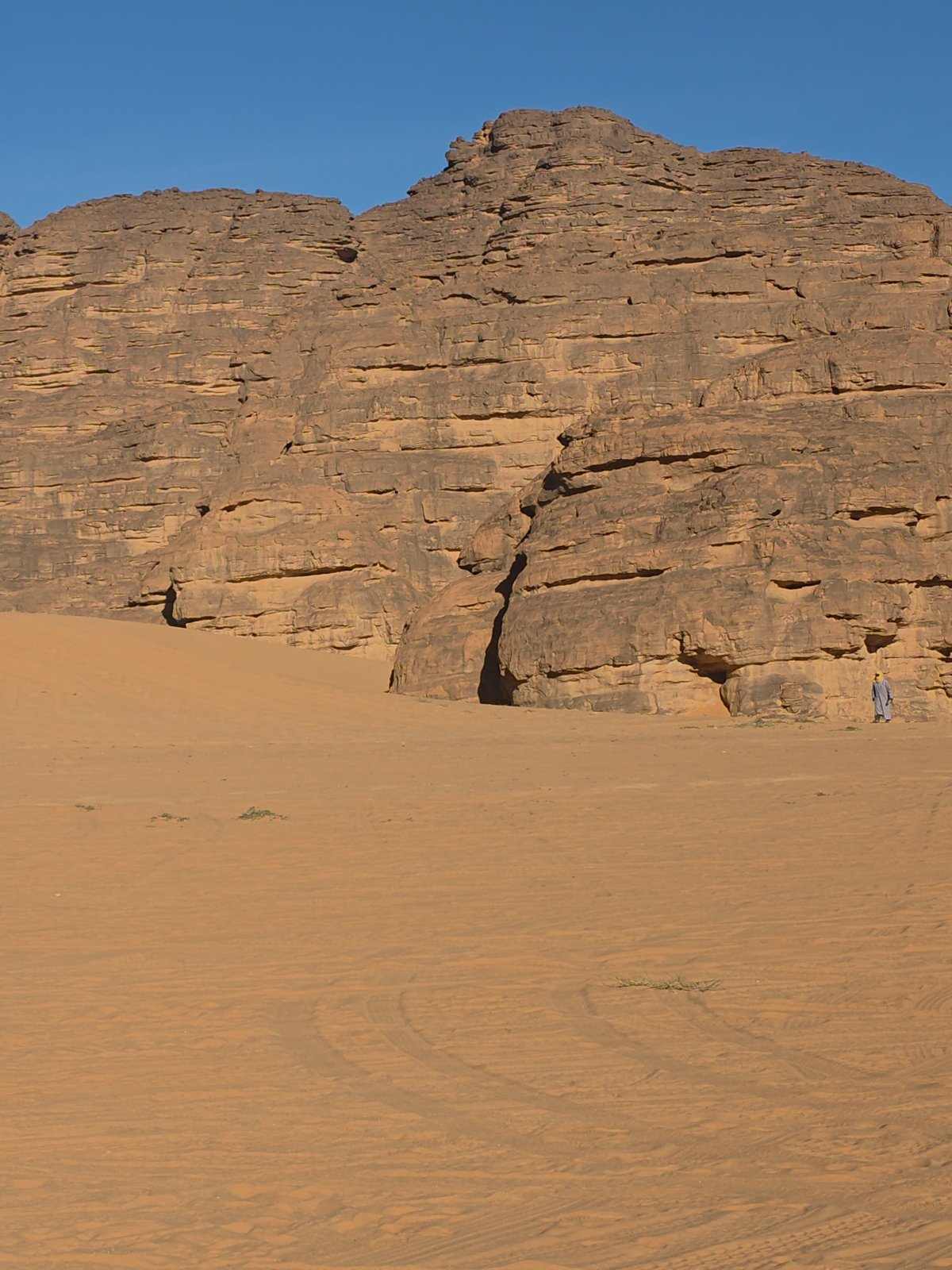
A tower · Domes · A giant block, sculpted by the wind
And then the giant arch, carved by thousands of years of erosion. Standing at its foot, a tiny figure finally gives the true scale of the place. All around, more masses of sandstone, just as outsized.
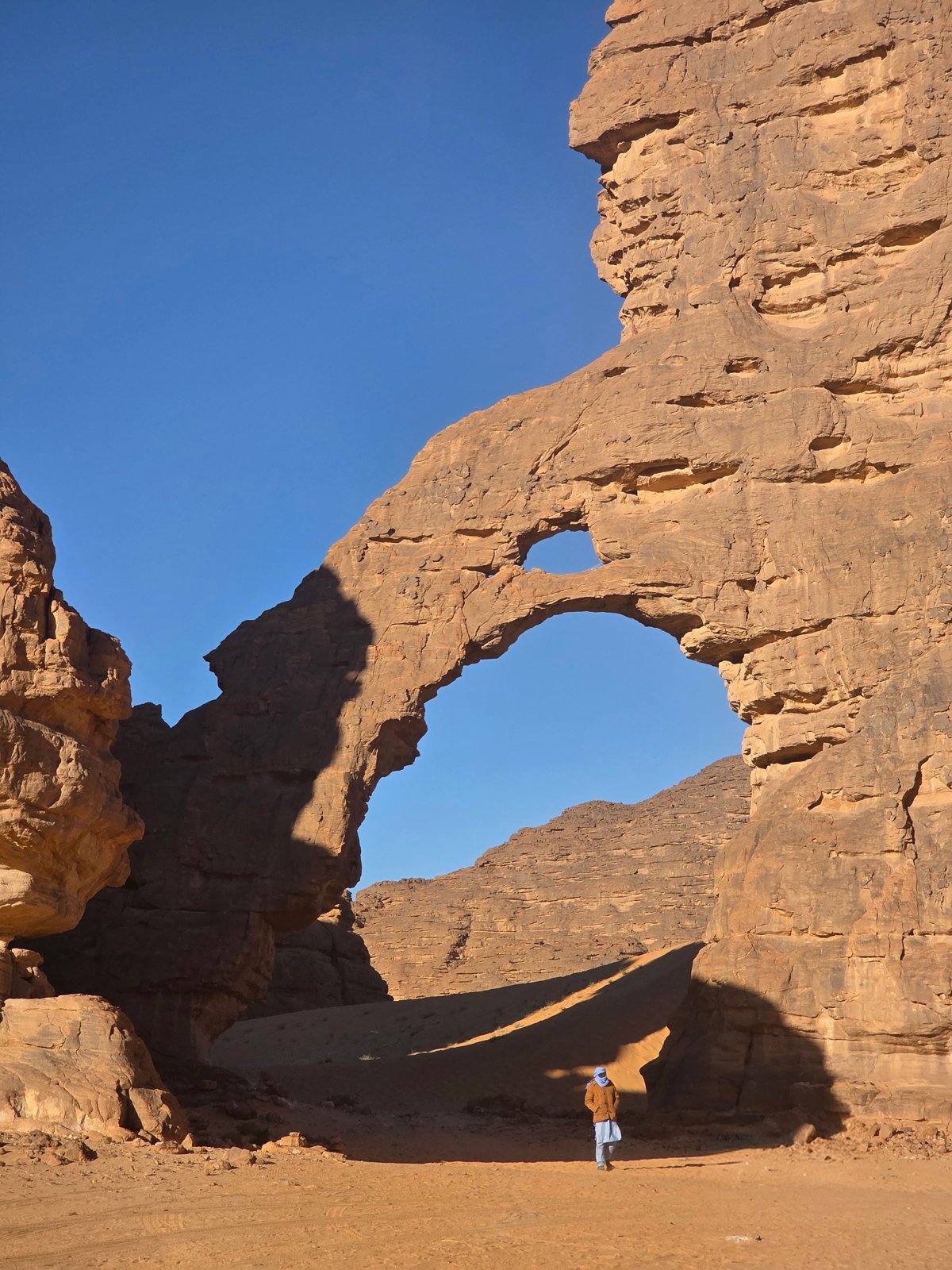
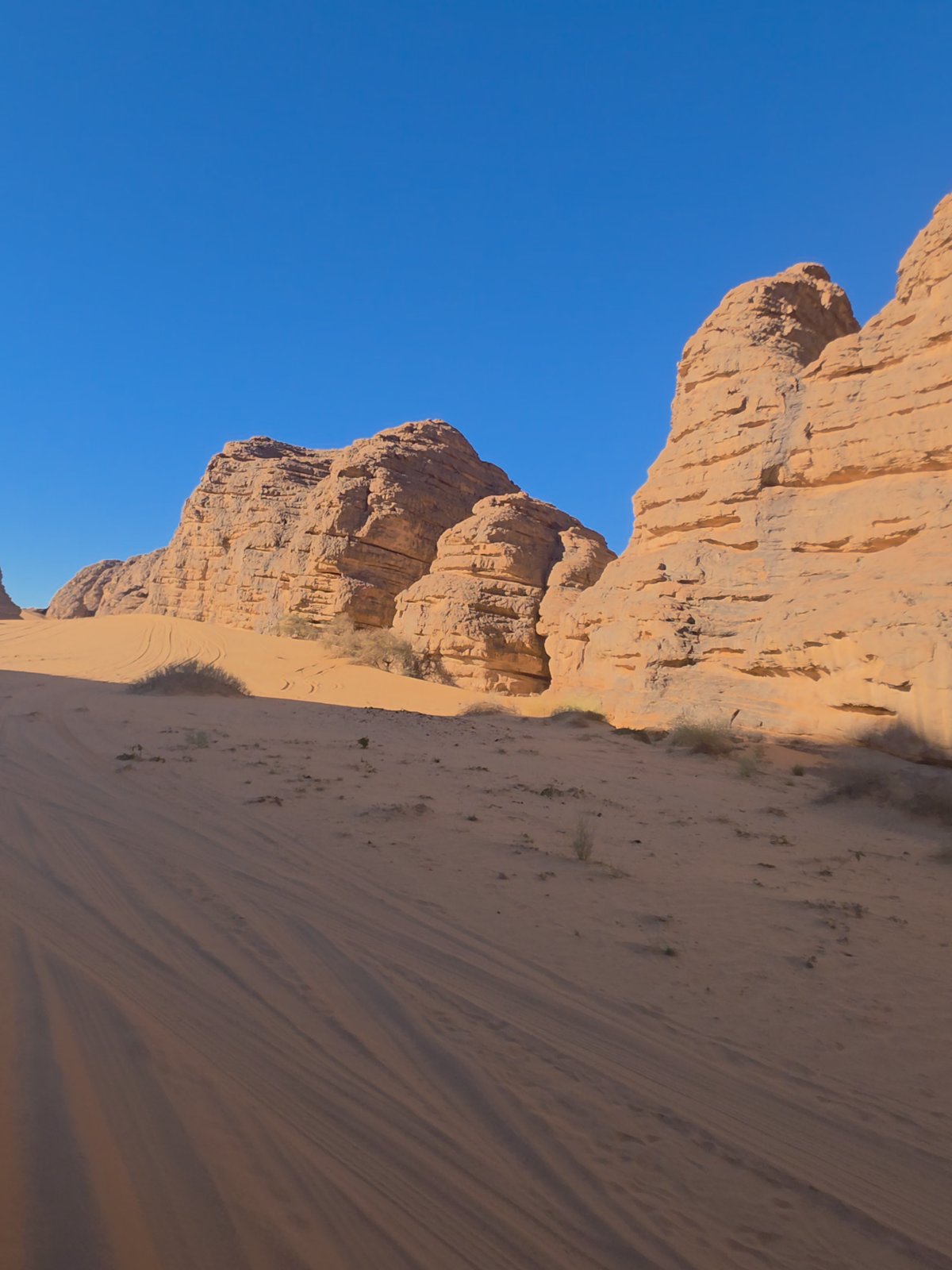
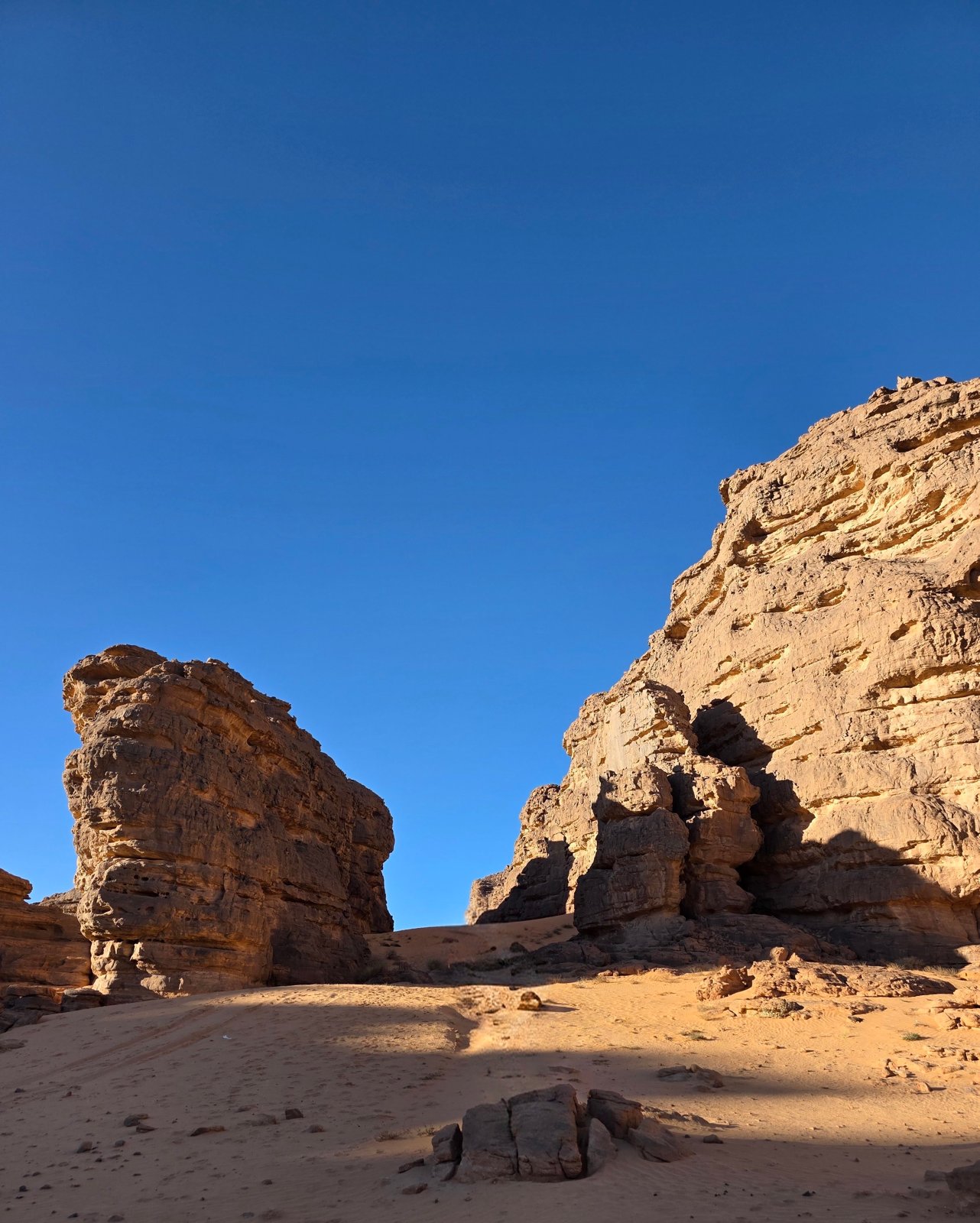
The giant arch, and us way down below · Two masses of sandstone · Rocks the size of buildings
The Tikoubaouine arch has an opening of about 14 metres and stands 16 metres high. And the name? Tikoubaouine means "sabre" in Tamahaq, the language of the local Tuareg.
A little further, a more intriguing discovery: a circle of black stones laid out on a dune, almost like a face seen from afar. A pre-Islamic tomb, we're told, a funerary remain several centuries old, sitting there in the open, with no fence and no sign.
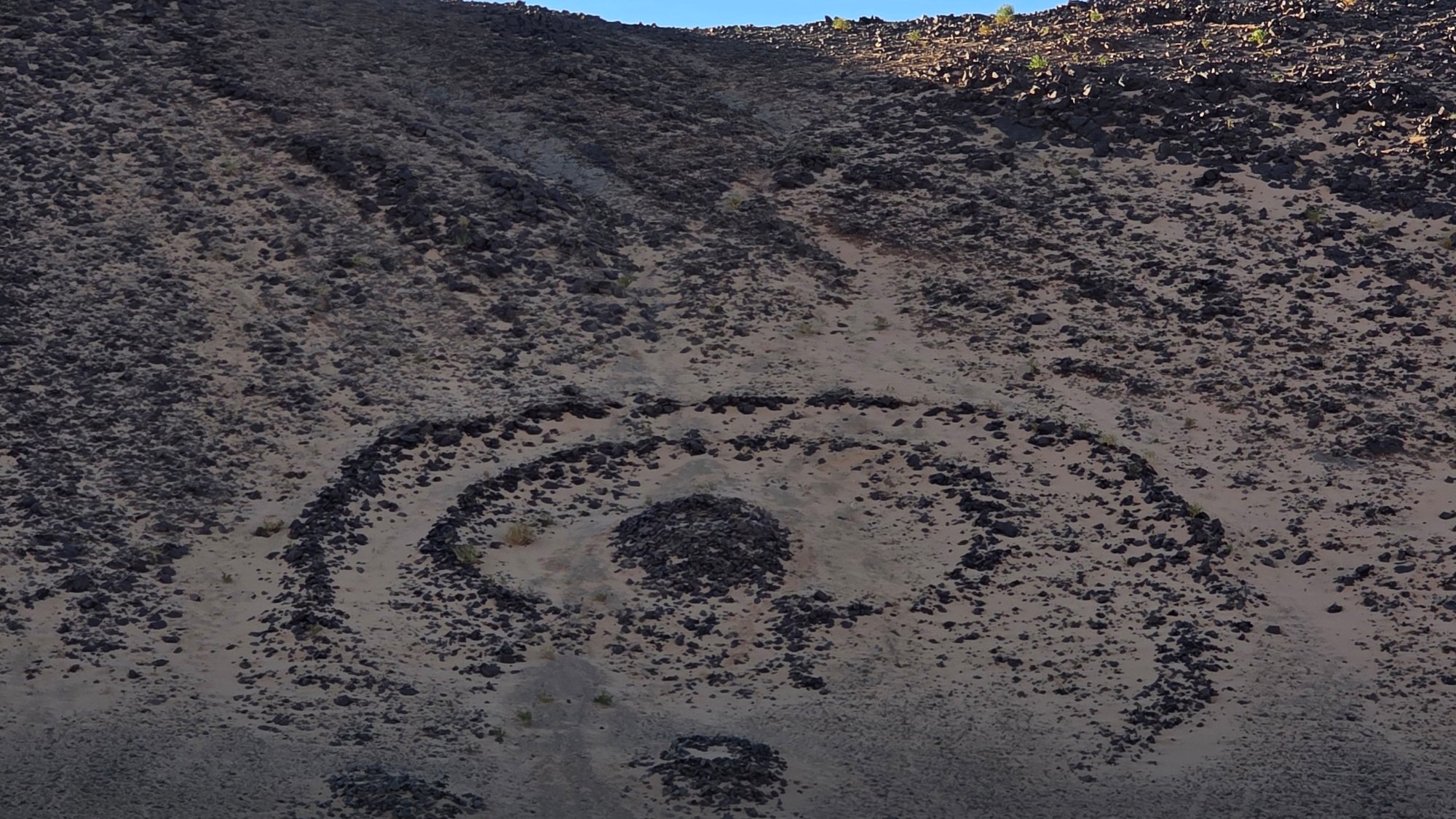
The tomb: a circle of stones, like a face resting on the hill
The Sahara is scattered with thousands of ancient tombs: simple piles of stones (tumuli), circles, or "keyhole" tombs, very common at the foot of the Tassili plateau near Djanet. They are almost always found in groups. During a recent survey mission in the Tassili, 265 funerary monuments were recorded among 510 sites.
1 January · evening
Sunset on the great dune
Right next to the camp, a huge dune invites you to climb up for the sunset. The ripples in the sand, sculpted by the wind, become almost hypnotic in the low light.
Then the sky catches fire, pink and orange, and far below we can see the parked 4x4s, the camp where we'll sleep tonight. Without knowing it yet, that's exactly where, the next morning, a very different kind of story will unfold.
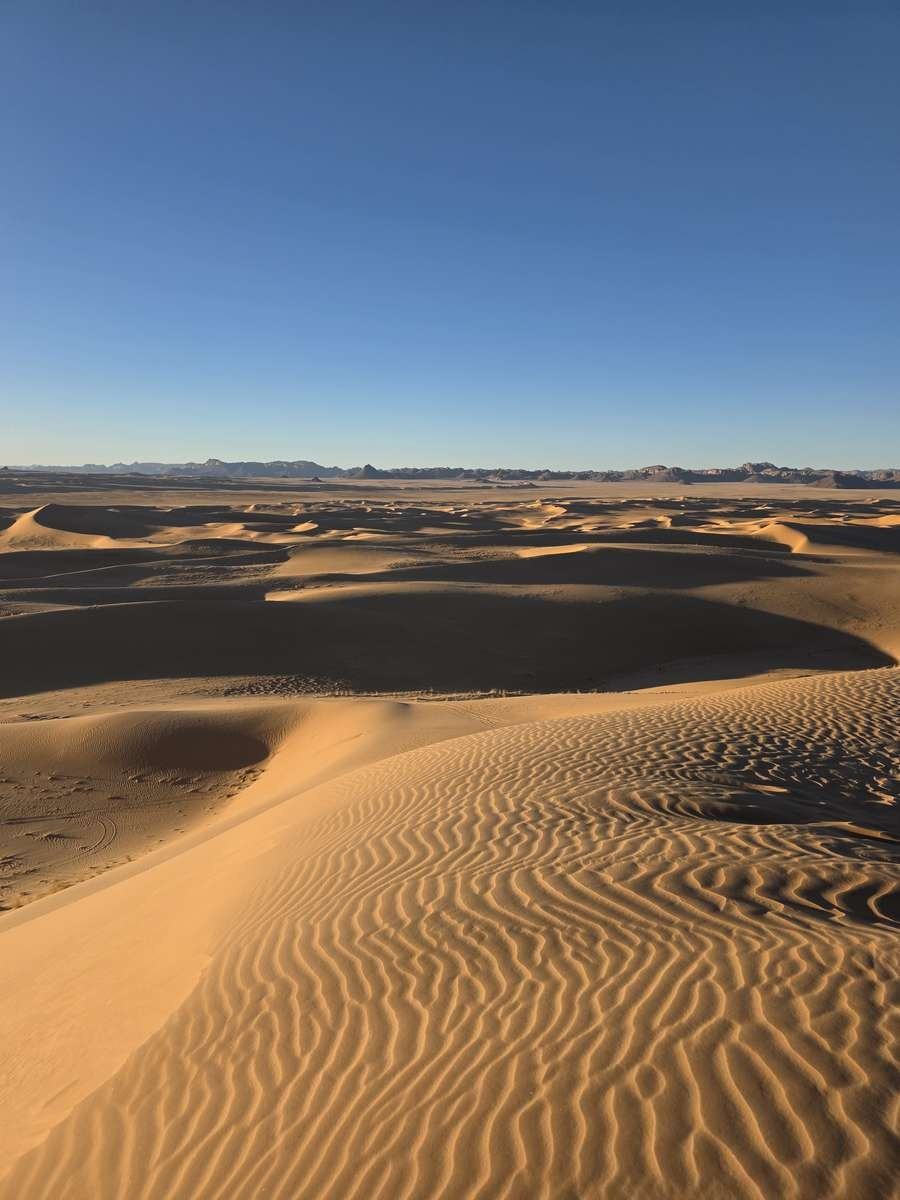
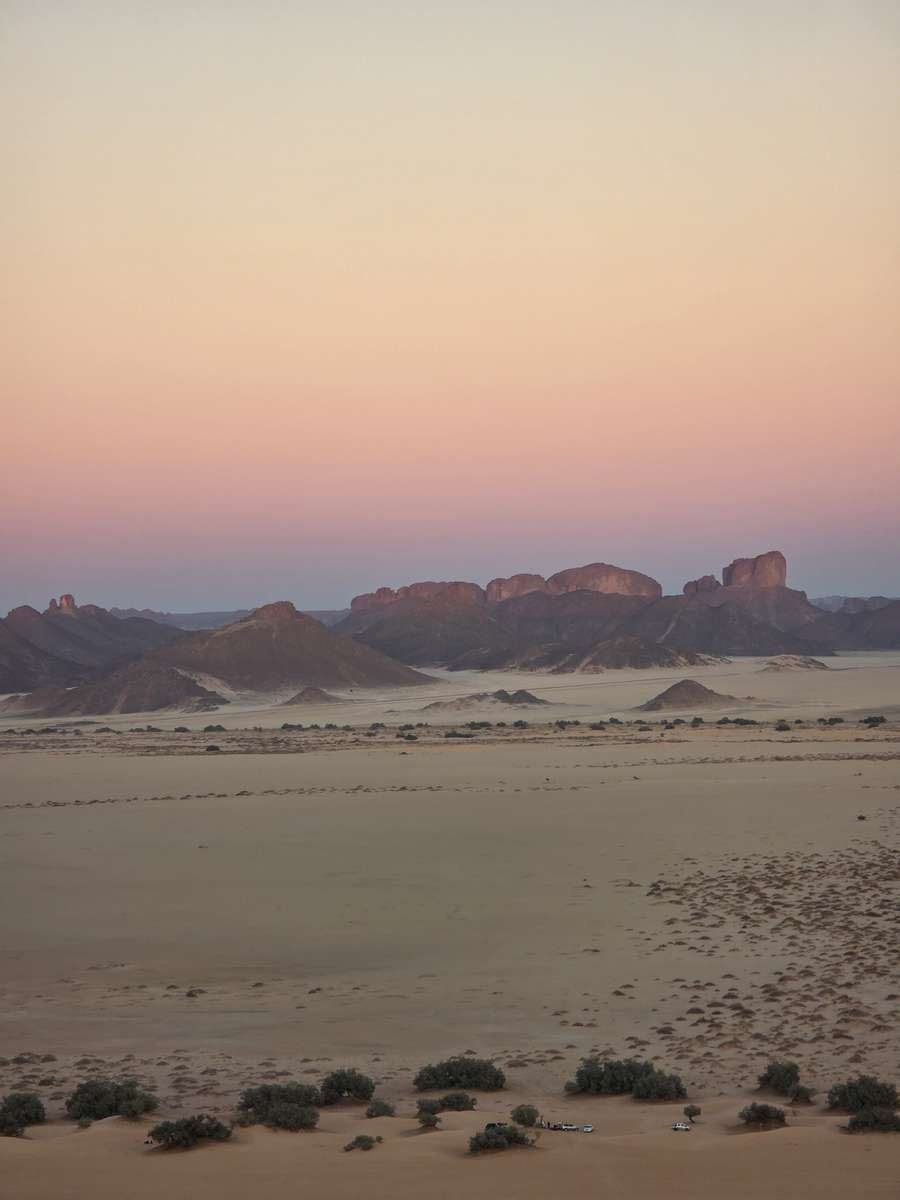
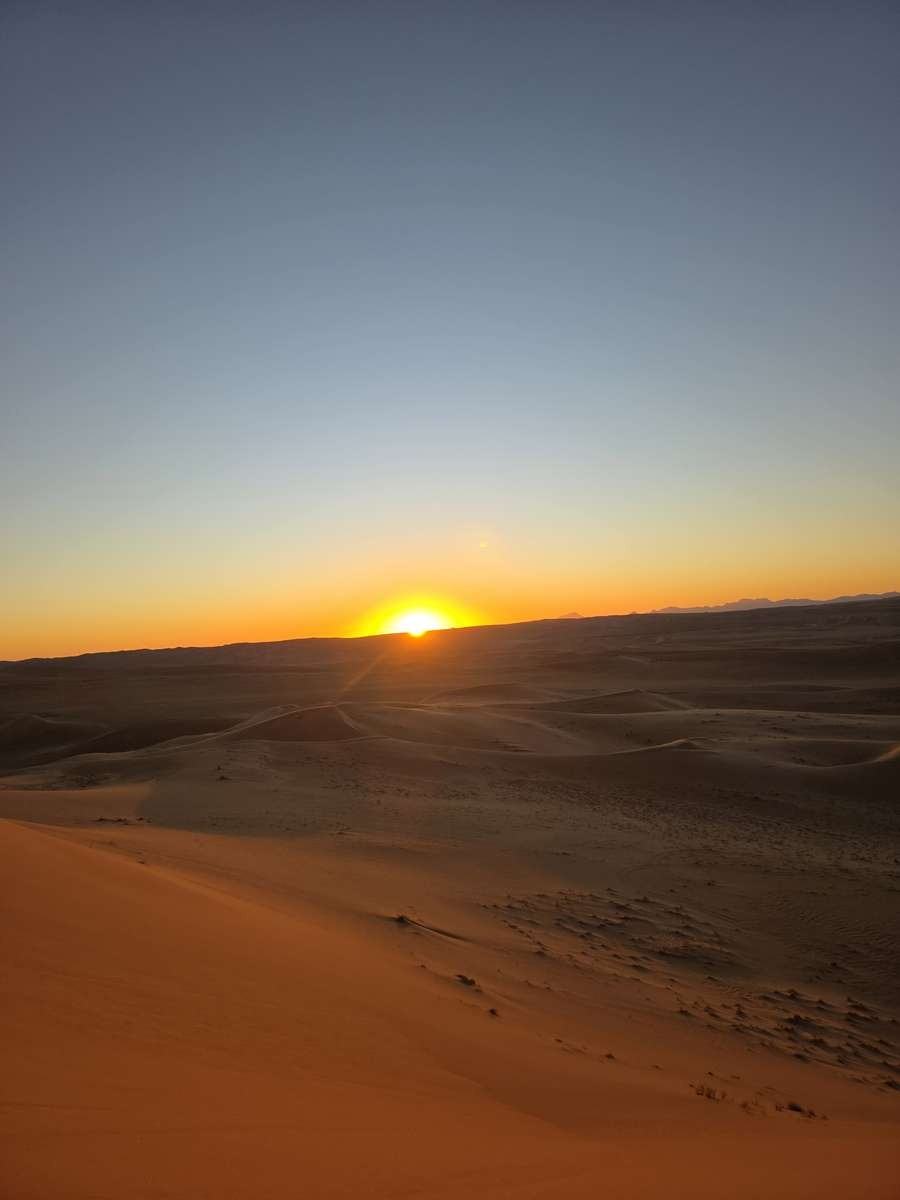
The sand, almost liquid in the evening light · Pink dusk over the camp · The sun disappears behind the dunes
If your tour includes a "signal hill", prepare your messages in advance (notes, drafts) rather than writing everything on the spot: the signal is fleeting and shared by the whole group at once.
We come back down quickly, pitch the tents, fire, tea, dinner, music: the evening ritual, almost unchanged since day one. That night, someone suggests Werewolf. No game in the luggage: we improvise with little pieces of cardboard, hand-drawn to represent each character. The Tuareg, who didn't know the game, throw themselves into it with total enthusiasm: cultural exchange in both directions, exactly as it should always be.
The riddles around the fire are theirs. Werewolf with hand-cut cardboard is ours. That night everyone taught someone something, and we played several rounds, until the wolf was finally unmasked.
One more night under the stars, added to the original programme. None of us yet suspects what will happen the next morning.