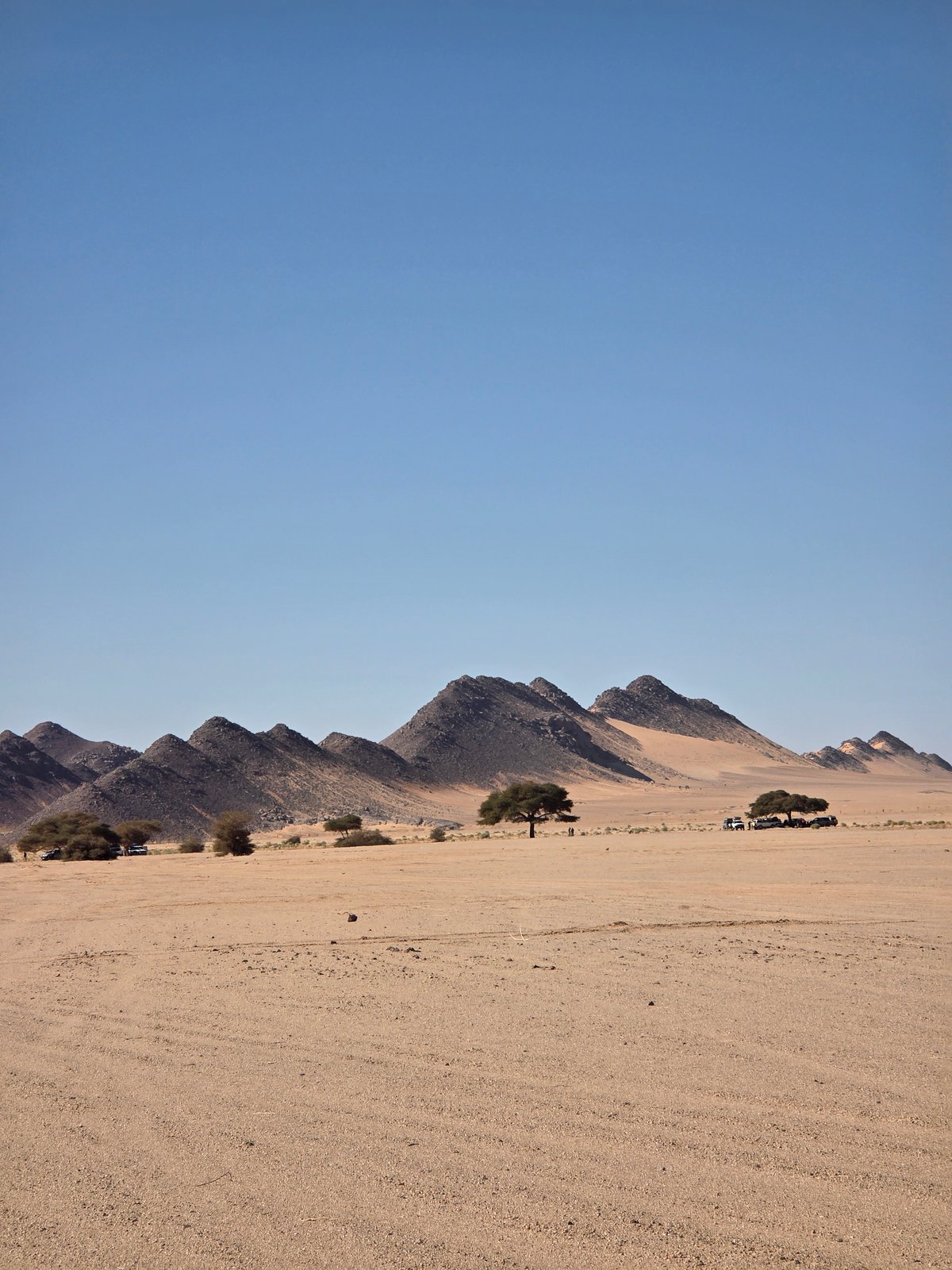
7 a.m. Second night in the little hotel in the centre, and already the feeling that the real story starts today. Downstairs at breakfast there are faces we have never seen: the rest of the group arrived during the night, a few hours earlier, with the same tired eyes we had the day before.
At the table opposite, a retired couple strikes up a conversation. Born in France, of Algerian origin, they came to enjoy their retirement here rather than anywhere else: hello to Mokhtar and his wife! He is probably the most active and funniest retiree we've ever met. We chat for a good part of breakfast.
We discover the rest of the group just afterwards, bringing the bags down to reception: two other couples, plus the one we had already met the day before, who arrived with us at 3 a.m. And a little eleven-year-old girl, the only child among ten adults, so of course she became the darling of the trip in about four minutes.
Eleven in total. And one thing strikes us quite quickly: almost everyone is French-Algerian, or French-Algerian-Moroccan. People who know the north of the country, sometimes very well, and are discovering the south for the first time. It's simply a different world. Several of them put it almost word for word:
That said, make no mistake: Djanet is not just a diaspora thing. Already on the plane we heard every language, and during the tour we came across plenty of Italians and Corsicans in big off-road 4x4s, there to race down the dunes.
The conversation soon turns to the question everyone asks: and you, how did you find this trip? Instagram for some, word of mouth for others. We stumbled on it almost by chance, while looking for local agencies online: all the ones we had been recommended were fully booked.
There was an eleven-year-old girl in the group, and it went very well. So yes, it's doable as a family. But be realistic: it's far from everything, no screens, no signal, cold nights in a tent. It depends a lot on the child. Her parents told us they also did it to show that it was possible.
9 a.m. announced, 11 a.m. for real
The programme said 9 a.m. We left at 11. In between: filling up with fuel, loading the supplies, fitting the luggage of eleven people onto the roof racks, and the whole Tuareg team arriving, drivers, cook, musicians.
With eleven travellers, everything takes longer than announced. Allow plenty of time for departures, and above all: don't stress. Nobody rushes here.
Then we climb into the 4x4s. A Berber rug on the dashboard, an embroidered heart swinging from the rear-view mirror, and ahead of us the straight road running into the sand. This is it.
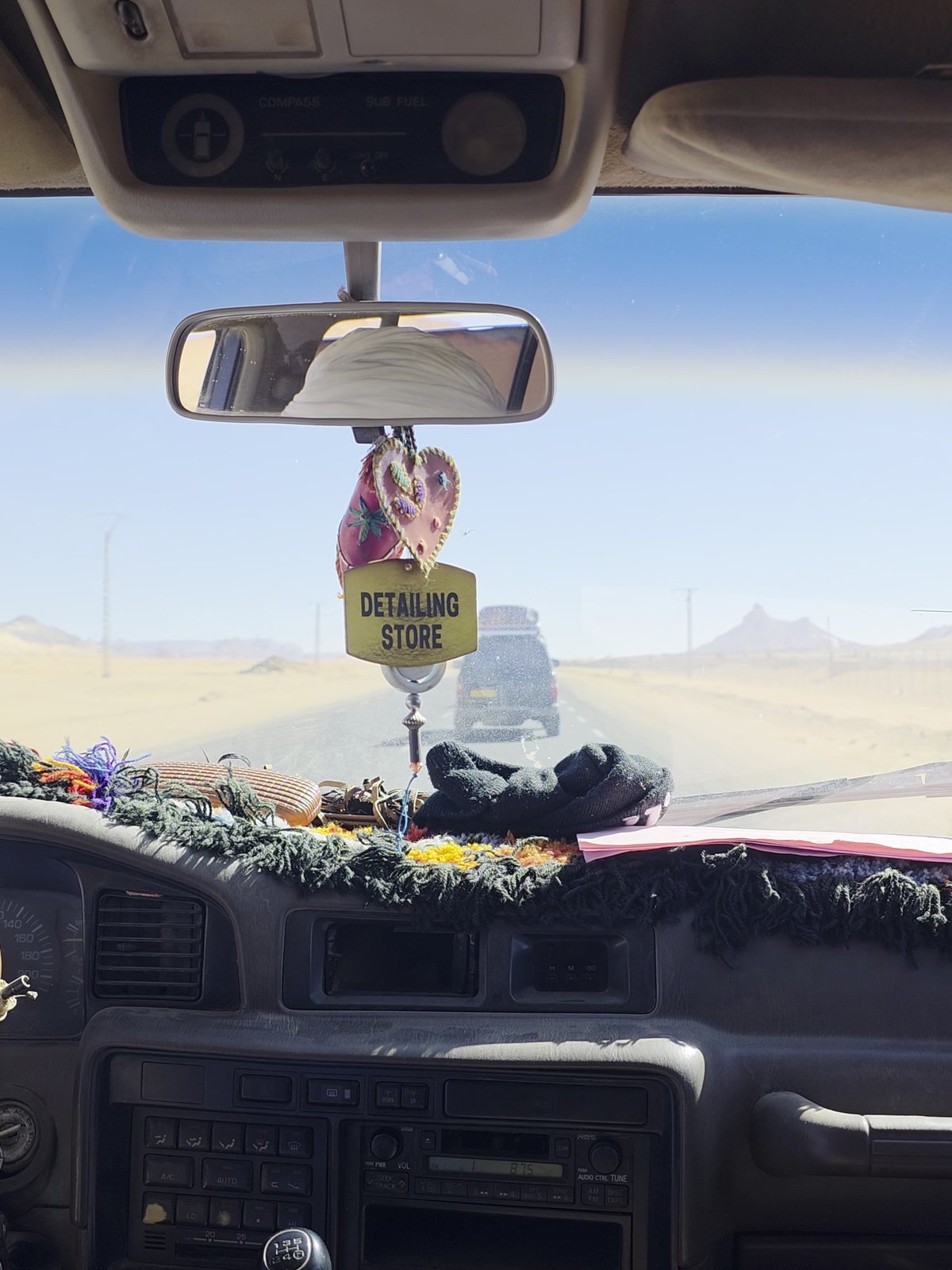
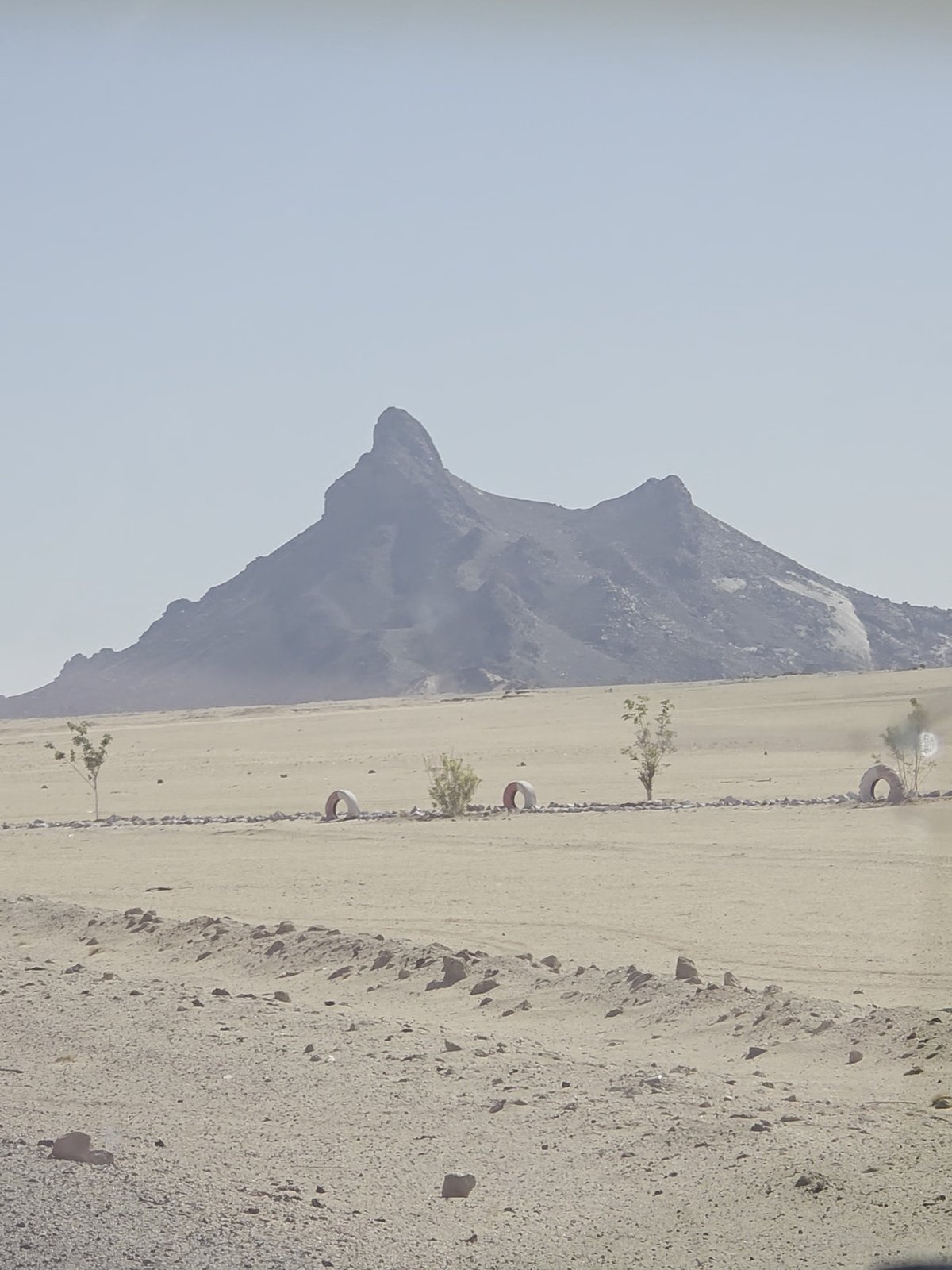
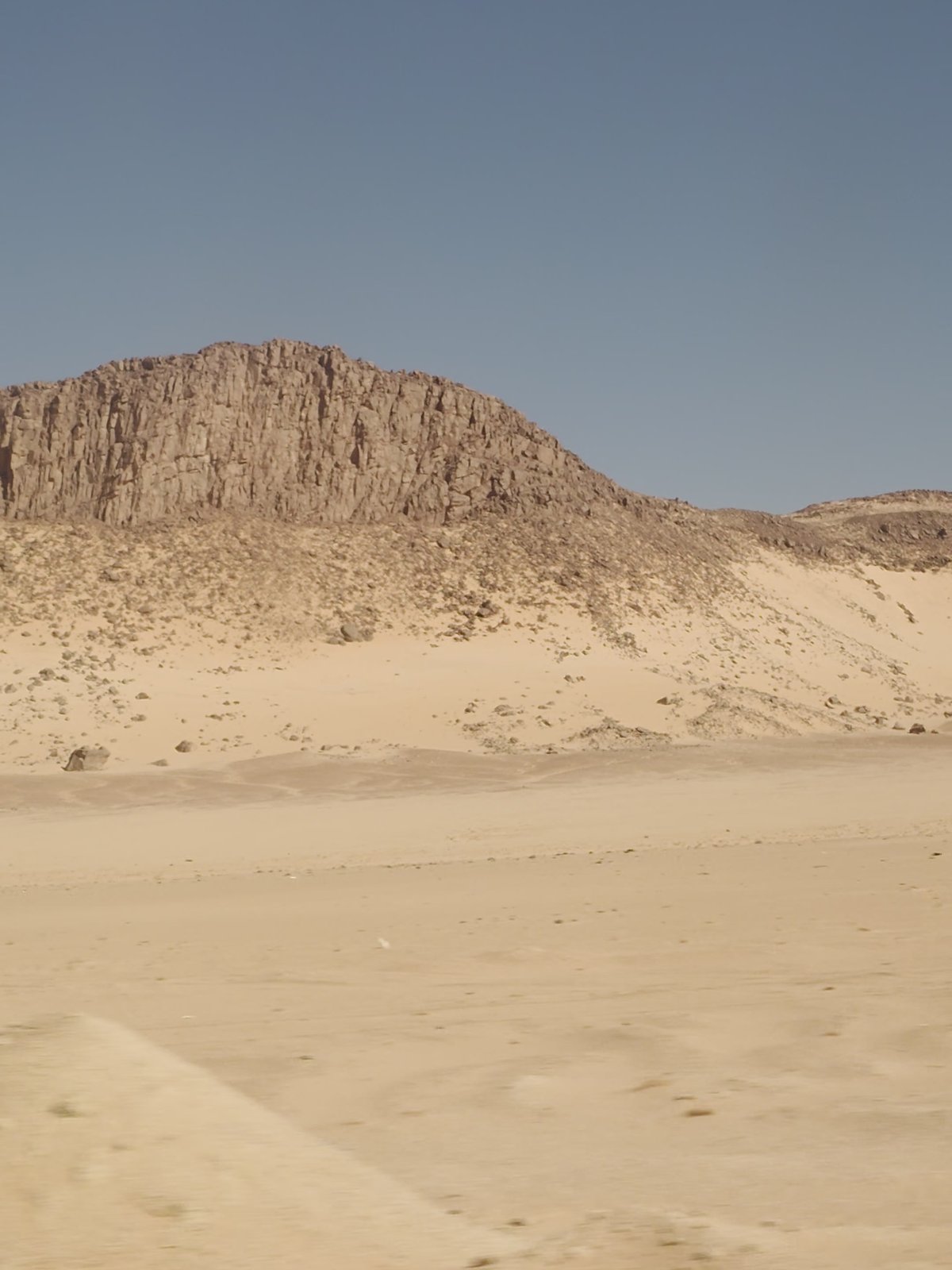
The real departure, from the passenger seat · In the distance, the first rock spire · Through the window, the sand takes over
The desert as sculptor
First stop around noon. We get out, and we immediately understand that the scenery won't look like anything we know.
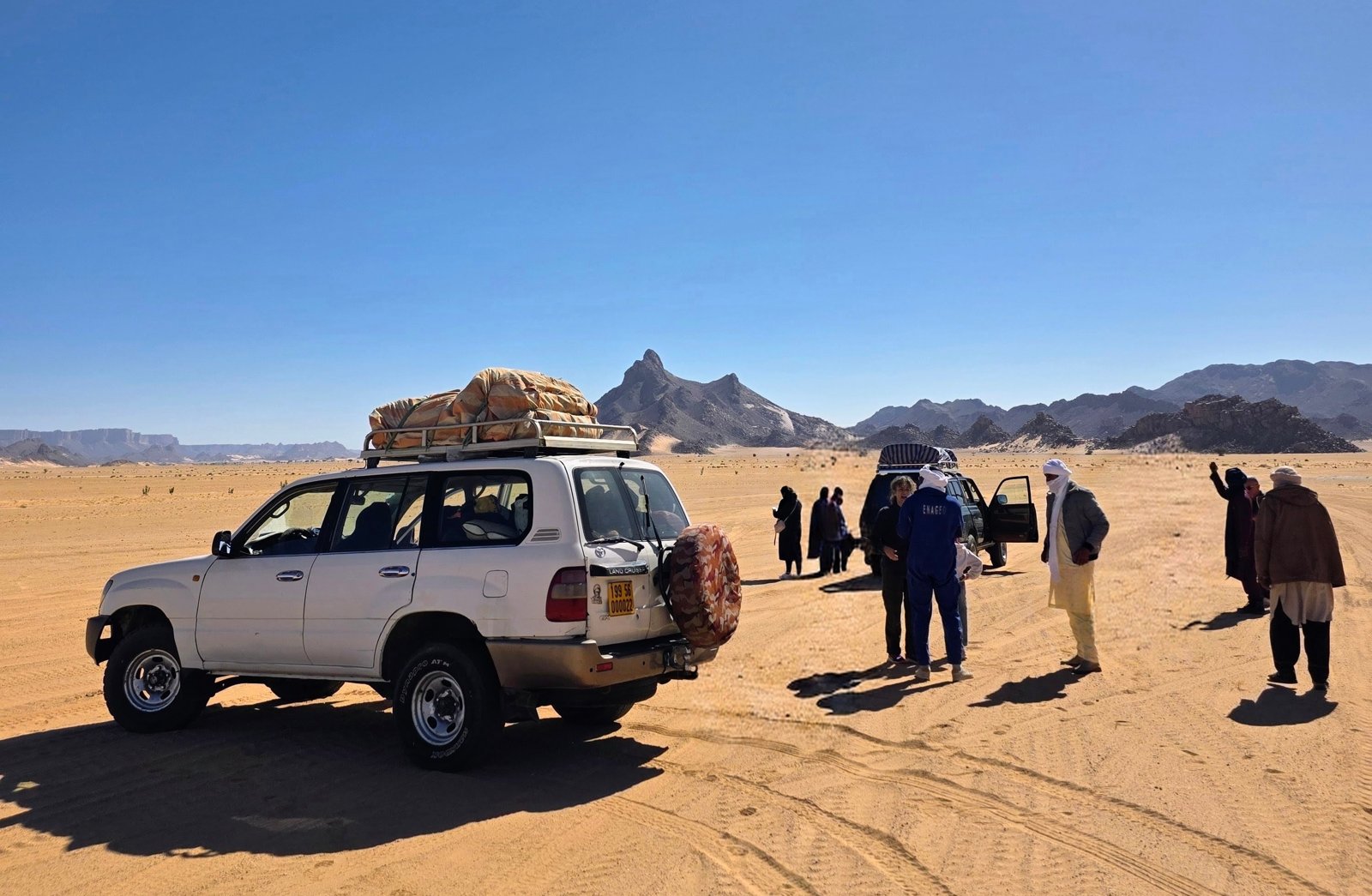
We stop wherever we like. There's nobody around.
There, sitting in the middle of the sand, a huge sandstone block hollowed out by two arches. The wind did that. No tool, no hand: just the wind, for a very, very long time.
They call it the elephant, and once you've seen it, you can't unsee it.
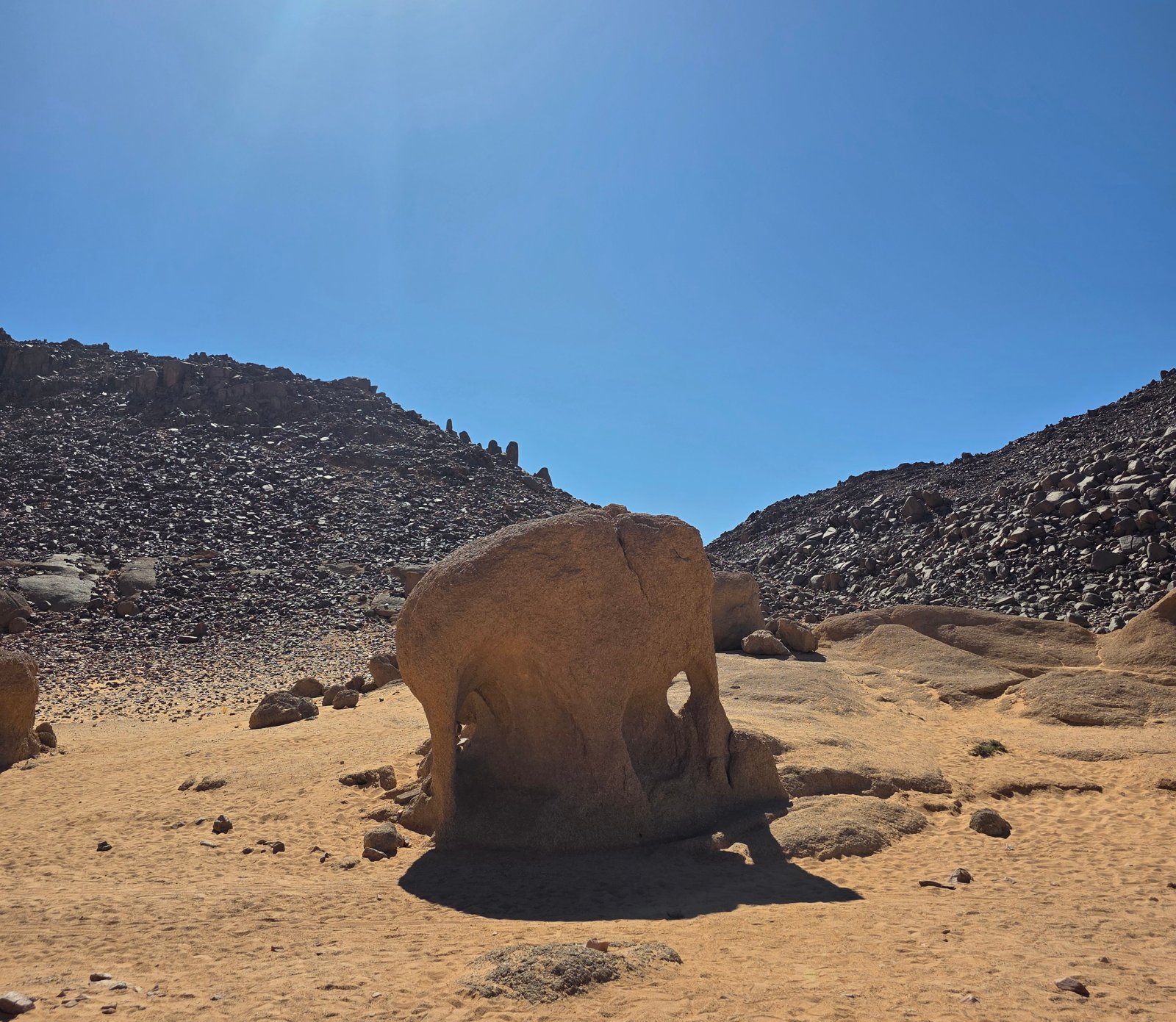
Look closely: the body, the head on the left, and the hind leg on the right
And a few metres further, another rock, smaller, more discreet. Rounded back, head low, leaning forward. For those who know, the silhouette jumps out: it's exactly the position of prostration. A man in prayer, all alone, facing the black mountain.
Back in the car, and the scale catches up with us: two tiny 4x4s at the foot of a wall that goes up, and up, and up.
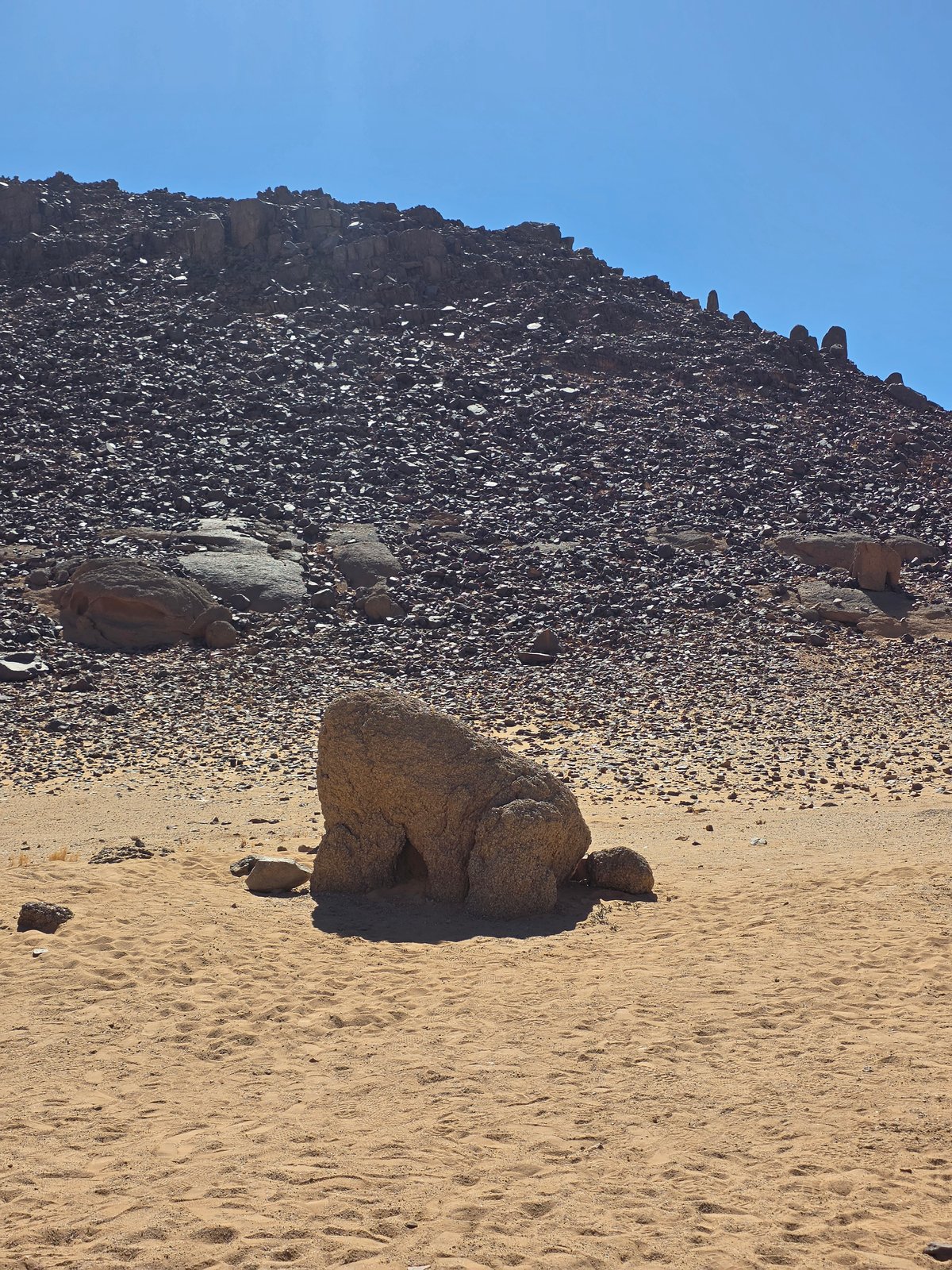
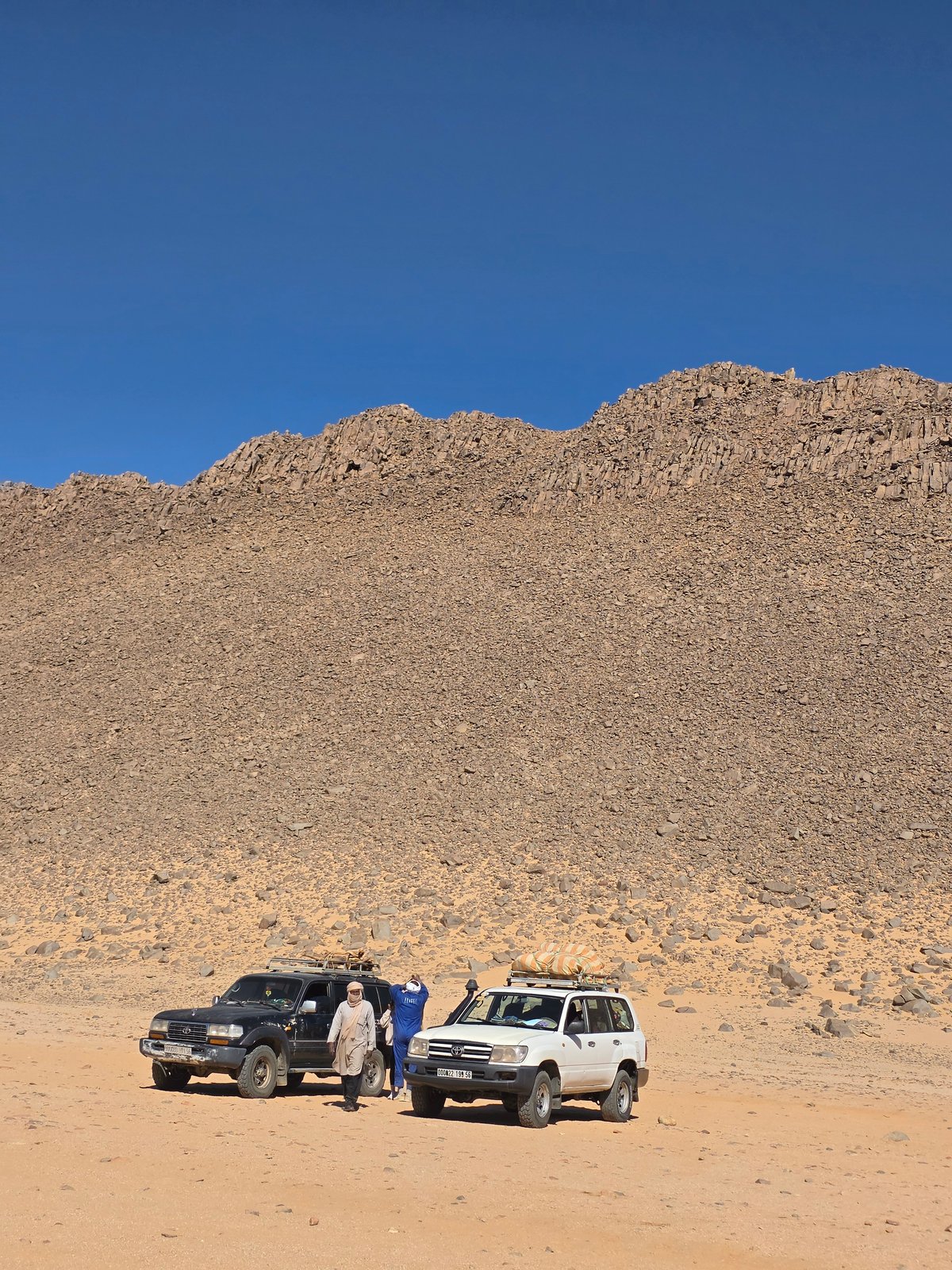
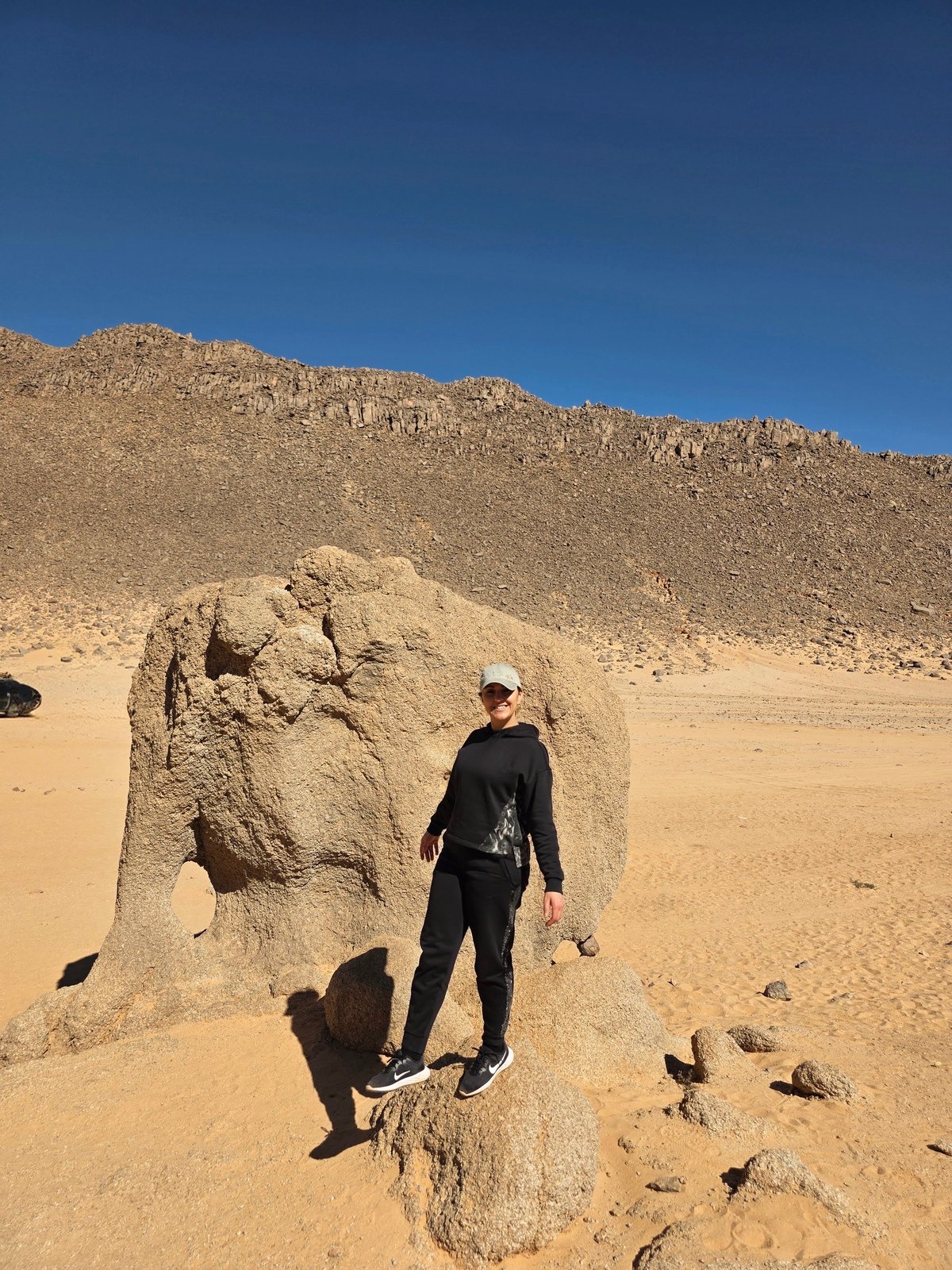
Nobody carved it. That's the most unsettling part. · Spot the cars · And for scale, one human in front of the elephant
The desert sets the table
While we were raving about rocks, the cooks had already gone ahead. That's how it works, and we only really understand it after two days: we visit, they drive, they set up, they cook. We arrive, it's ready.
When we join them, the fire is already lit, the teapot is on the embers, the little glasses are lined up on the tray.
And there's a detail you don't notice at first: the 4x4 isn't parked just anyhow. It's placed right against the fire, to block the wind. They don't look for shelter: they make one, with what they have. We'll see that gesture again all week.
Little bonus: here the fire isn't lit with a lighter. It's lit with a blowtorch. Maximum efficiency, zero romance, and honestly, we approve.
Lunch is eaten under the only tree for miles around. A lone acacia, spreading its shade in the middle of the void. That's exactly why we stop there.
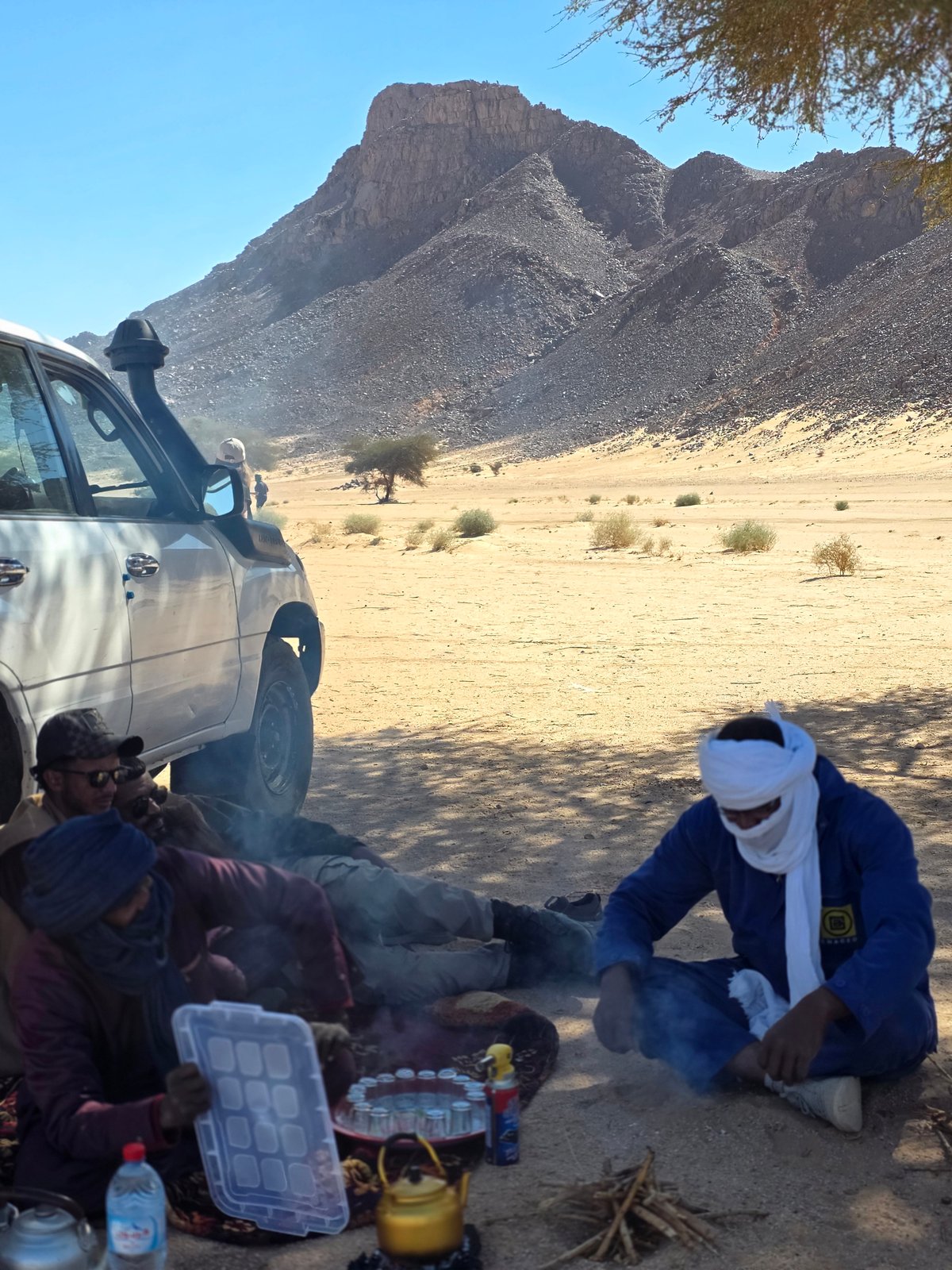
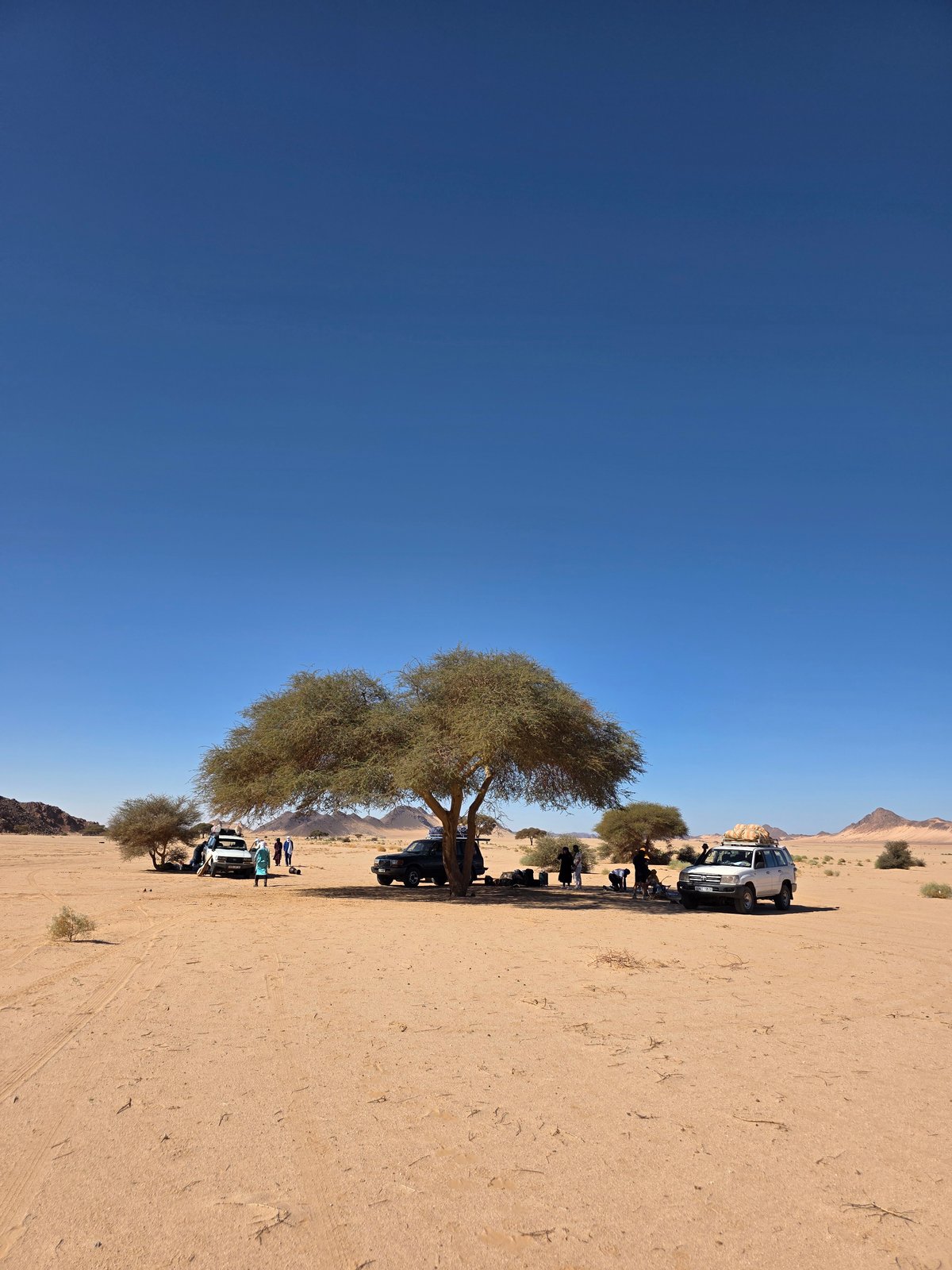
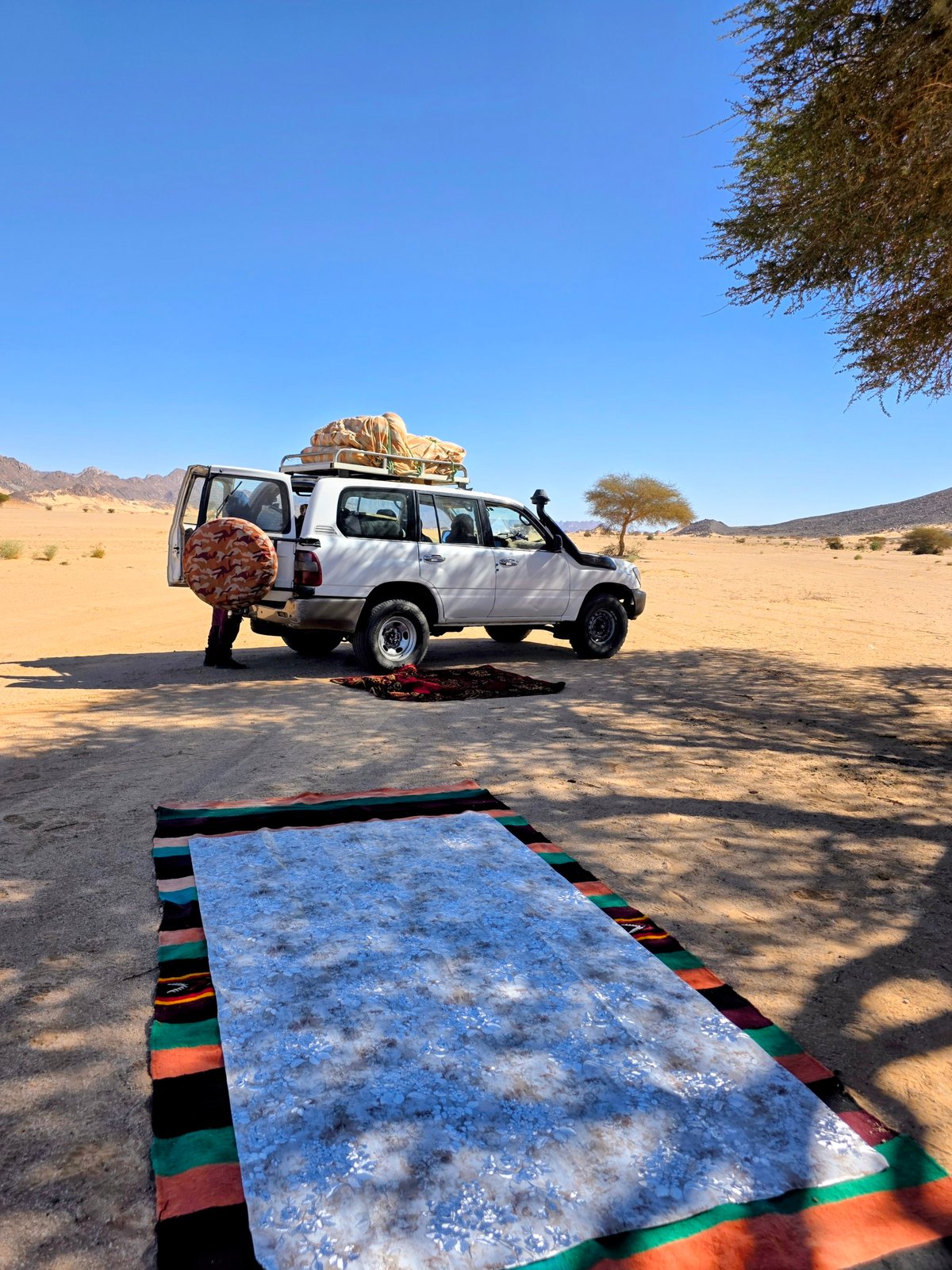
Three branches, a teapot, and that's that · The only shade in the area · The tablecloth rolled out on the sand
Tomato salad, a hot dish, oranges, cold drinks. We eat like at a restaurant, except there's no kitchen, no electricity, no sink, nothing, just sand, a wood fire, and people who know how.
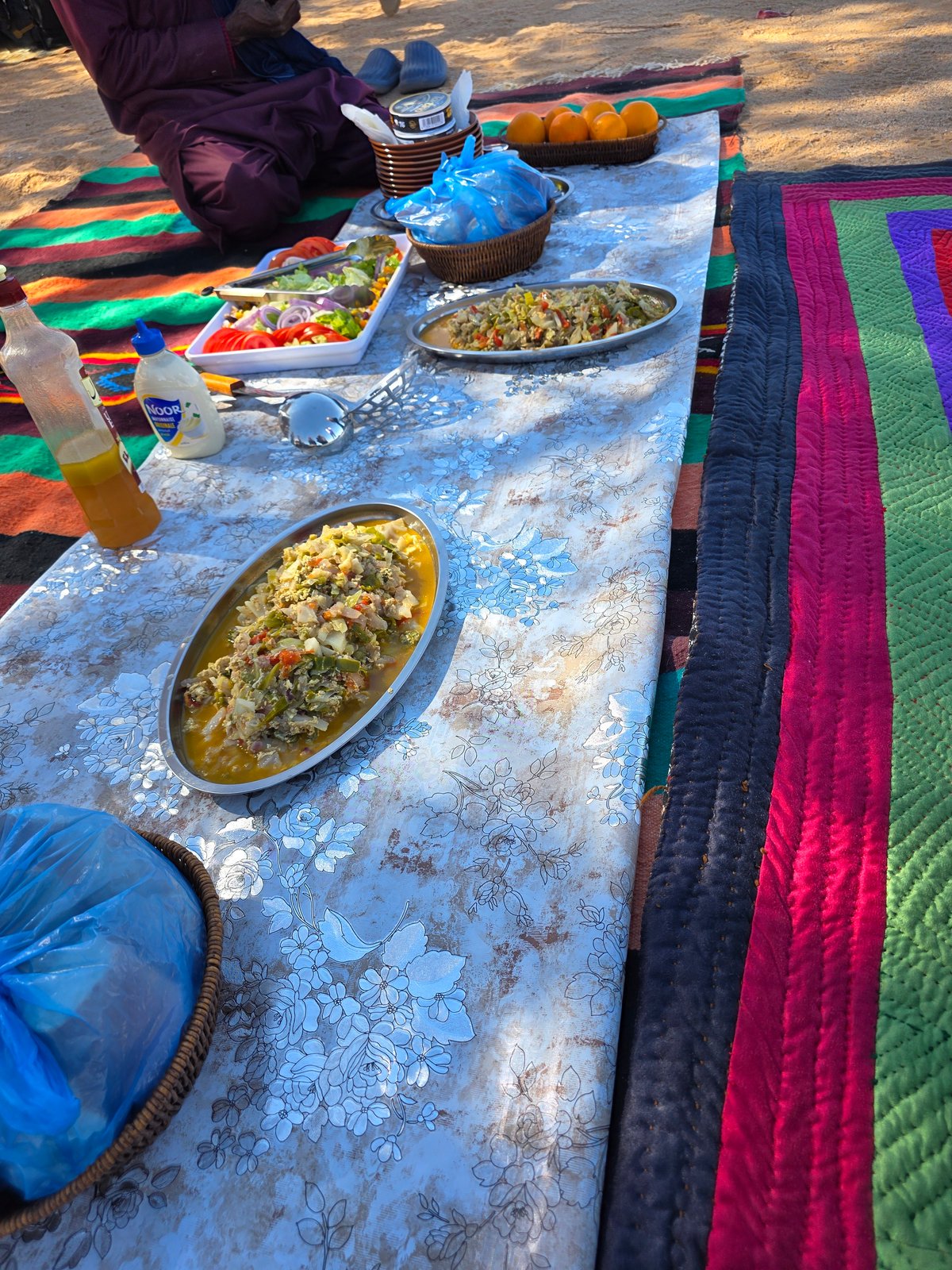
The rugs, the tablecloth, and a feast cooked over a wood fire
A nap, and a little watermelon
After the meal, everyone does what they like. Some sleep, some play, some lean against the tree and stare into the distance.
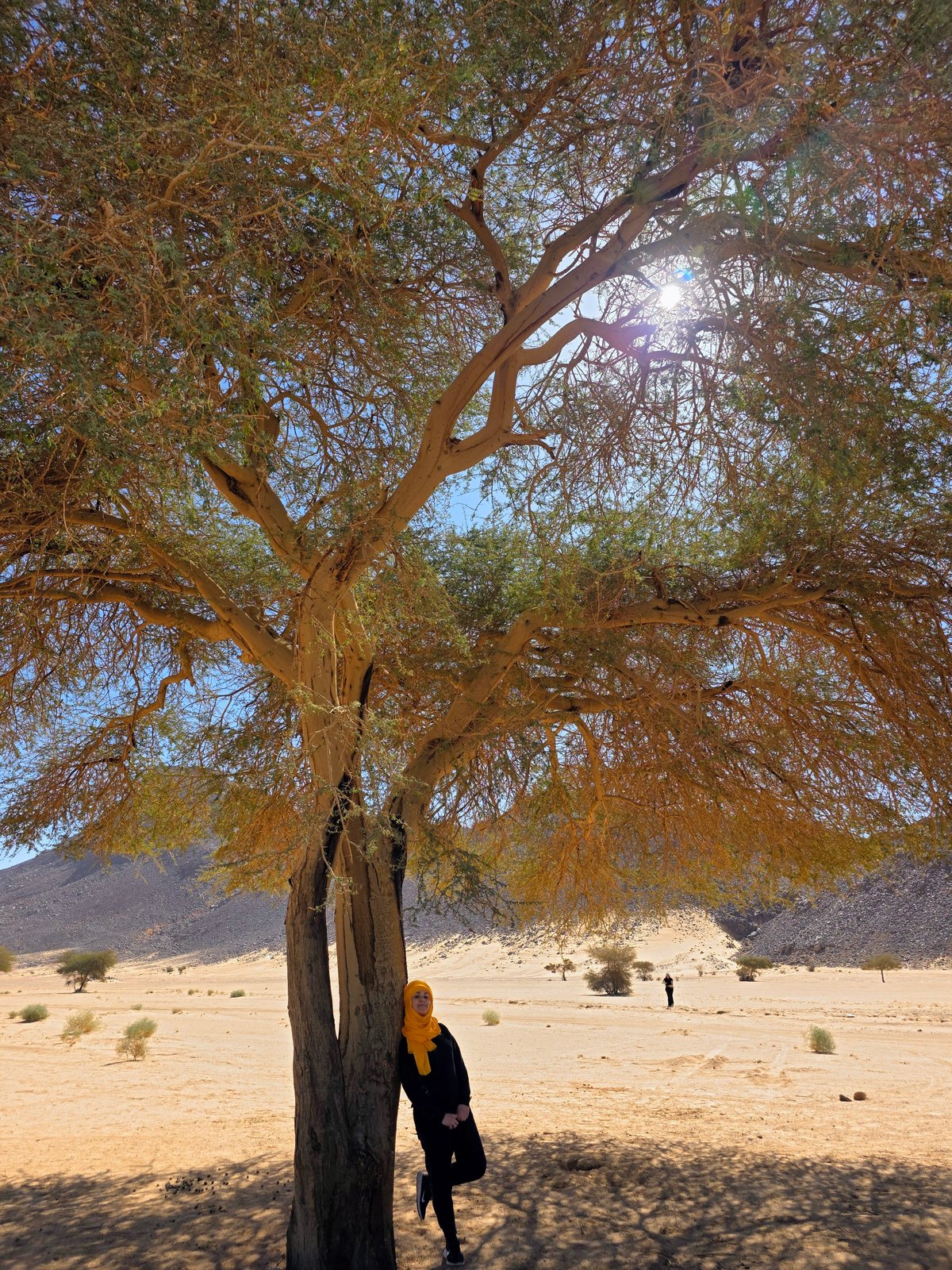
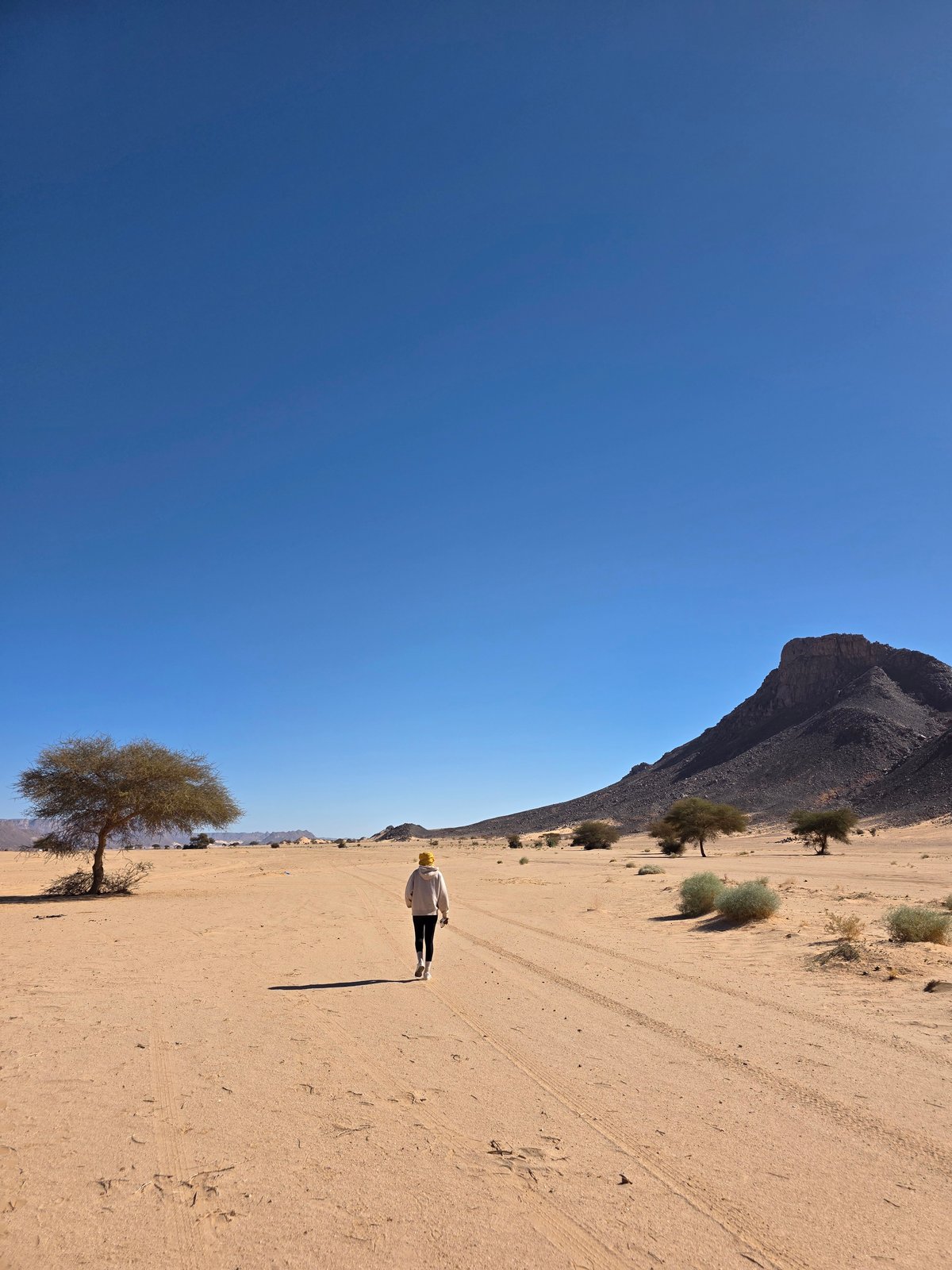
The acacia, seen from below · Everyone wanders off
That's when one of the guides comes over with something in his hand: a small green and yellow striped ball, barely bigger than an orange. A wild desert watermelon. He explains what it's used for and, true confession, we've forgotten. We'll have to ask again.
And sometimes the energy shoots back up. Without warning.
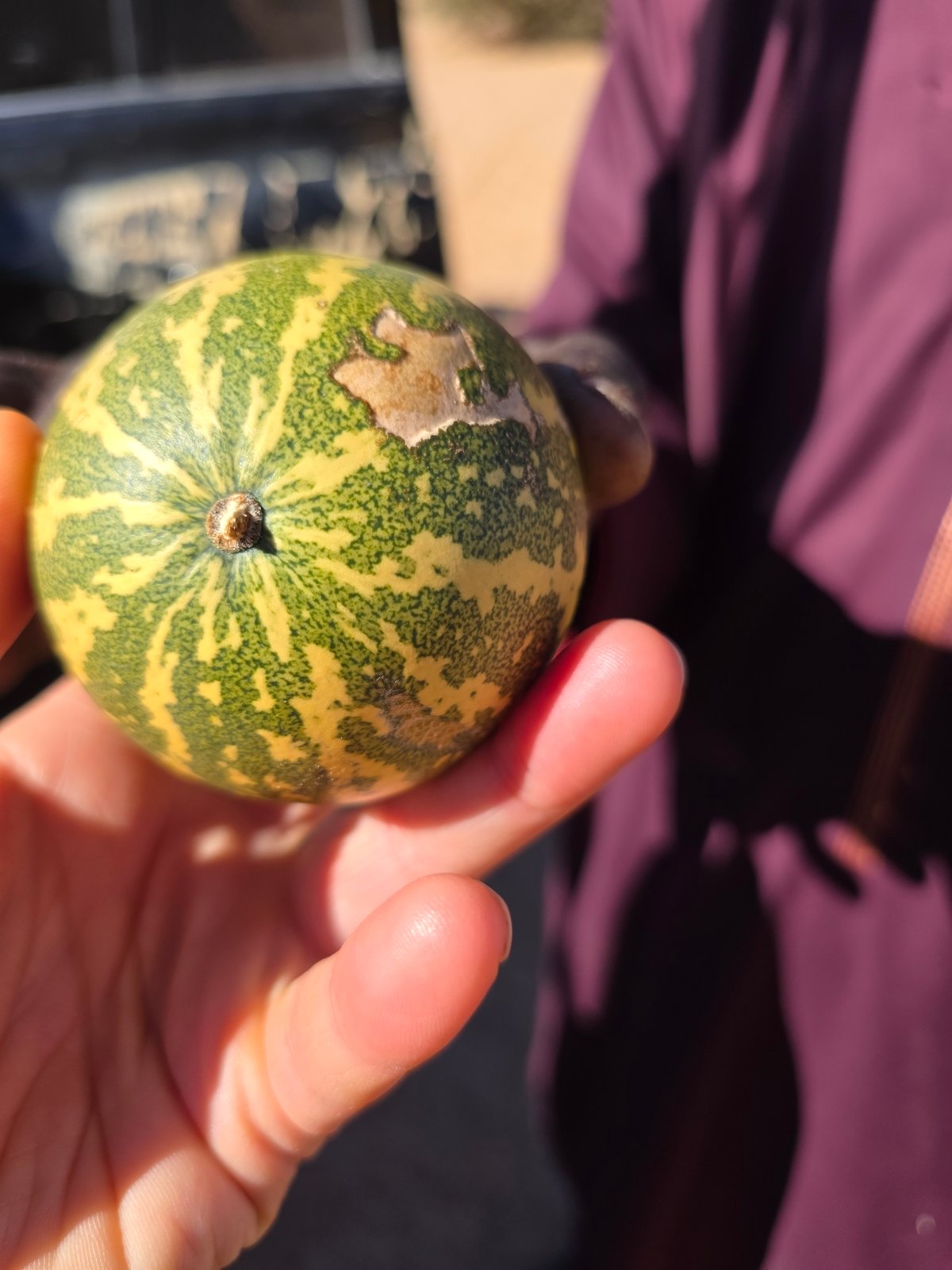
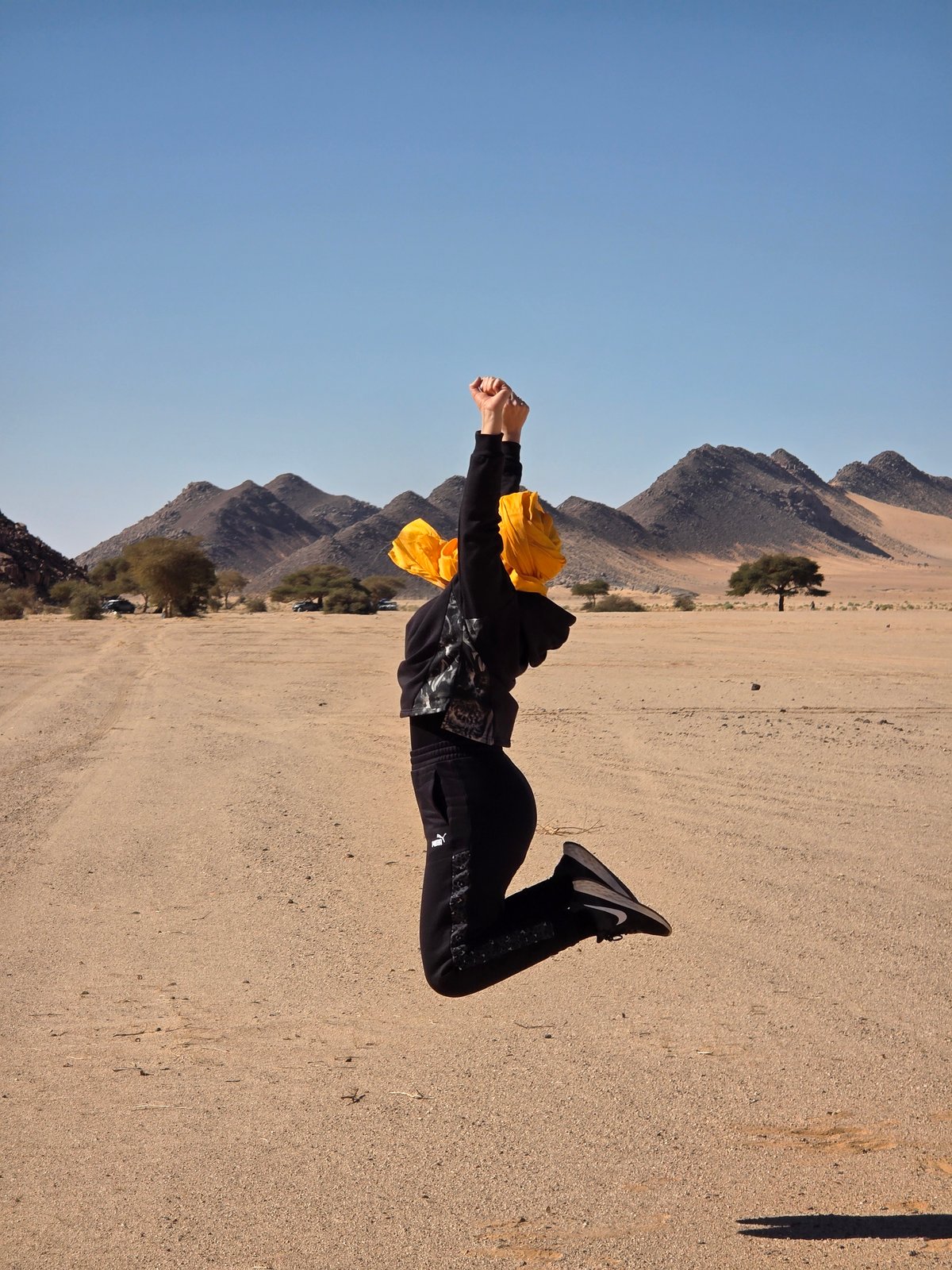
It grows on its own here · There you go. That was pretty much the vibe.
The road nobody takes
The sign that puts things in perspective
In the afternoon we're back on tarmac. And a road sign sets the scene better than any map: Libya to the left, Niger to the right.
And right at that spot we meet the character of the day: an Algerian crossing the desert by bike. Alone. Thousands of kilometres on the clock, panniers everywhere, and a huge smile.
We are three 4x4s loaded to the brim, with a cook and musicians. He has two wheels and some water. We bring out the Algerian flag, take photos together, and wish him a safe journey.
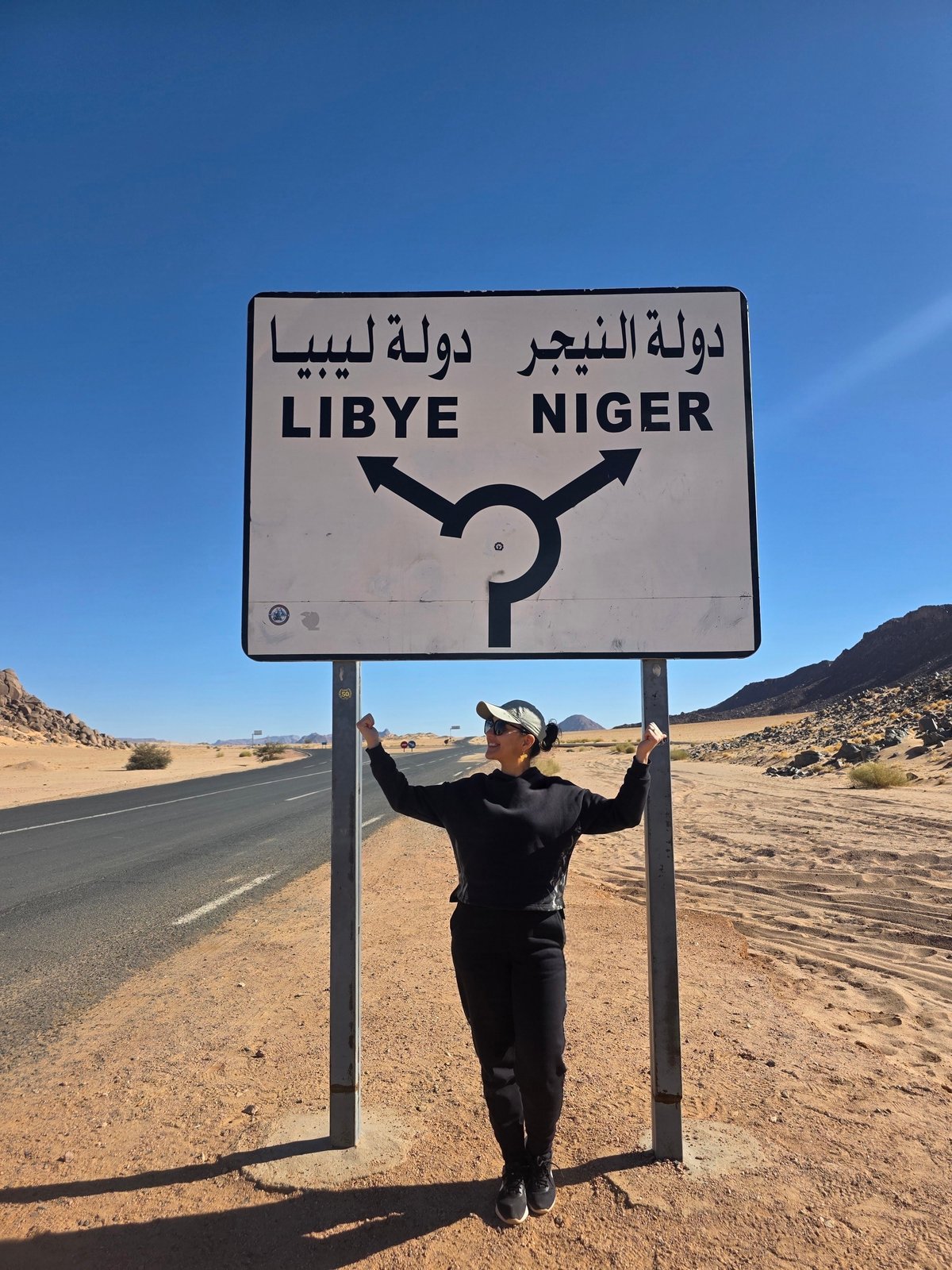
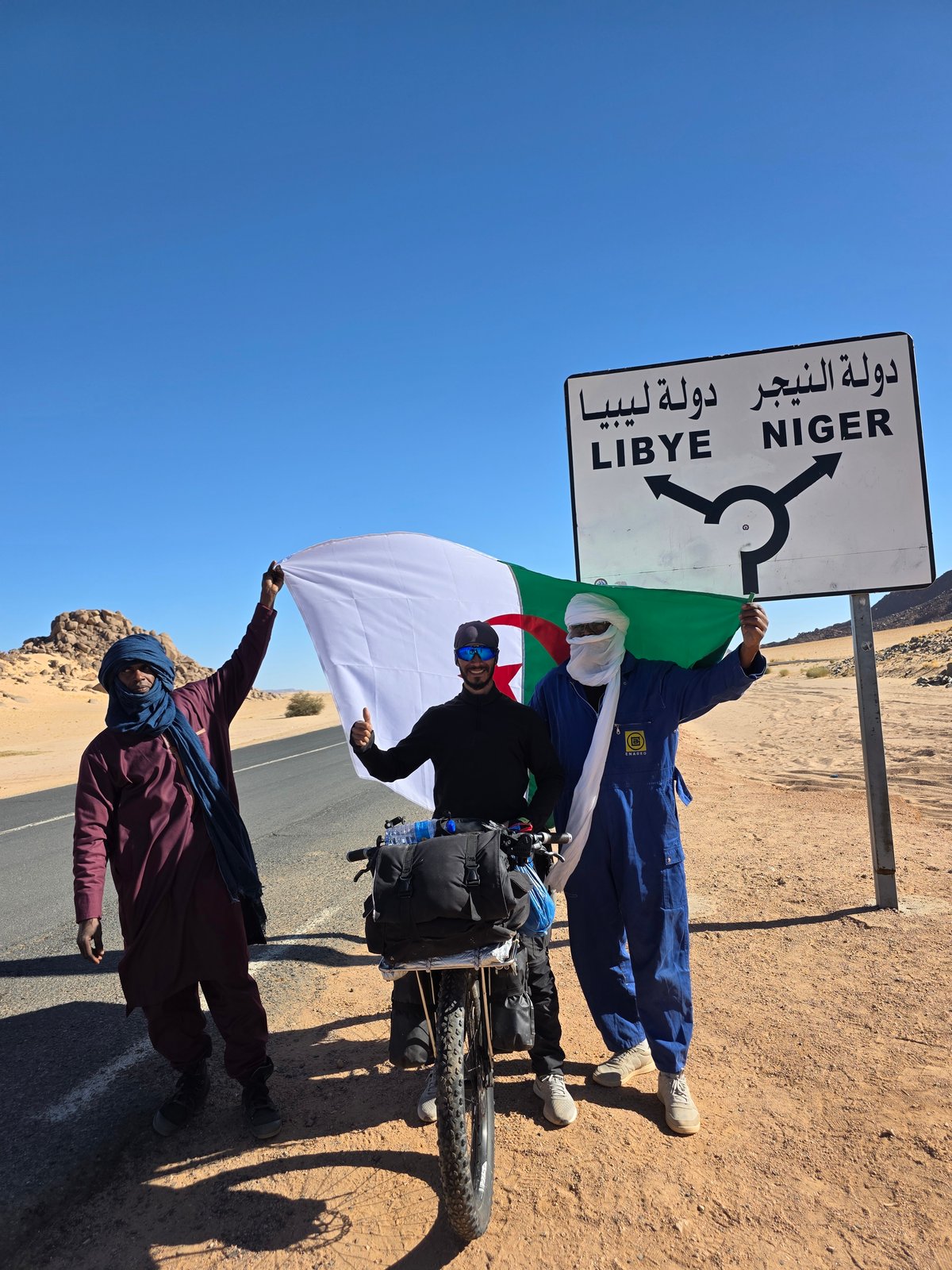
That's when we realise where we are · Meeting at the Libya-Niger junction
He rides as Anouar's Trail, his Instagram account is @anouar_zghb. Honestly, it's worth a look.
A little further on, the road runs away: a perfectly straight black line drawn through nothing, mountains on each side and not a single car on the horizon.
So of course, we sit on it.
Then everyone joins in. Guides included. We lie down in a row along the white line, arms spread, laughing like kids while our shadows stretch out beside us.
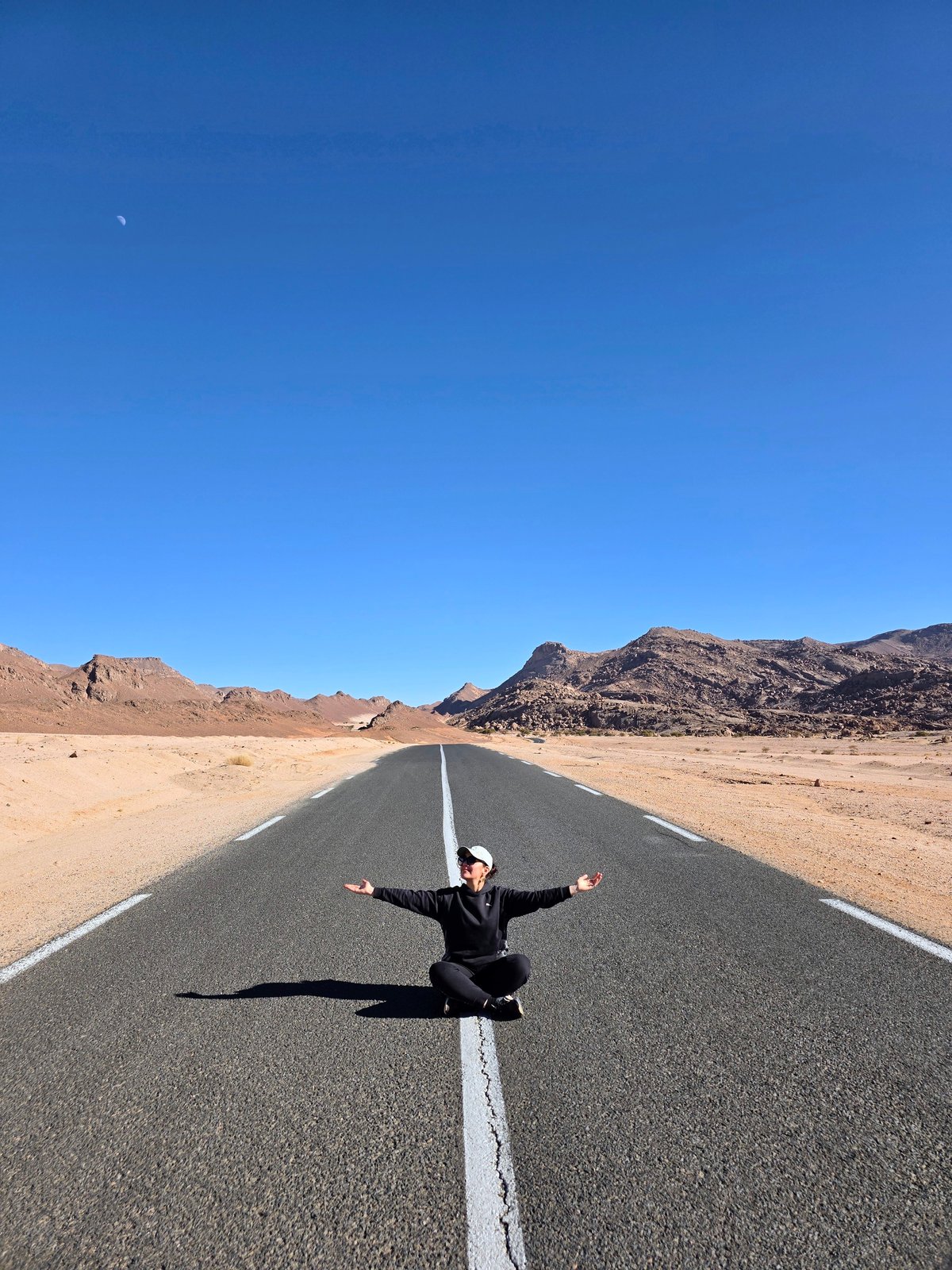
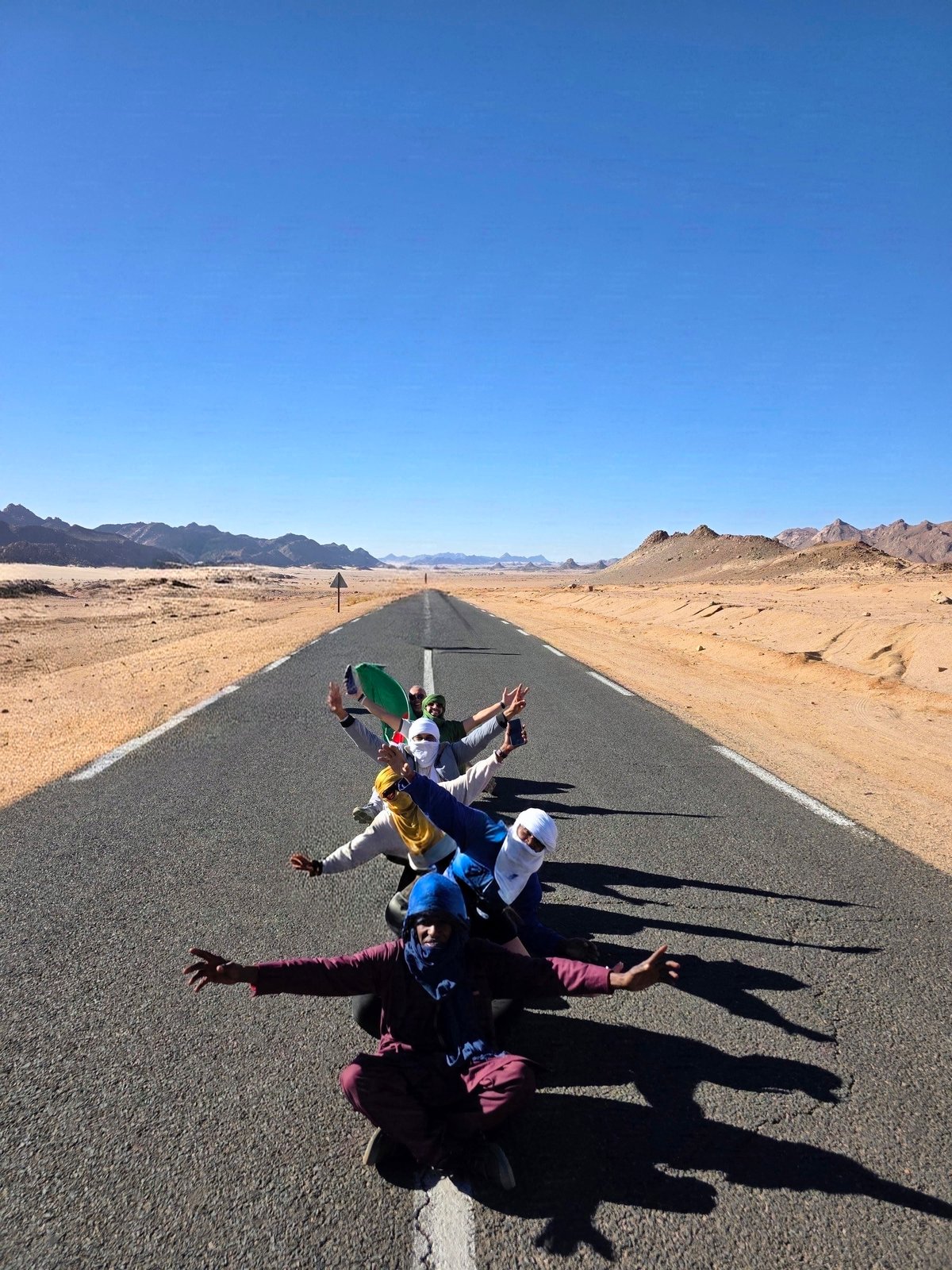
The moon, in the middle of the afternoon, top left · No risk: fewer than three cars an hour
And then, camels
A few more kilometres, and a whole herd appears on a plain of dry bushes. They graze peacefully, without paying us the slightest attention. There's even a tiny one, glued to its mother.
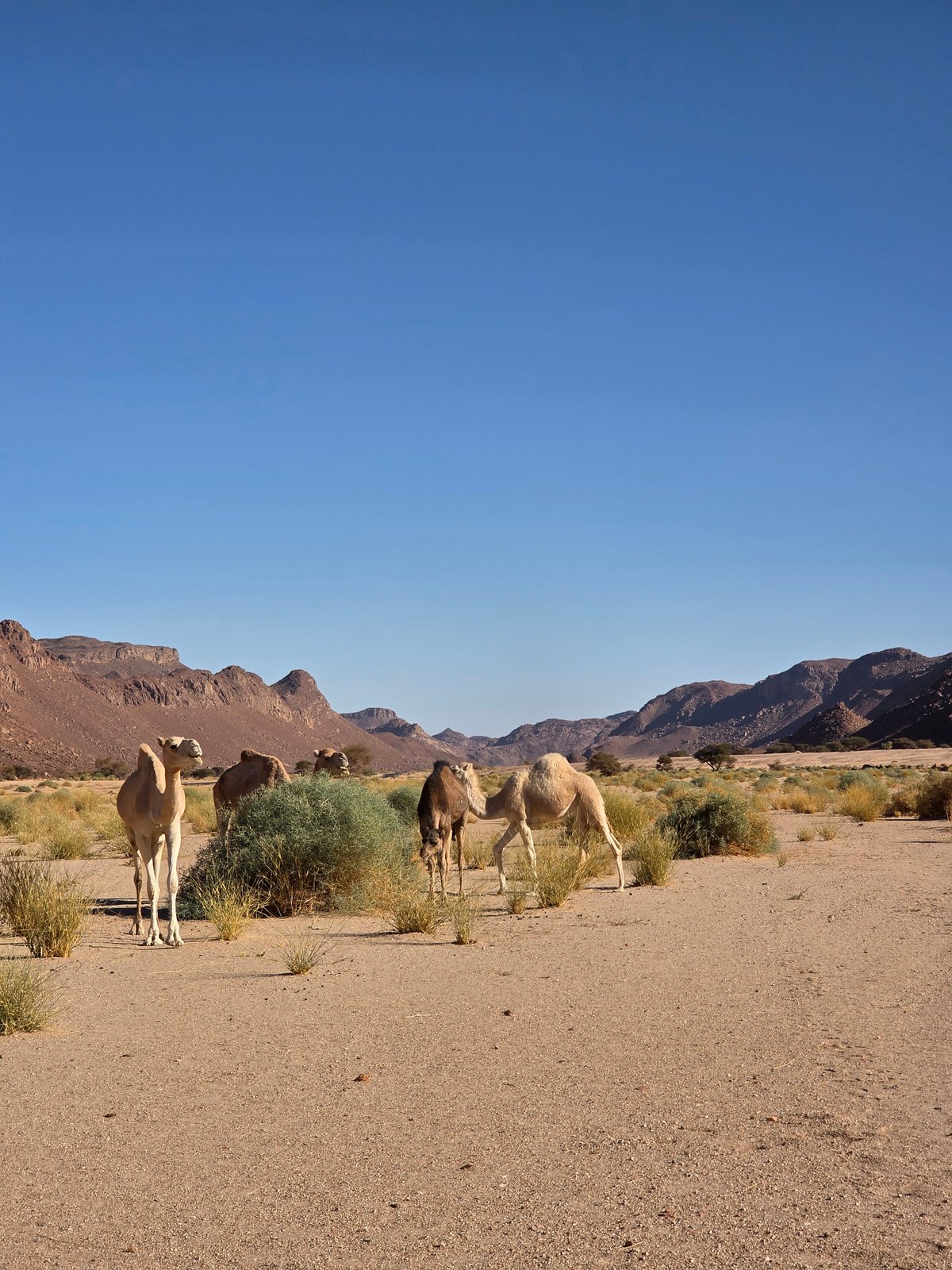
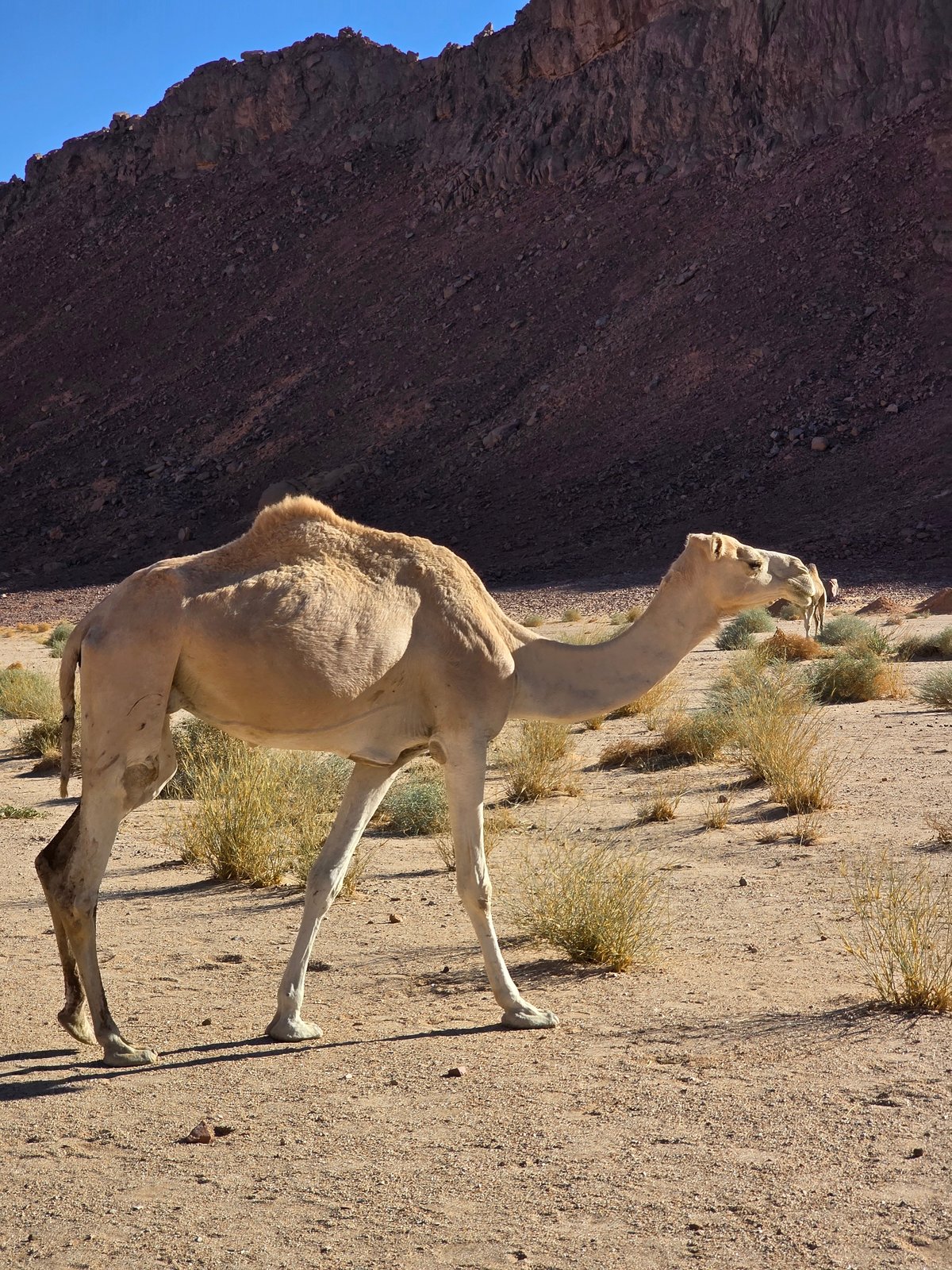
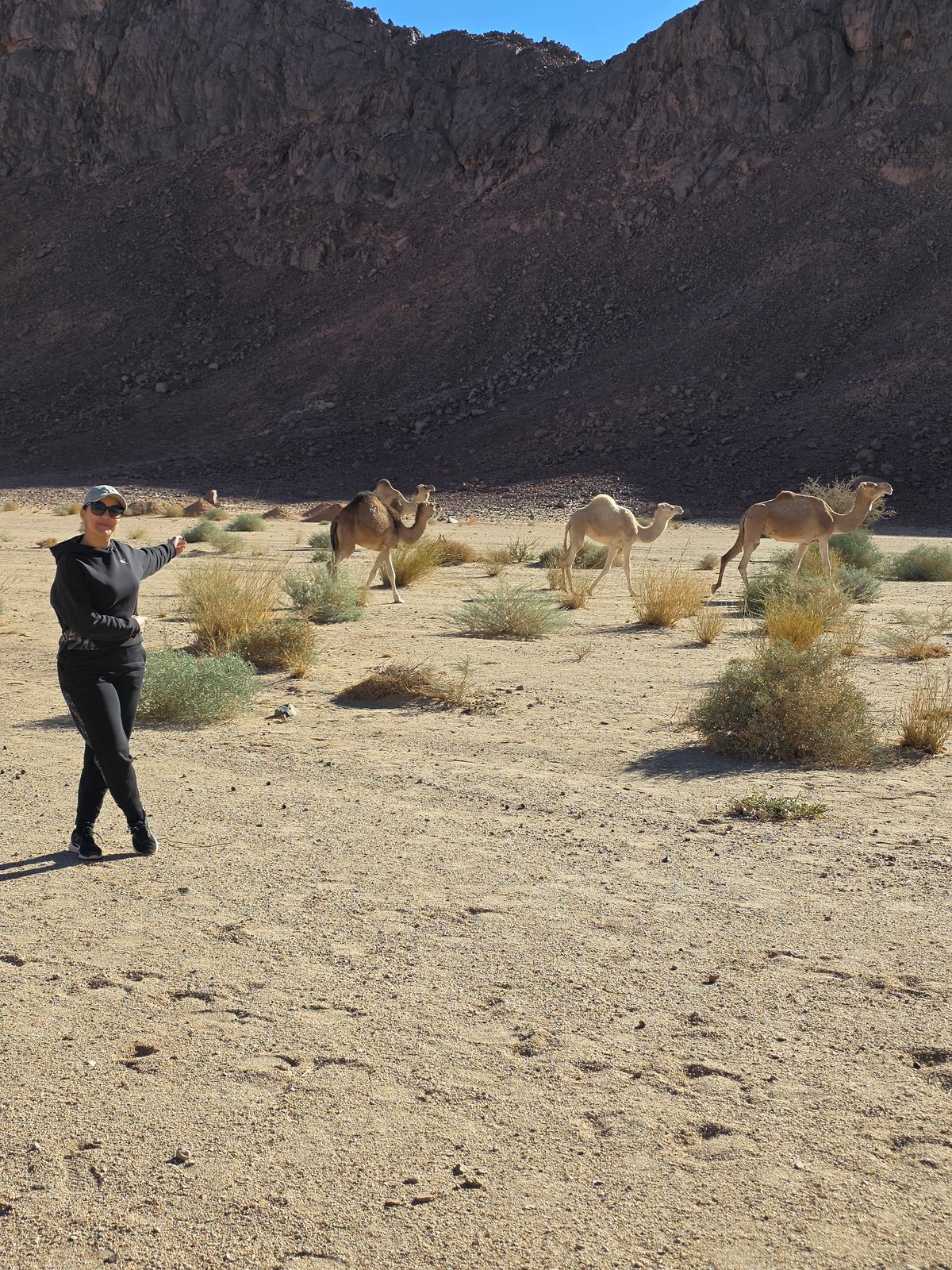
The whole herd · The most photogenic of the bunch, and he knows it · We get closer, they couldn't care less
And then, a little panic
Then the light drops. The 4x4s leave the track and plunge into a sandy valley, raising clouds of golden dust. We drive towards the spot where we'll stop for the night.
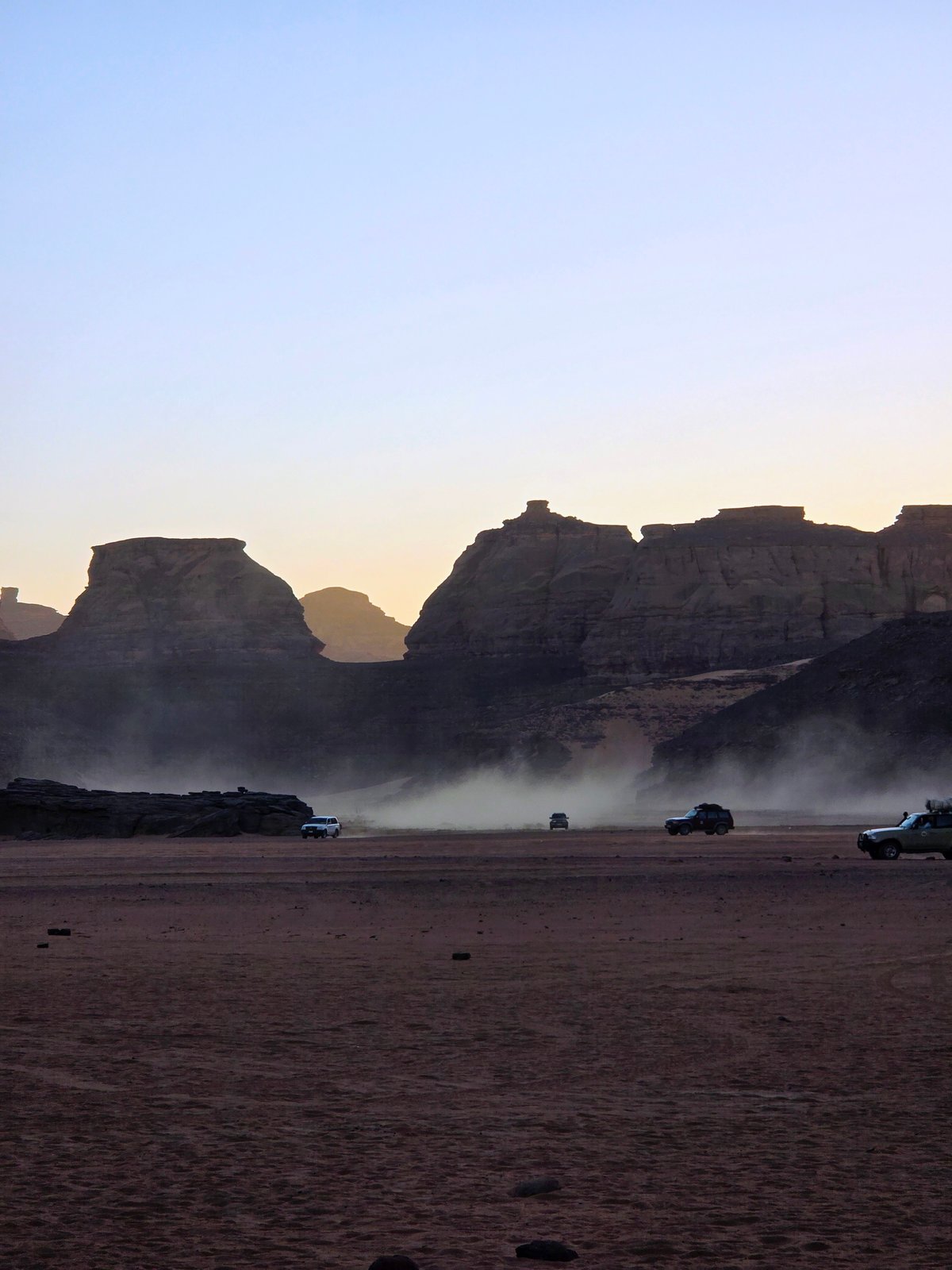
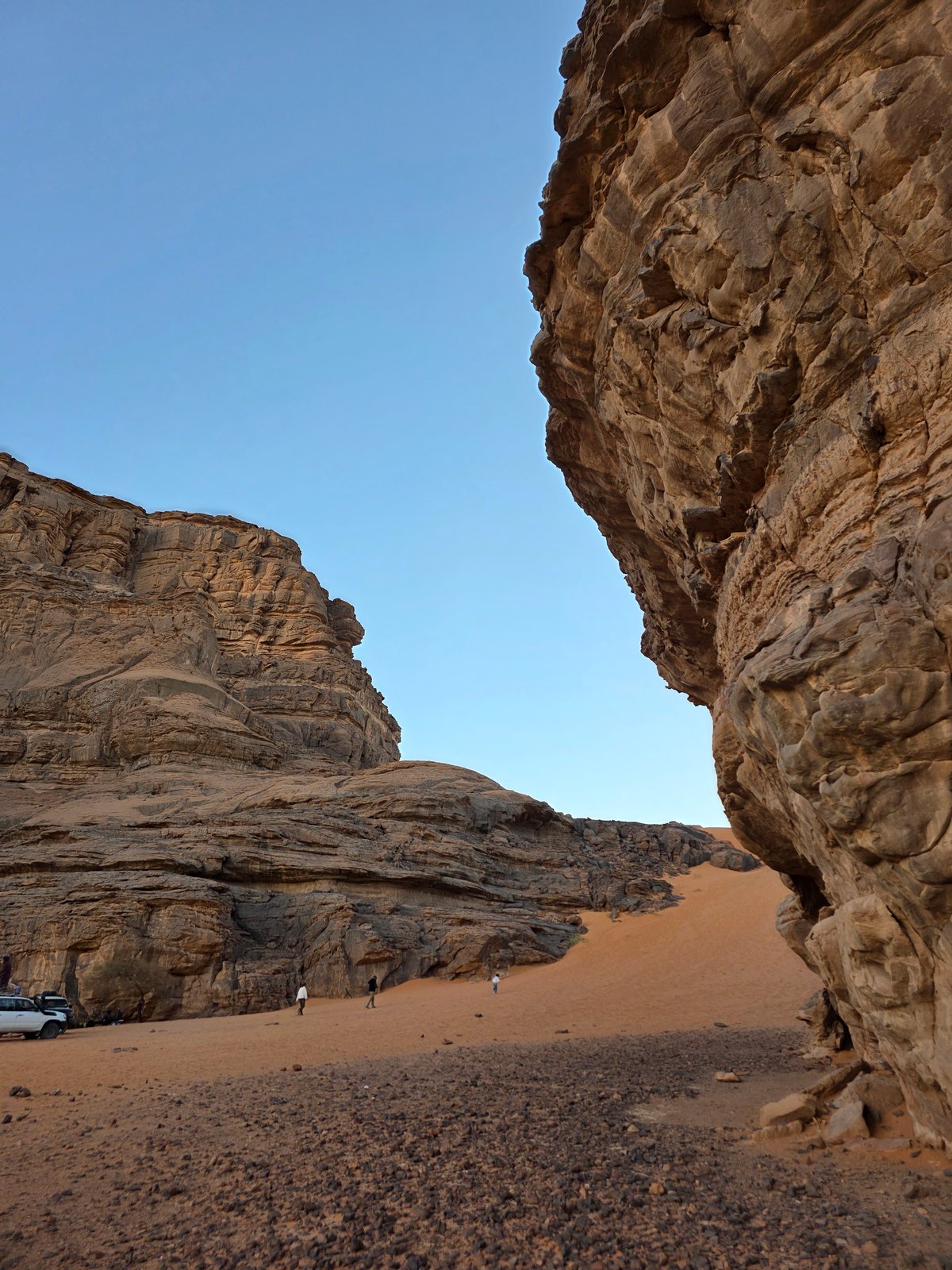
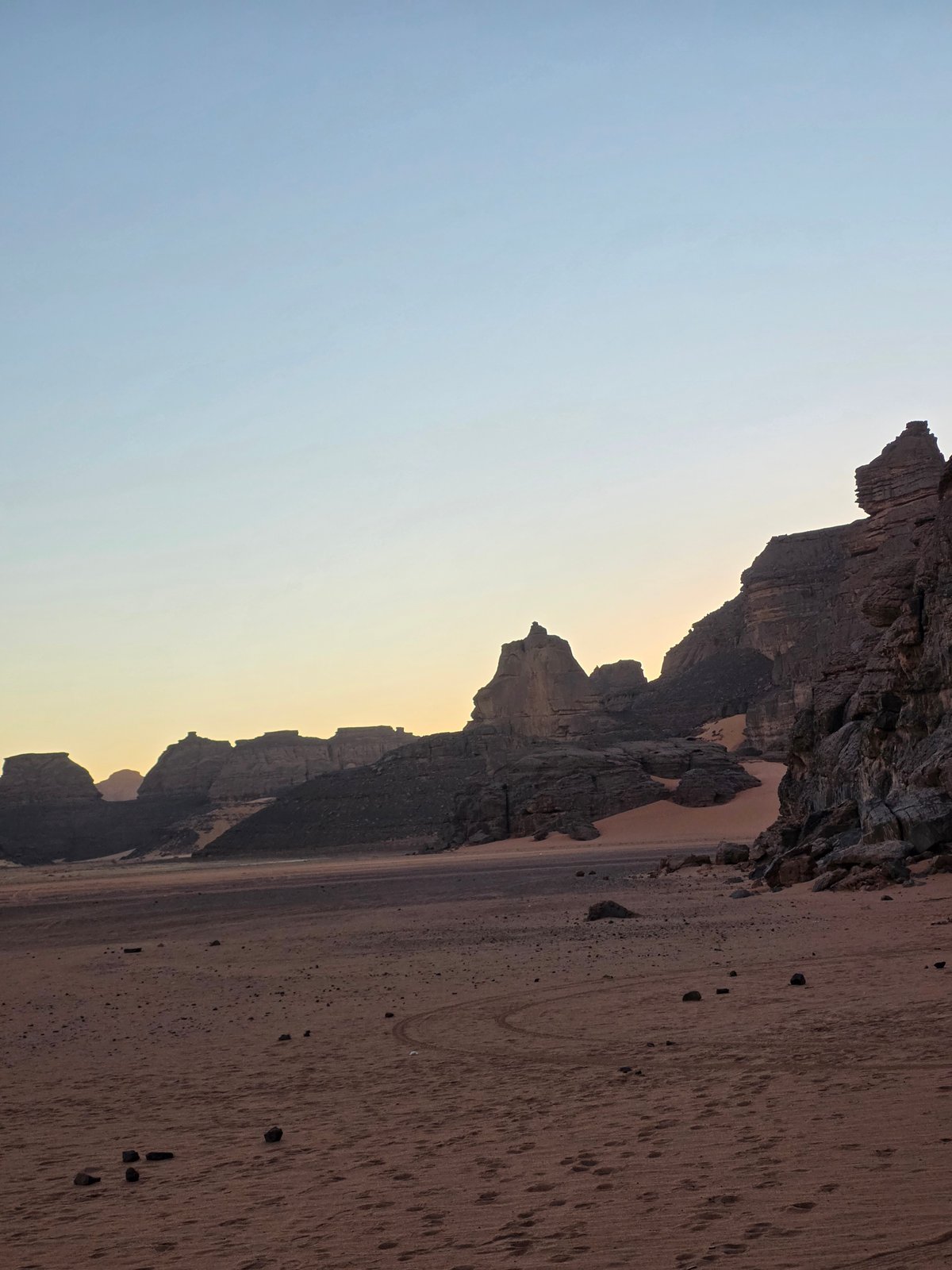
Heading for the first bivouac · The cliff lighting up · Then dusk
And that's when my stomach tightened a little.
No building. No light. Not a fence. Just a huge cliff, sand, and darkness coming fast. We may have wanted this, chosen it, paid for it, but when the engines stop, the silence has a strange effect.
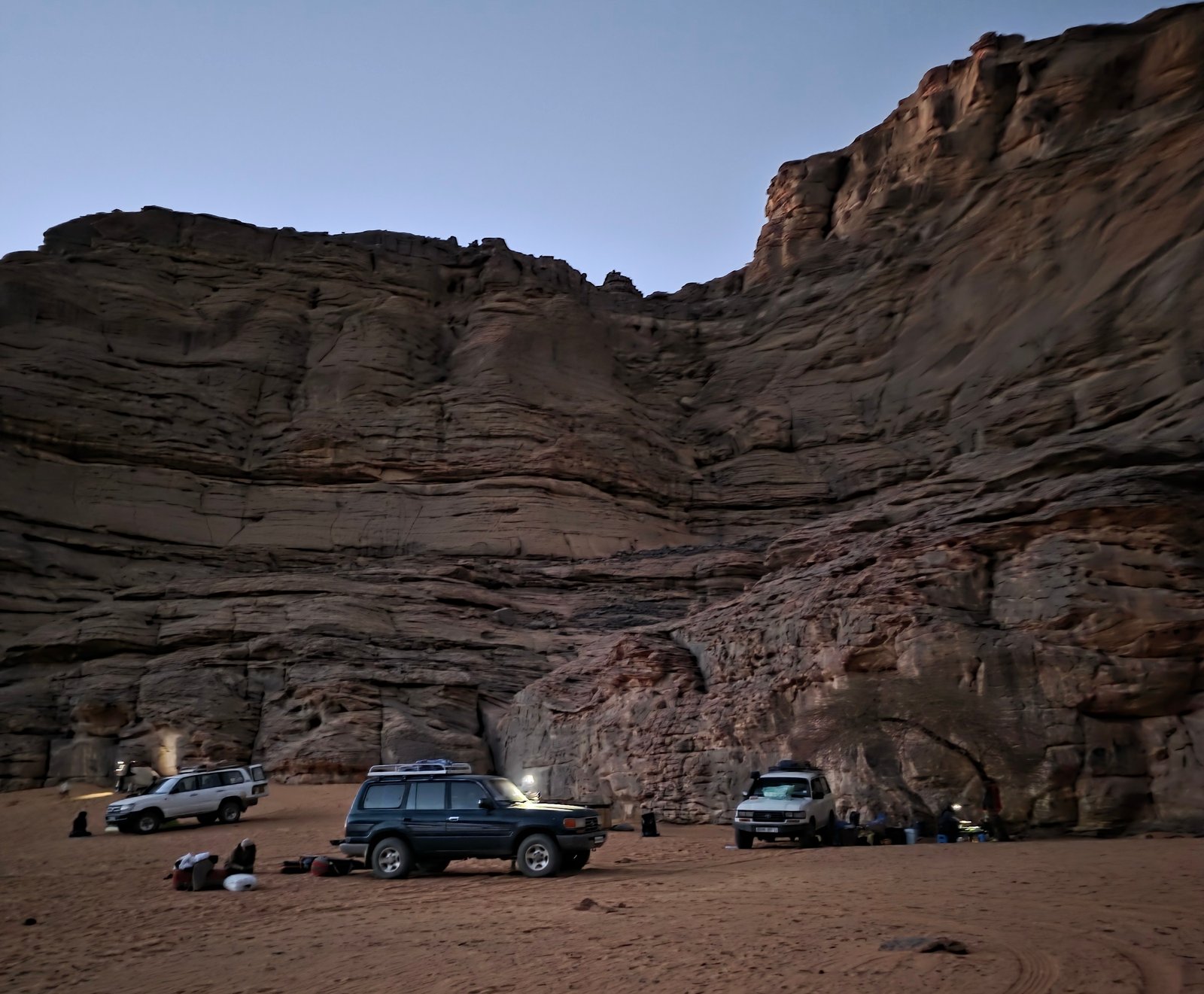
Three cars at the foot of a cliff. That's the hotel.
Then someone lights a fire
And everything changes.
The Tuareg unroll the rugs, bring out the mattresses, put up a woven-fibre windbreak against the rock, once again to protect the fire from the wind. Then the teapot goes back on the embers, and the little glasses reappear.
In half an hour, that black hole in the middle of nowhere has become a living room. There's light, warmth, the smell of tea, people sitting in a circle. We're in exactly the same place as thirty minutes ago, and yet we're not scared at all any more.
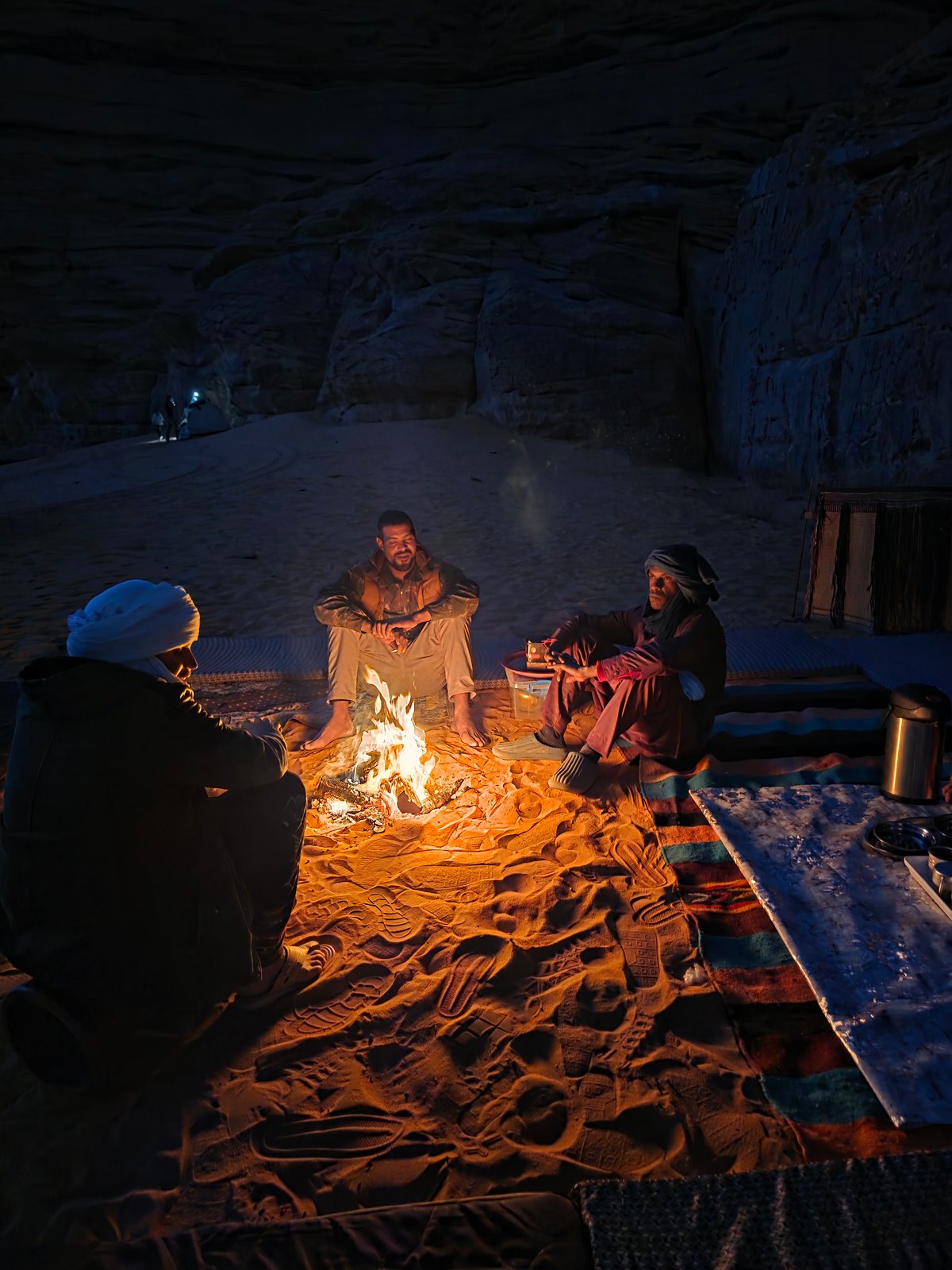
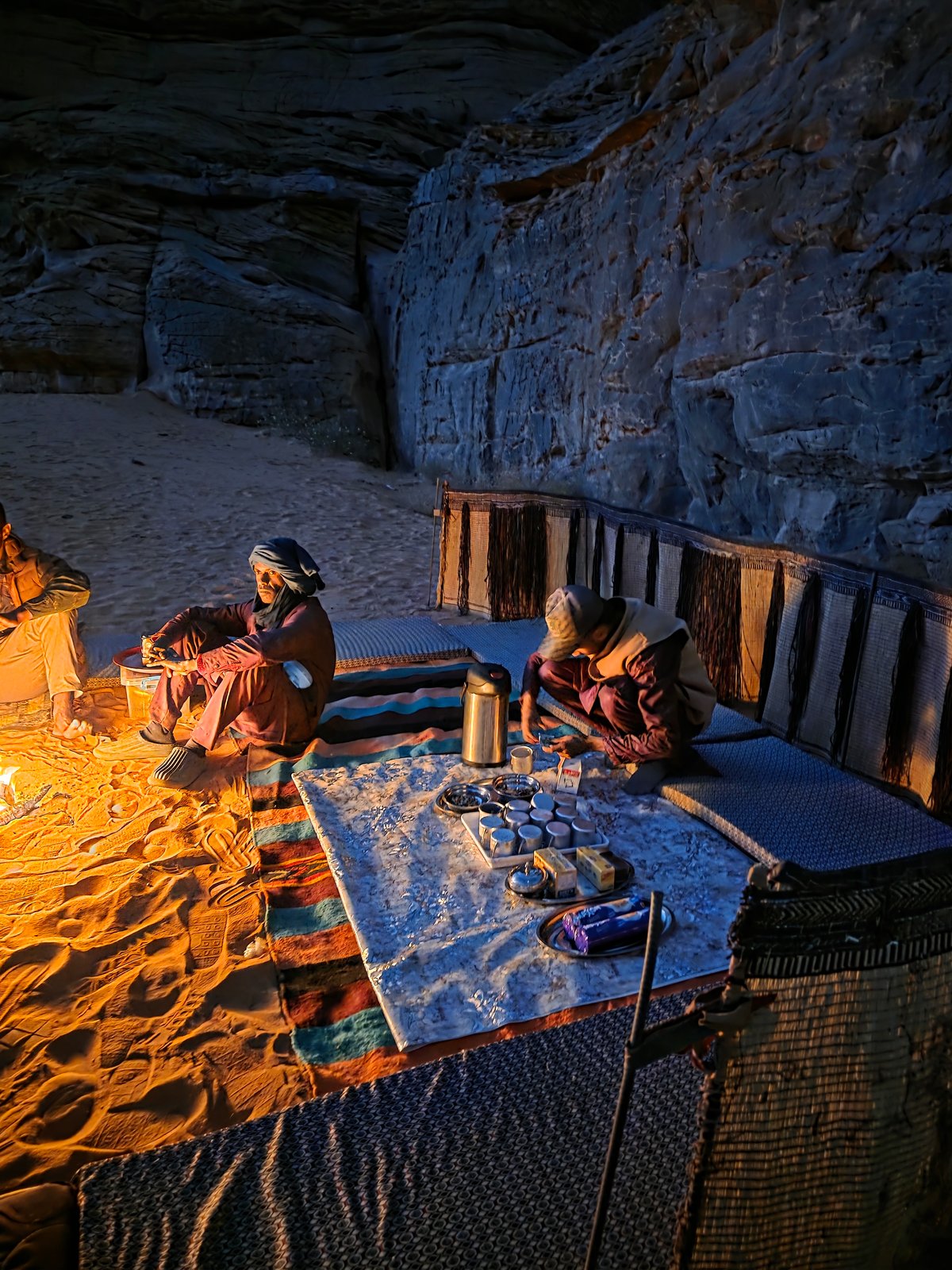
The fire, sheltered against the cliff · The windbreak up, the rugs spread out, the tea on its way
Maybe that's the real wisdom of the desert: not finding shelter, but making one. Protecting the fire literally means making yourself a home in the middle of nowhere.
The private concert
After dinner, the guitar comes out. Then the drum. One of the guides starts playing, softly, and nobody says another word.
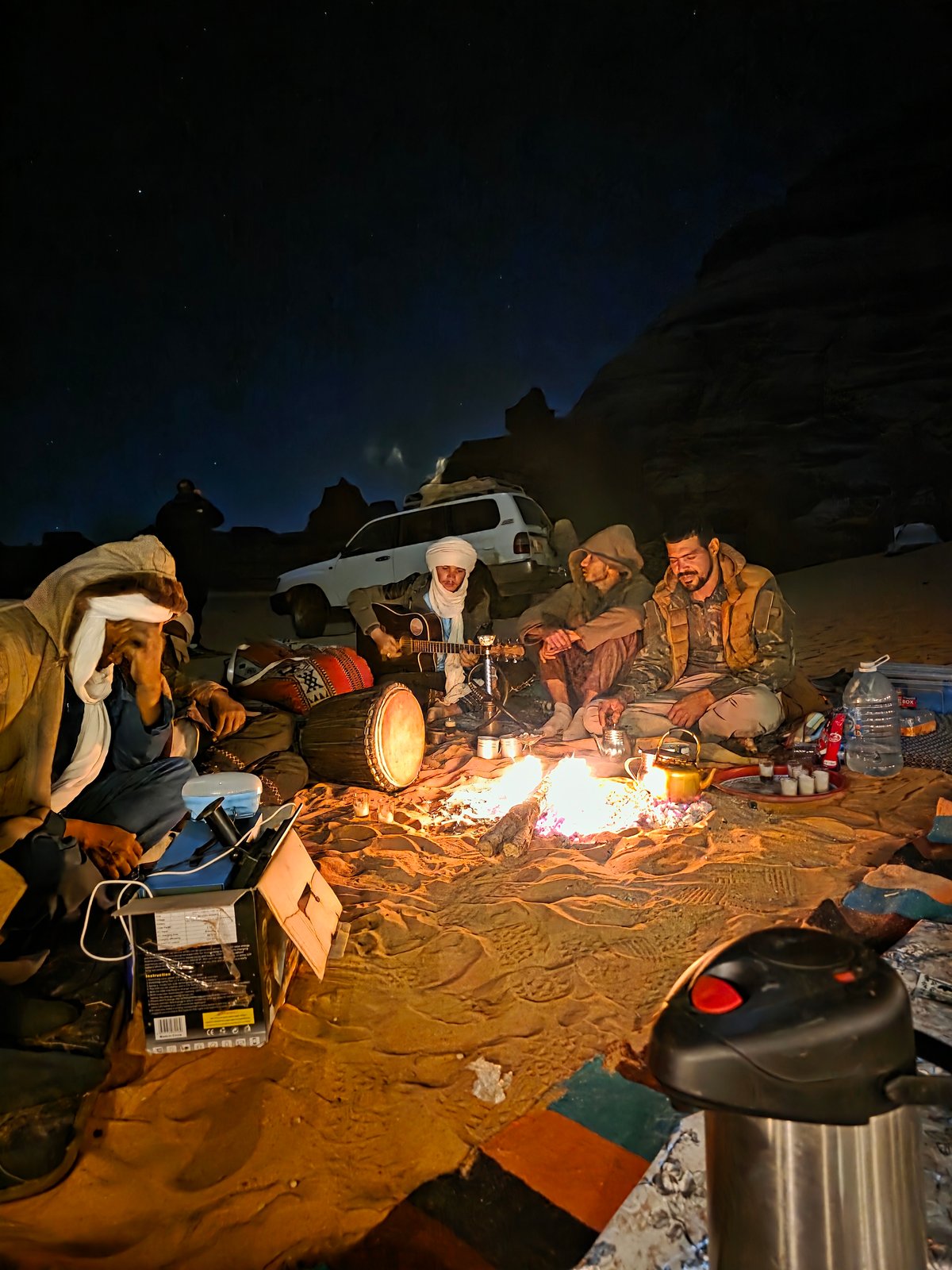
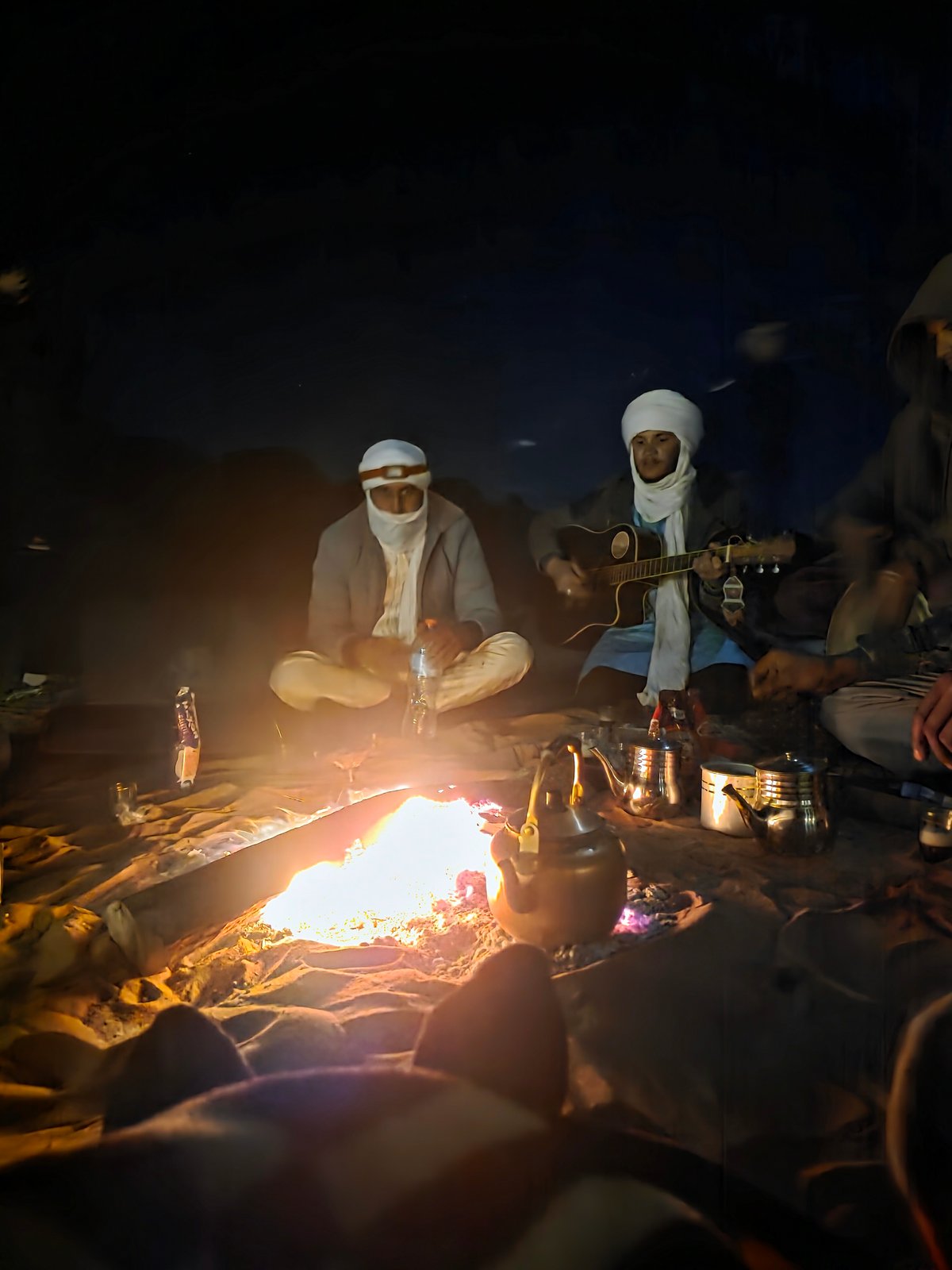
Guitar, drum, tea, and a sky full of stars · The copper teapots, front row
It went on for hours. Midnight, one in the morning. At some point we started singing with them, badly, no doubt, but with great conviction. We weren't spectators any more.
Good night, it's minus something
Then comes the least glamorous moment of the day: brushing your teeth with water so cold it hurts your fingers. The desert at night, in December, is no joke.
T-shirt by day, curled up by night. Bring a really warm sleeping bag, thermal underwear, a beanie, and above all two pairs of socks. Everyone ended up sleeping with a beanie on. Nobody found it ridiculous.
First night in a tent, and nobody really sleeps. You hear the sand, you hear the wind, you even hear the neighbours snoring: bivouac intimacy, you get used to it fast, for lack of choice.
And then, at some point, we step out of the tent.
Not a few constellations like in the countryside. A whole sky, saturated, overflowing, with the Milky Way laid across it as if someone had drawn it. However much we've travelled, we had never seen anything like it.
And we understand, without anyone needing to explain, why we came all this way.
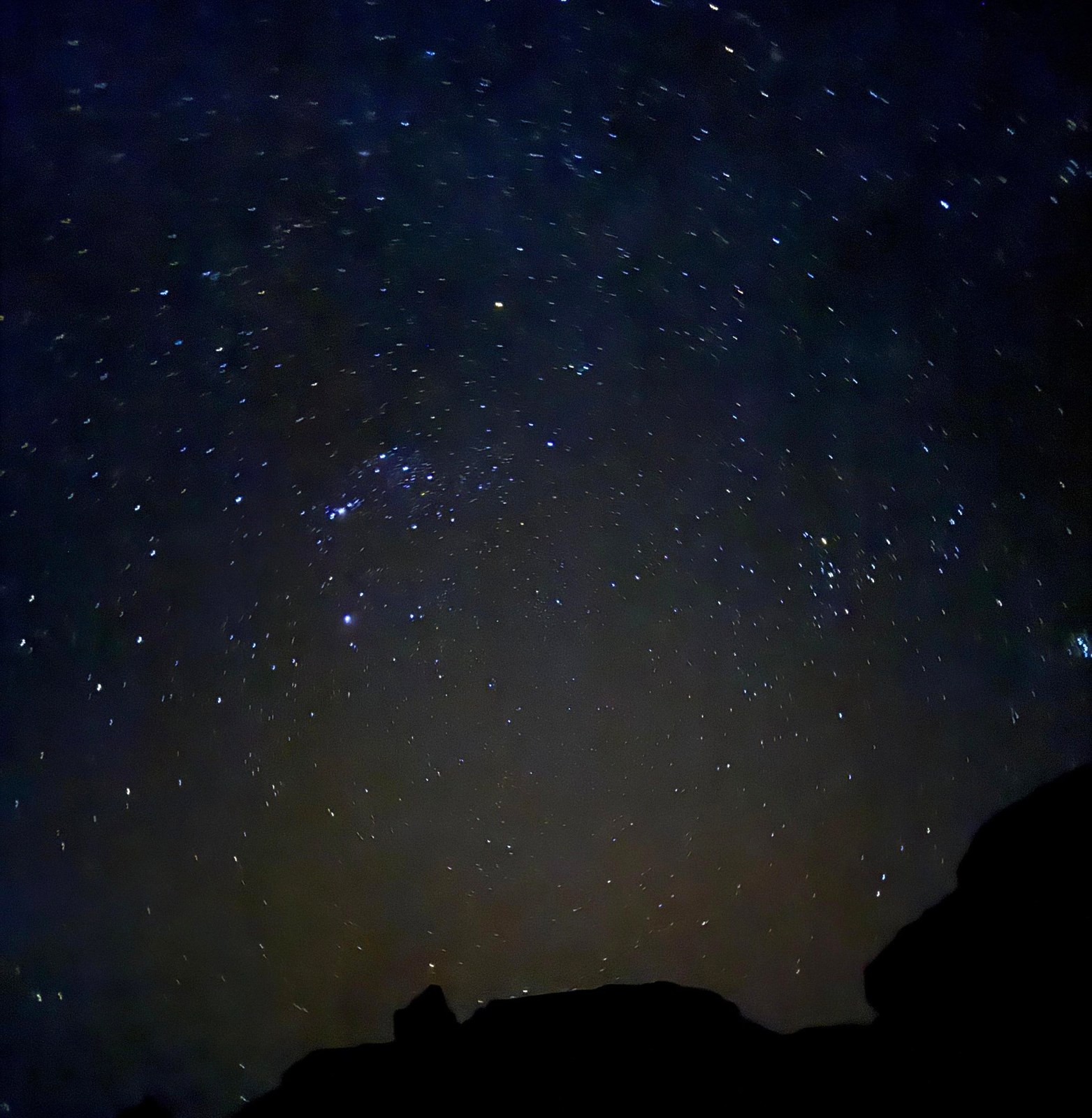
On a phone, handheld, in the middle of the night. In real life it was ten times more. Thanks to the photographer for the picture! 😉
Turn on night mode, rest your phone on a stone or a bag, and don't move for a few seconds. And above all, take the time to look without a screen.
Tomorrow, wake-up at 6. We'll have to fold everything up, load everything back, and set off again. We don't know it yet, but that gesture will become a ritual, and it's that ritual that will change us.