Fold up, load up, drive off. We won't describe the morning ritual in every episode, you know it by now. Coffee, bread, double socks, a fire already lit by people who were up long before us. That morning: off to a canyon.
The canyon
We walk between two walls that close in so tightly you have to brace an arm against each side. Two or three hundred metres like that, in light falling like a blade from a slit of sky far above. It's the kind of place where everyone lowers their voice without a word.
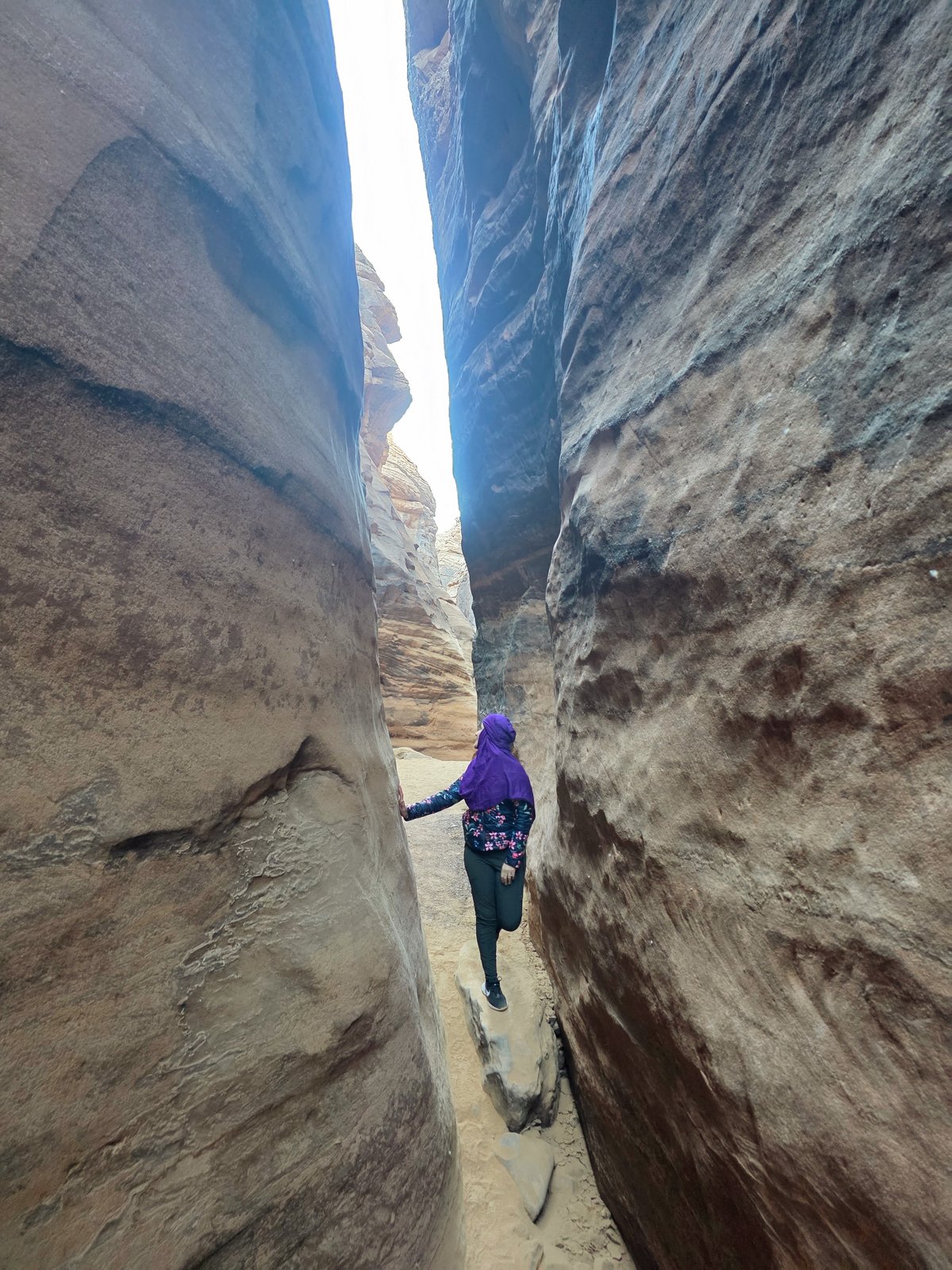
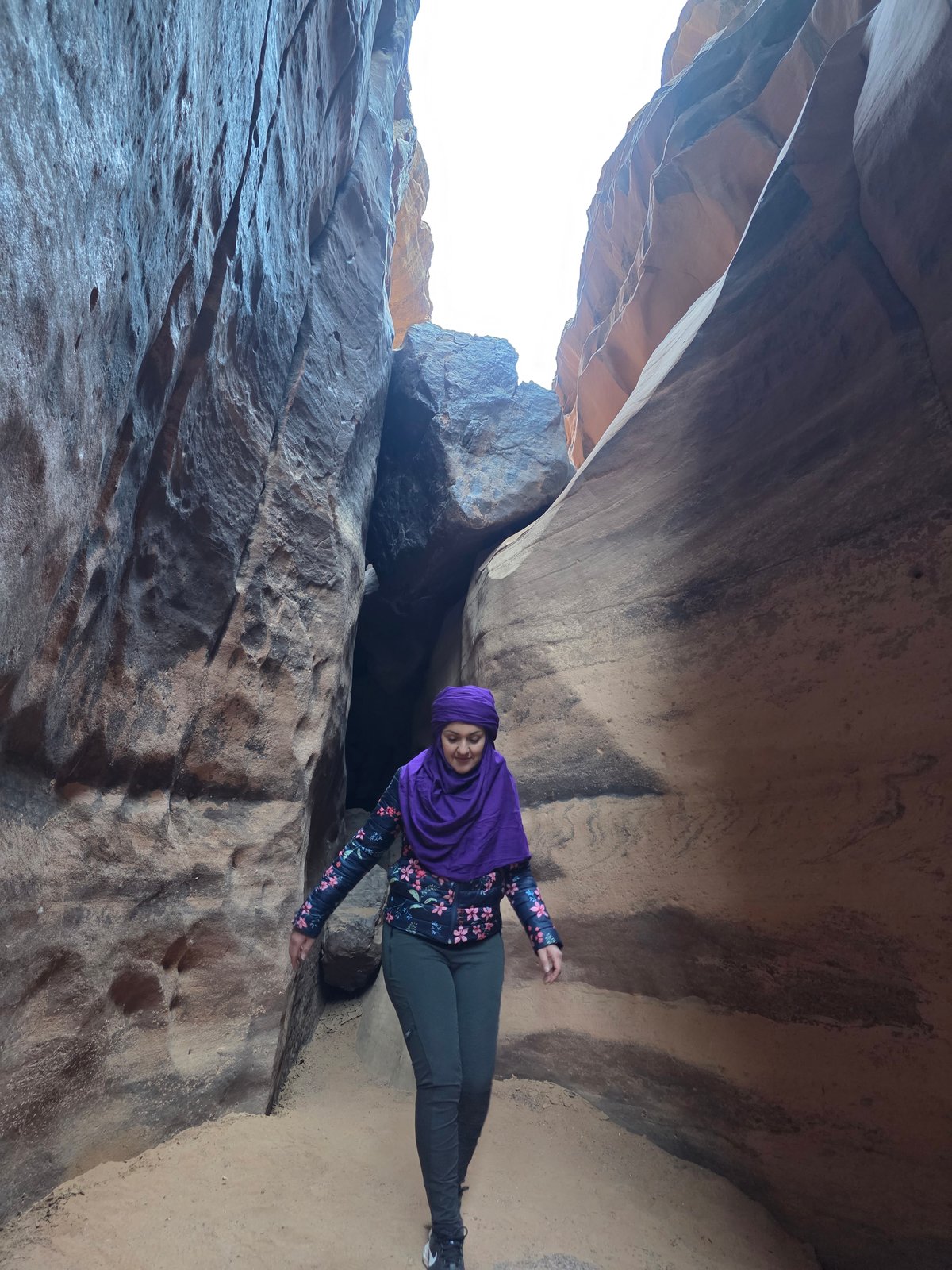
Bracing ourselves against both walls · The walls close in
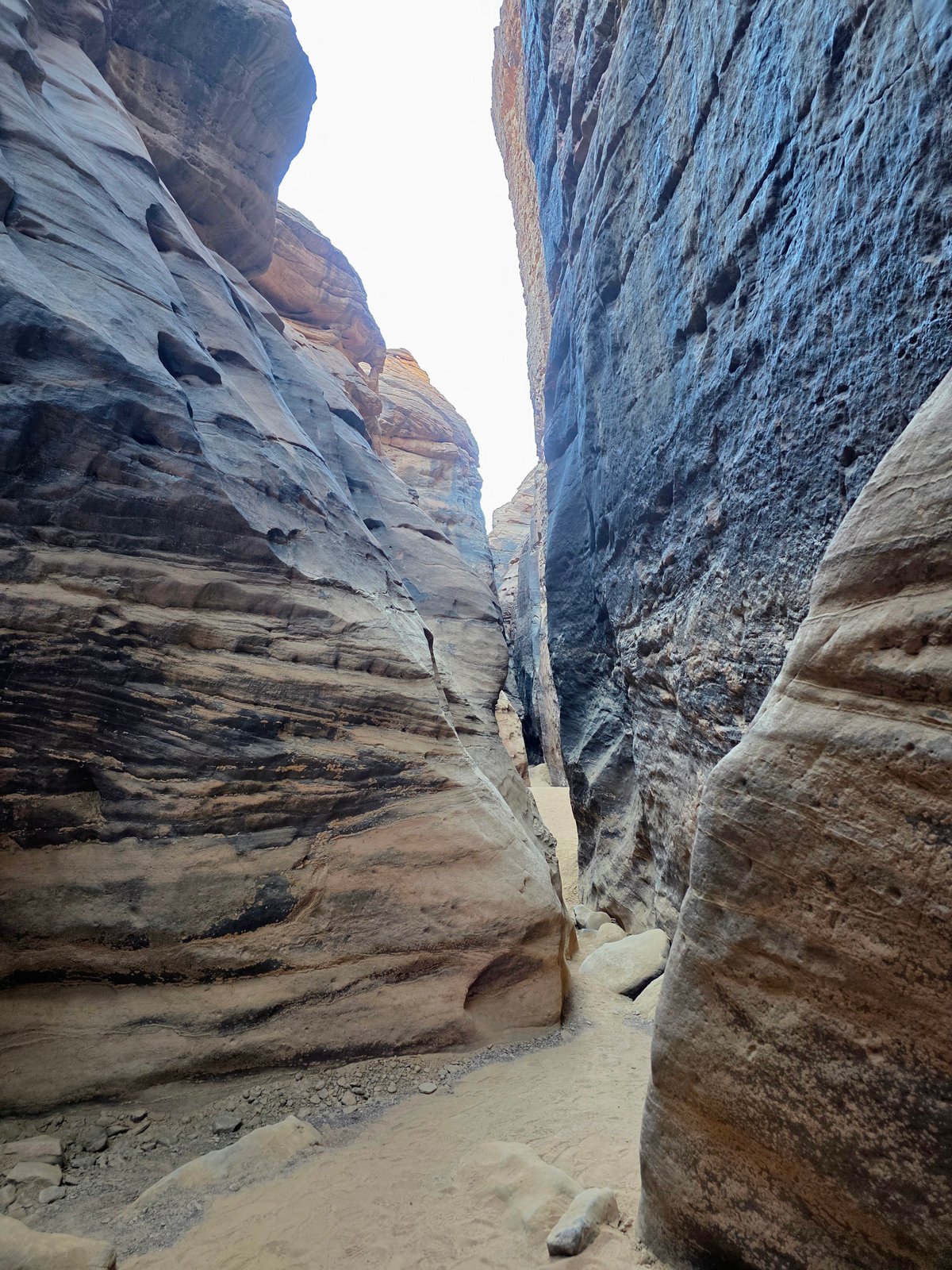
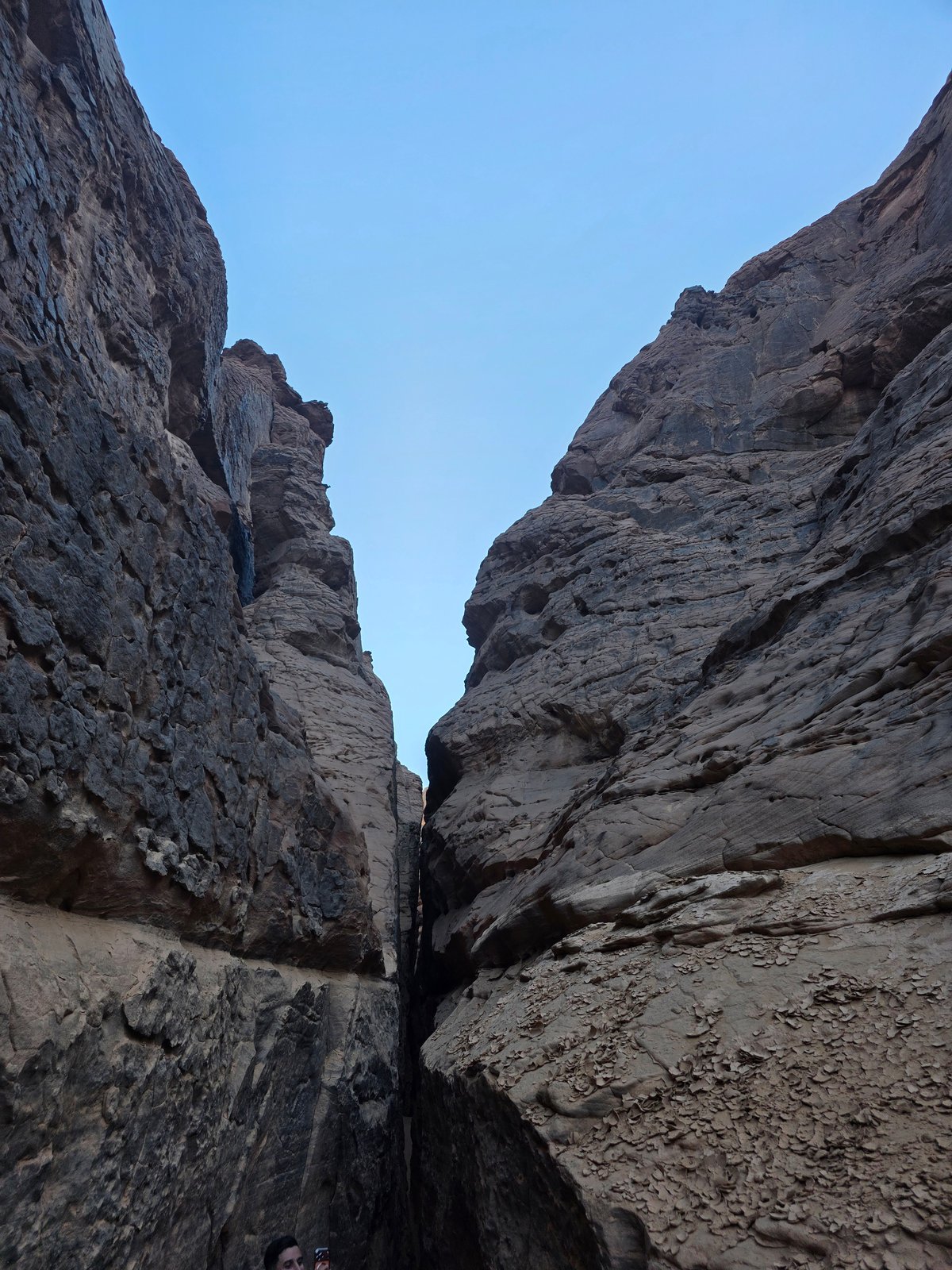
The empty canyon, the scale of the place · A slit of sky, far above
What the rock kept
After the canyon, on the road to the Tin Merzouga erg, one panel of engravings and paintings follows another, some said to date from the Bubaline period, the age of the hunters. It takes the guide's eye to spot them; some are so faint we would have walked right past. Three giraffes side by side, a giraffe surrounded by humans, fish, a frieze of figures dancing or walking in procession under a rock that leans over like an awning.
Everything we saw is part of the Tassili n'Ajjer, a UNESCO World Heritage Site since 1982. More than 15,000 drawings and engravings have been recorded there, spanning about 10,000 years: it's one of the largest collections of prehistoric rock art in the world.
And the Tadrart Rouge? It's the Algerian extension of Libya's Akakus: a sandstone massif about 150 km long and 15 to 30 km wide, peaking at around 1,340 m. A few thousand years ago it wasn't a desert but a savannah, hence all those giraffes and elephants on the walls.
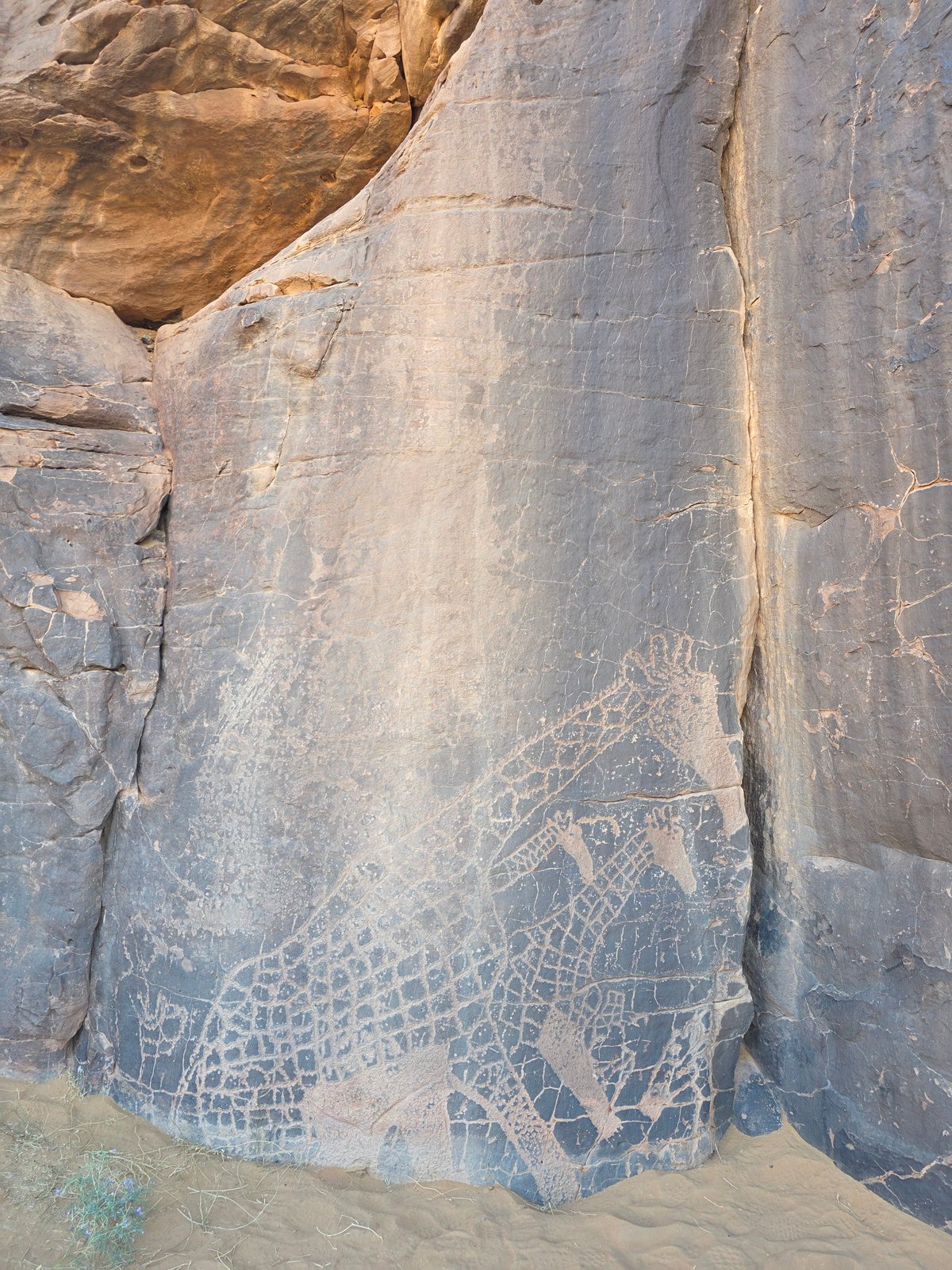
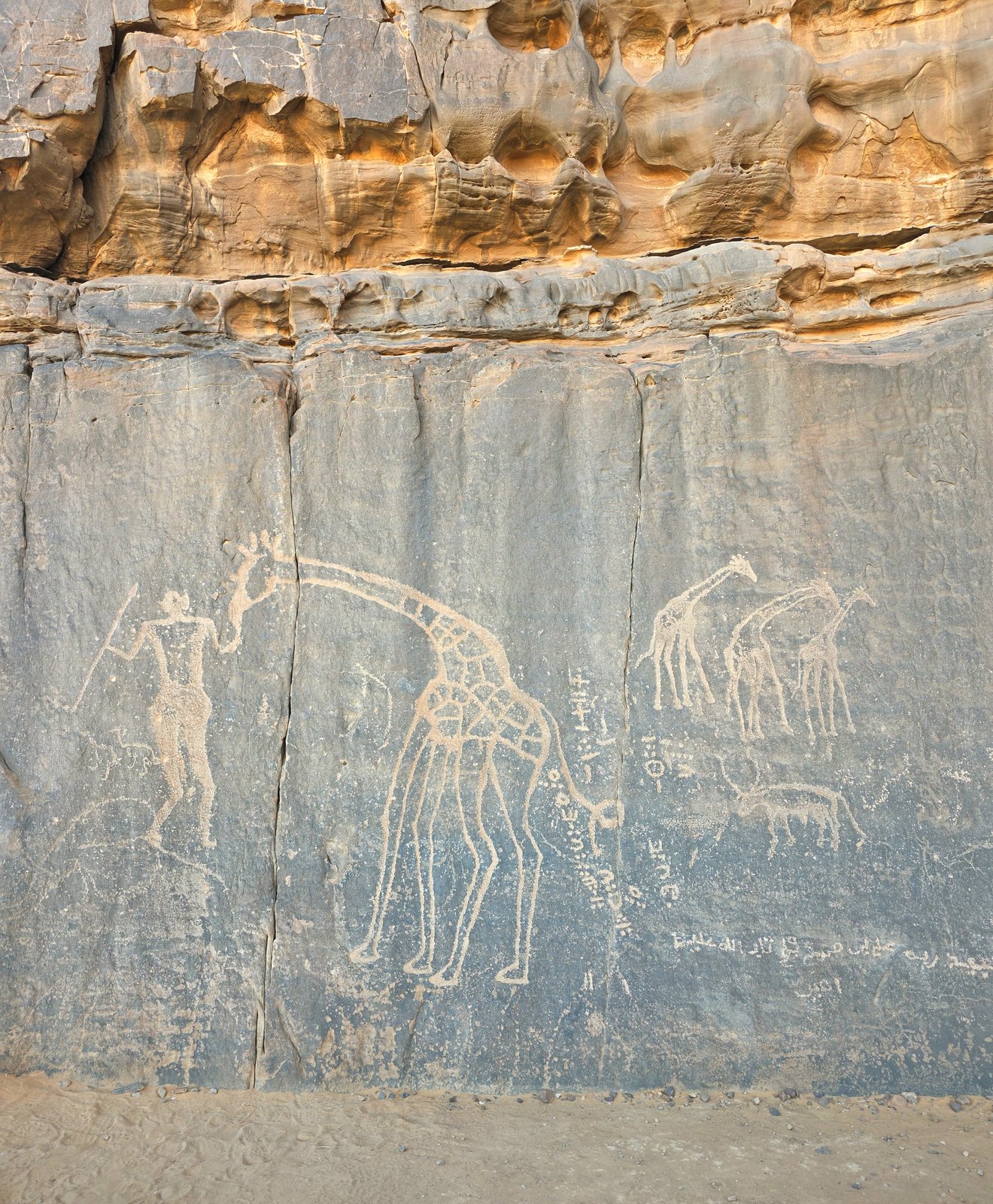
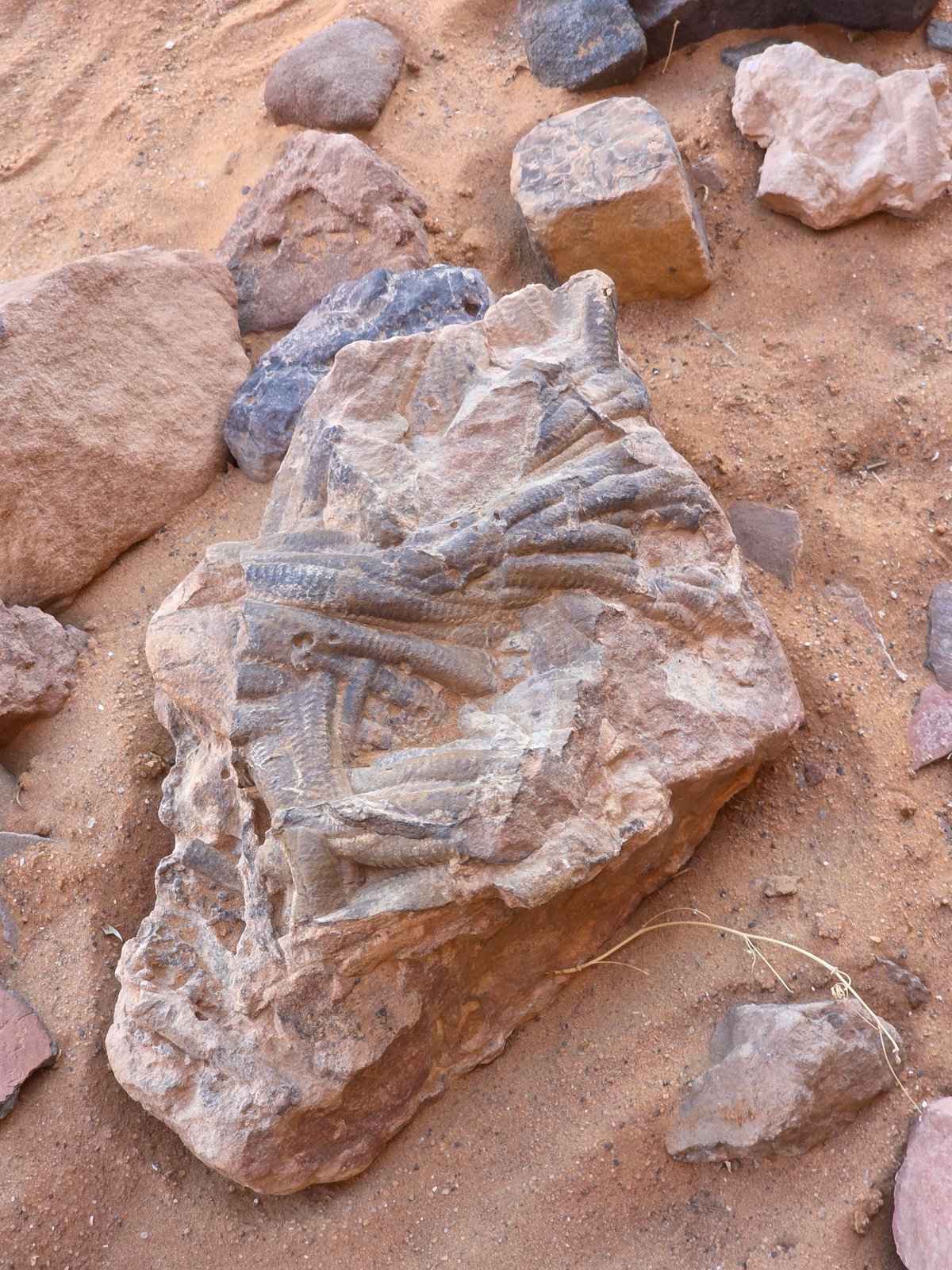
Three giraffes, one beside the other · A giraffe and humans · An engraved stone, lying right on the sand
A little further on, a frieze runs along the sand. And I walk alone for a while, on a track that leads nowhere and everywhere at once.
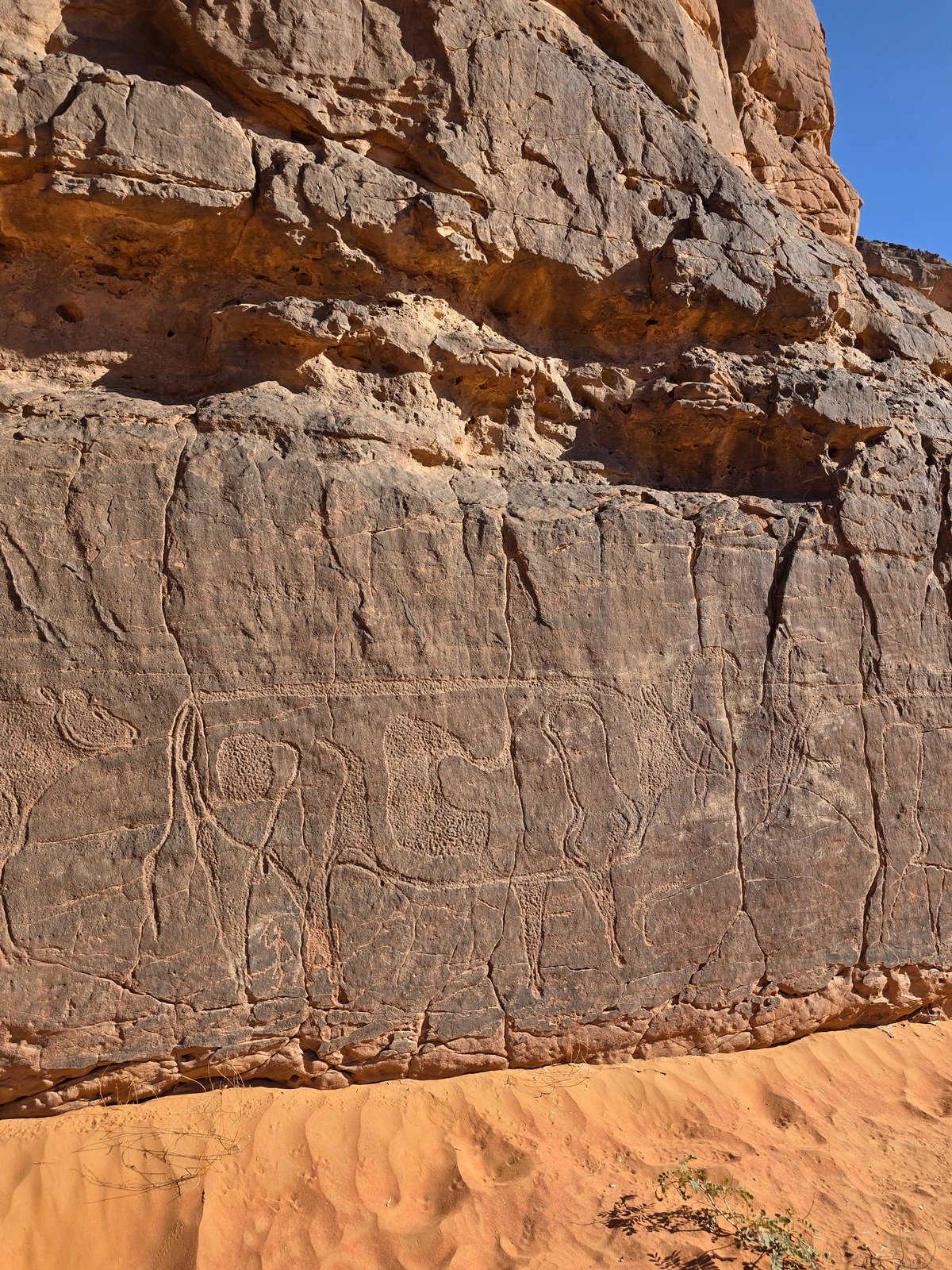
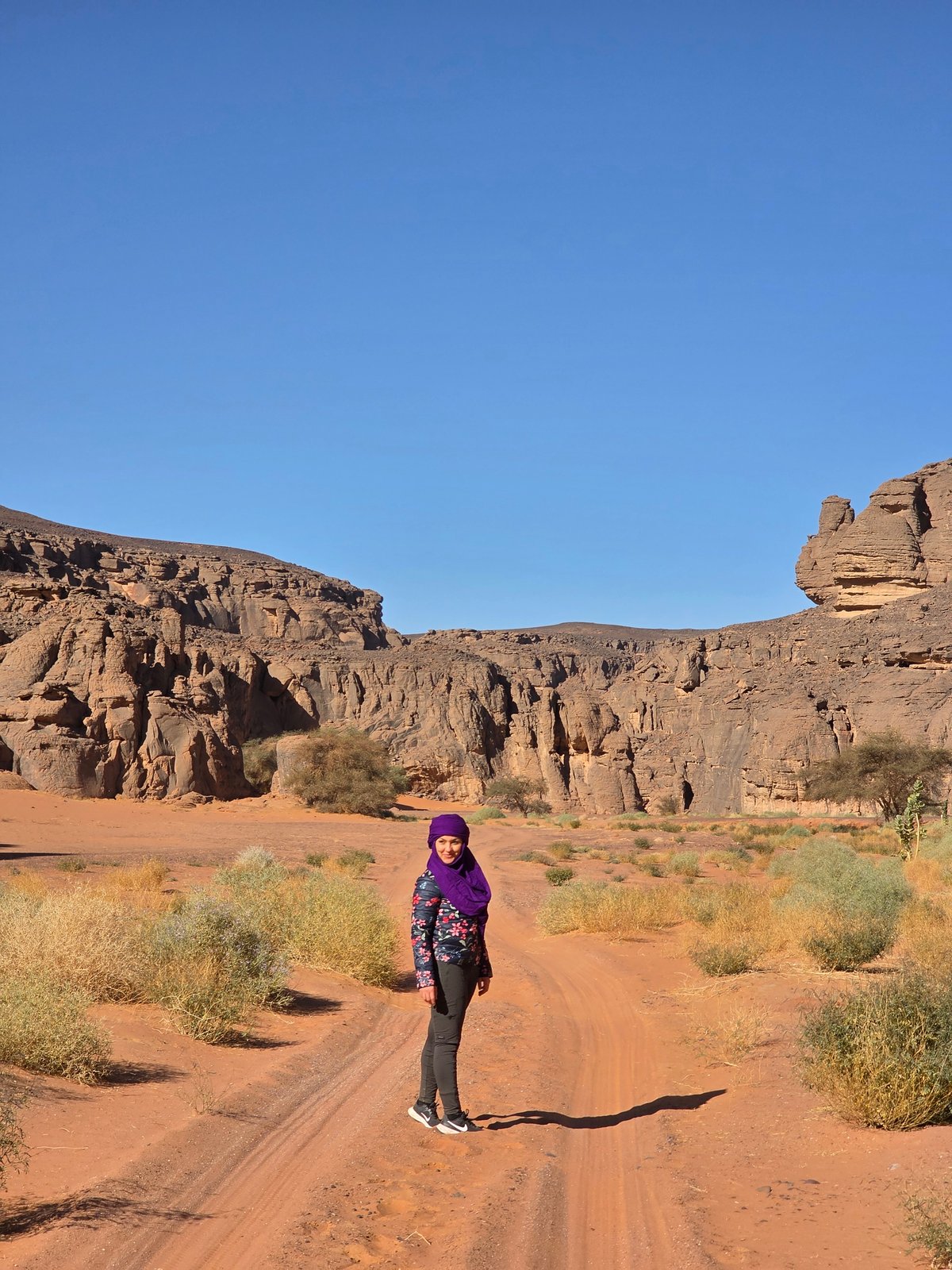
A frieze at sand level · A track that leads nowhere, and everywhere at once
Nobody knows the exact age of these engravings; historians argue between 6,000 and 10,000 years. One thing is certain: there were giraffes, elephants, hippos and fish here, when the Sahara was still green. What we're looking at is really the logbook of a desert drying up before our eyes, or rather, before the eyes of those who carved it, a very, very long time ago.
The desert turns orange
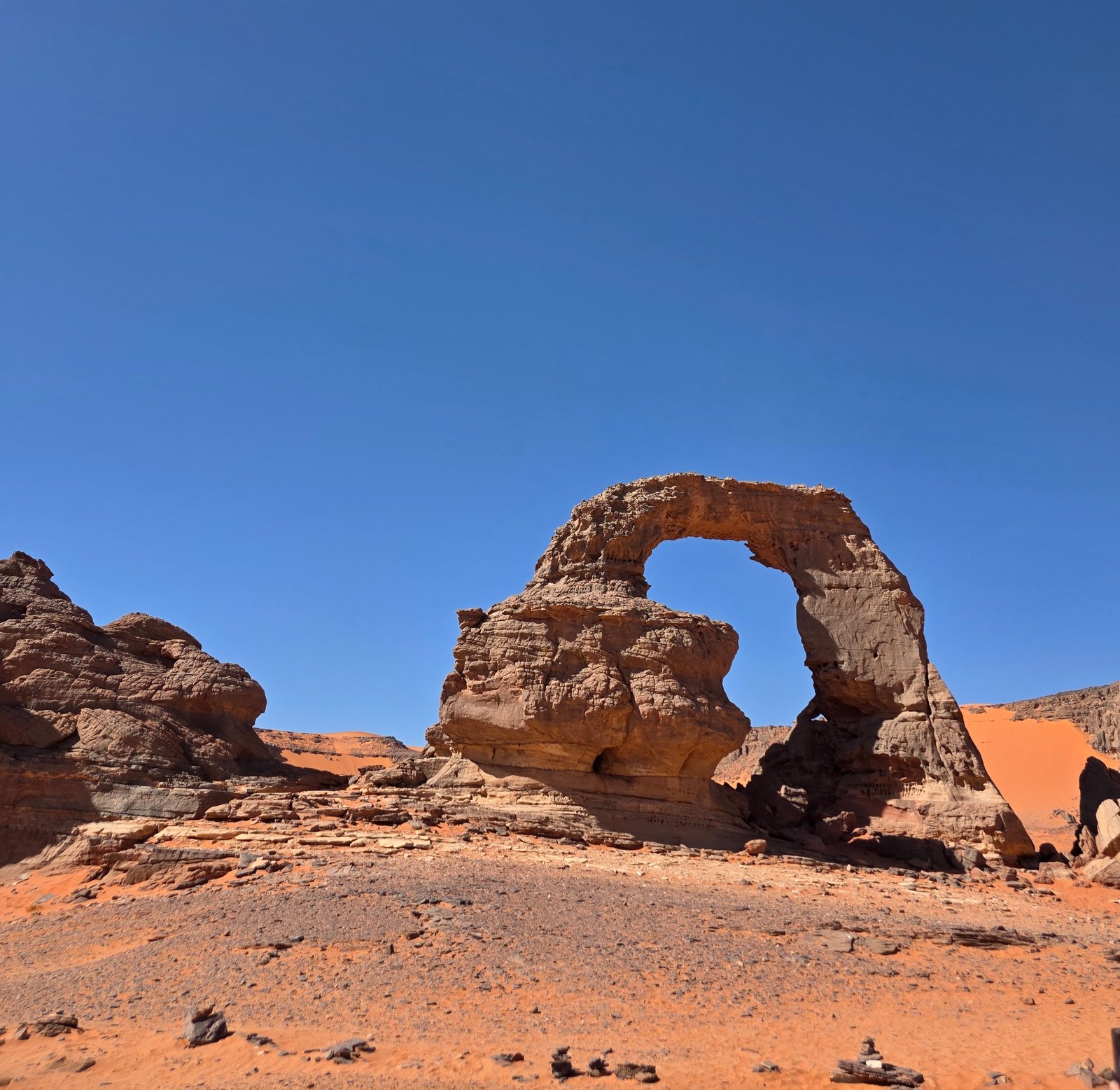
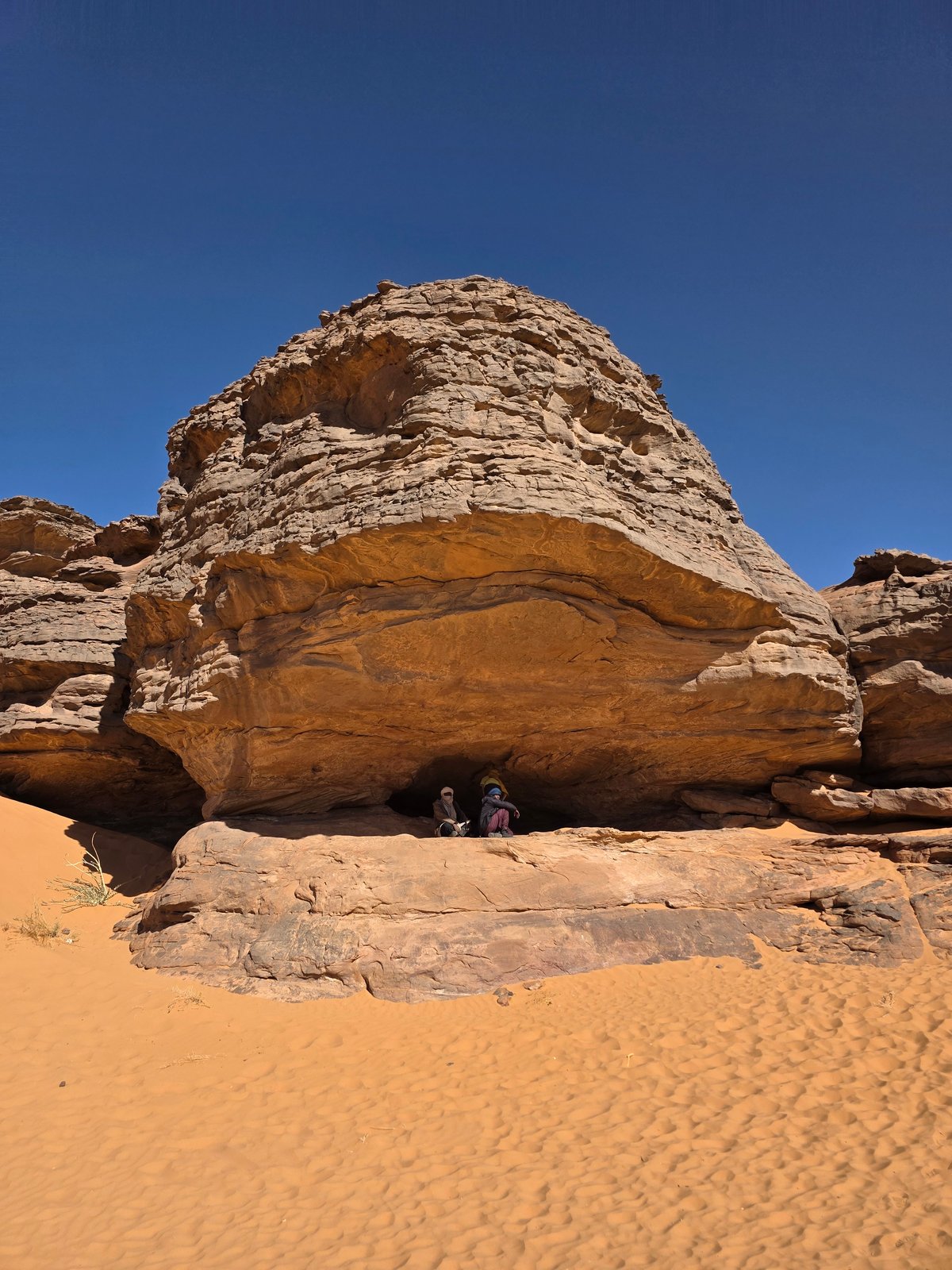
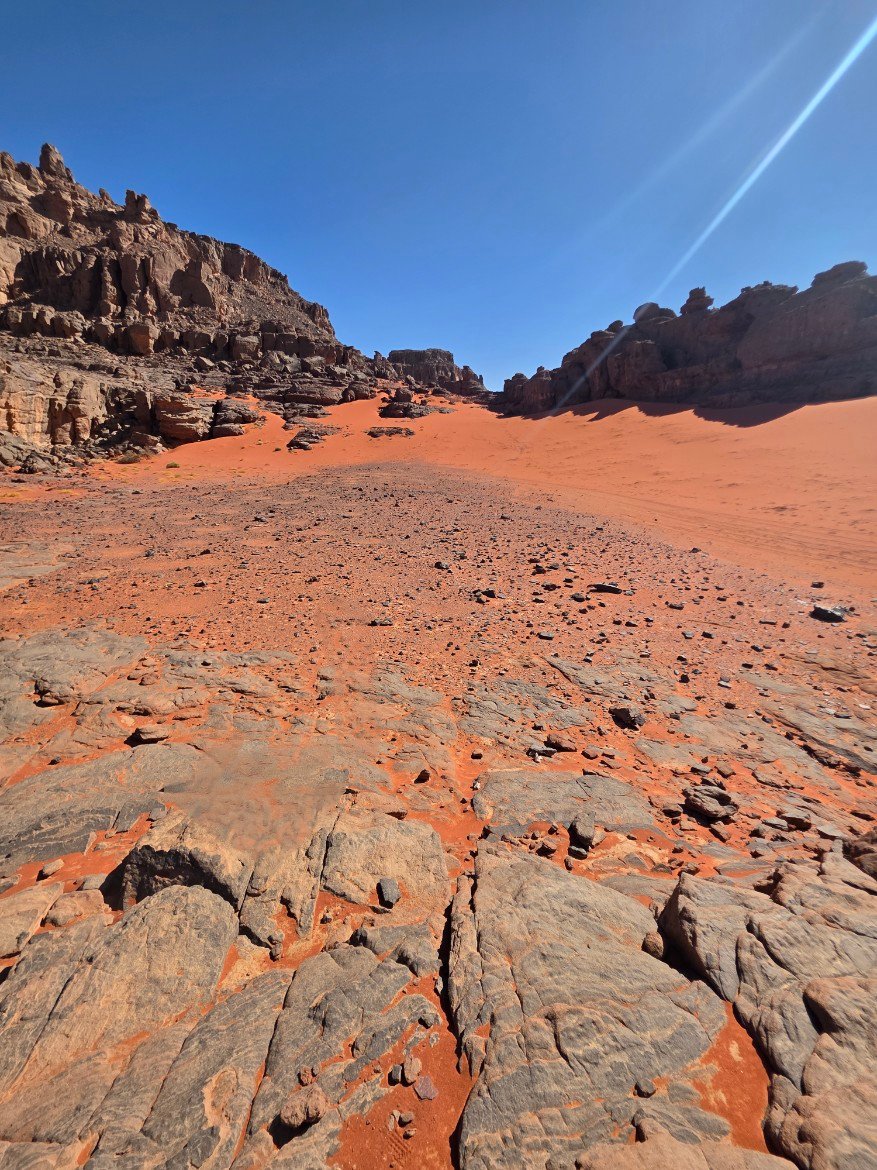
This is where the Tadrart Rouge truly starts living up to its name. The sand changes, and so does the rock: sculptures shaped by the wind, shelter under an arch carved into a giant boulder, a dune unrolling to infinity, striped with tyre tracks and footprints.
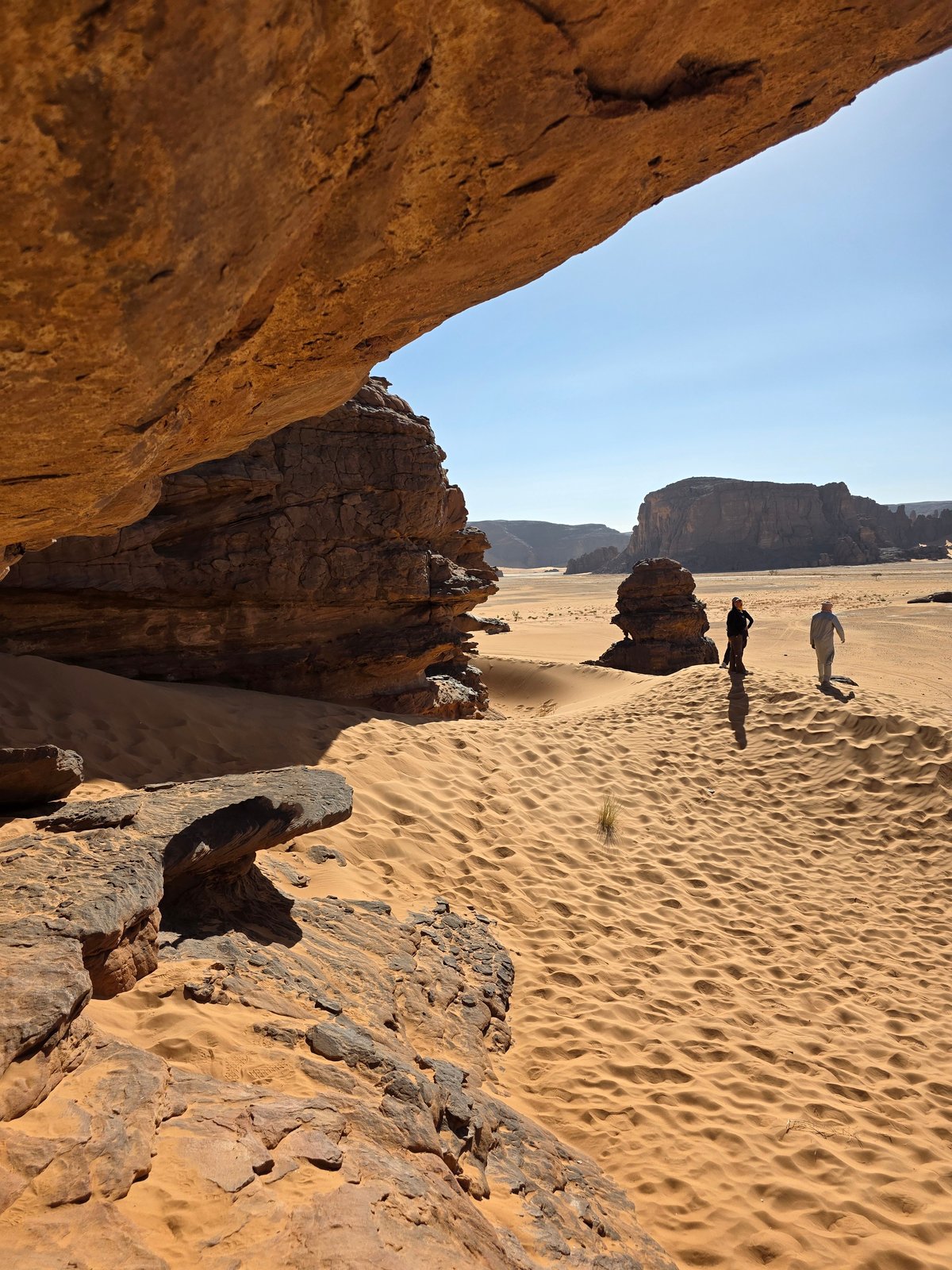
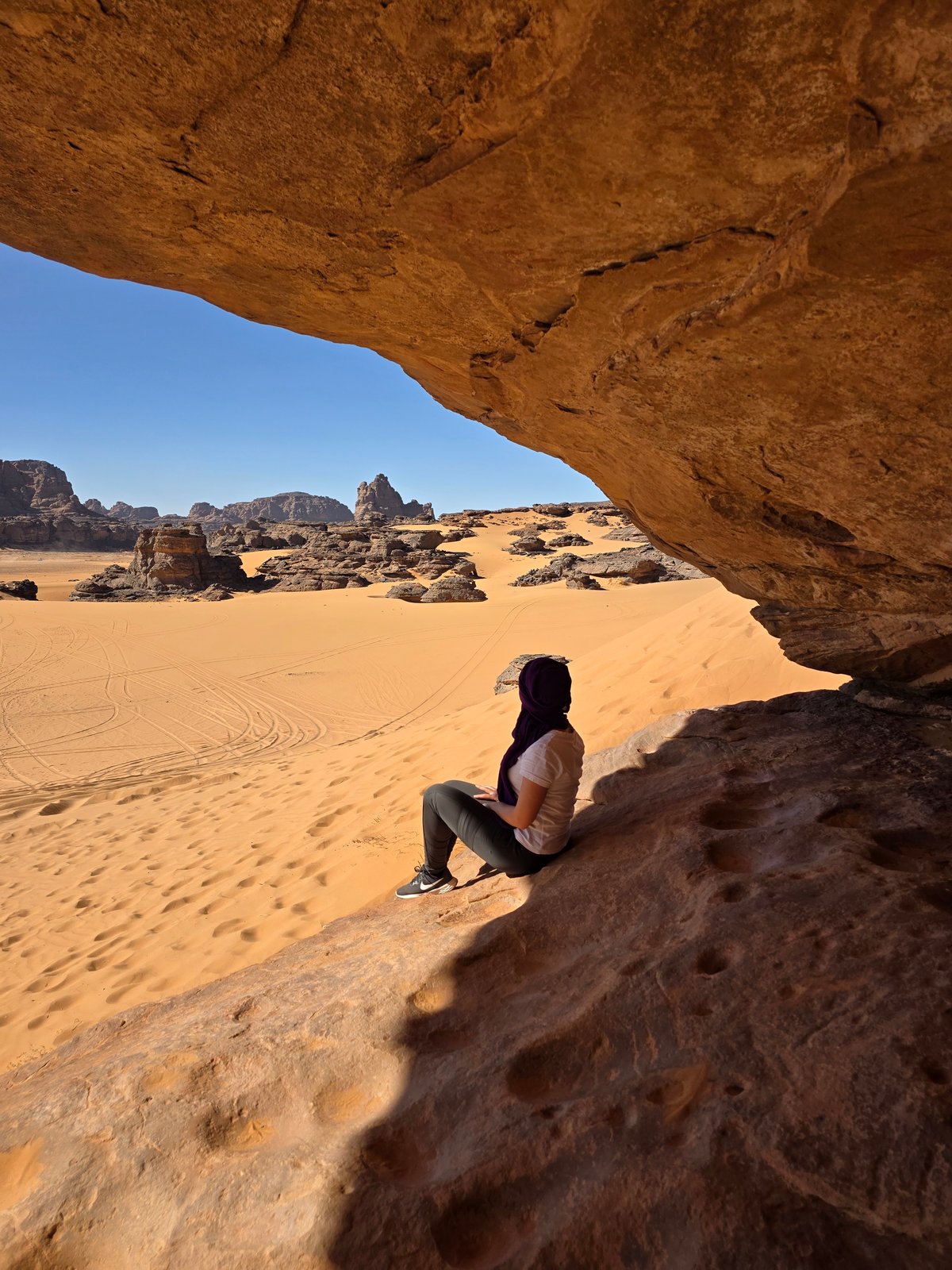
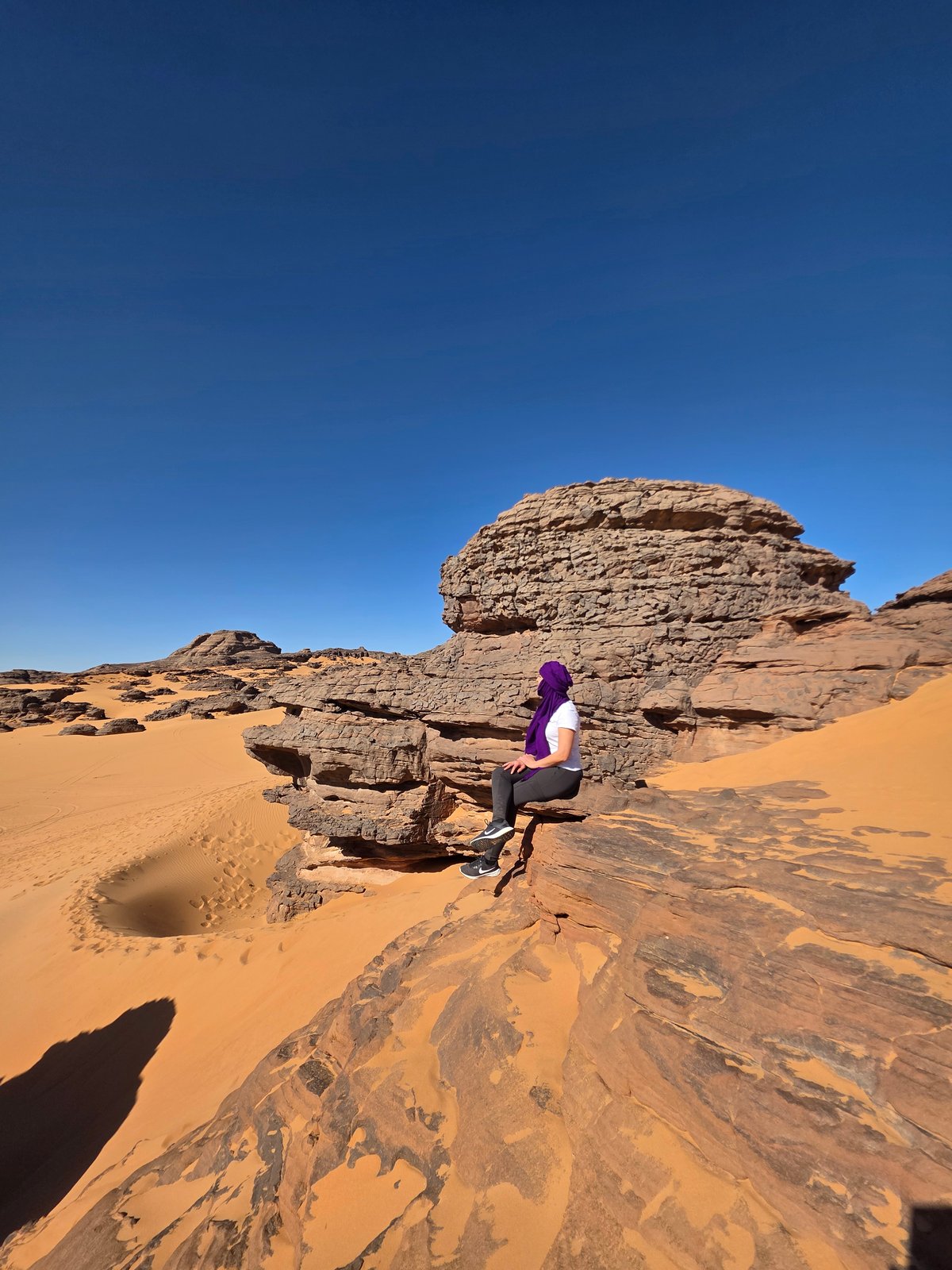
Under the arch · In the shade, facing the void · The sand turns orange
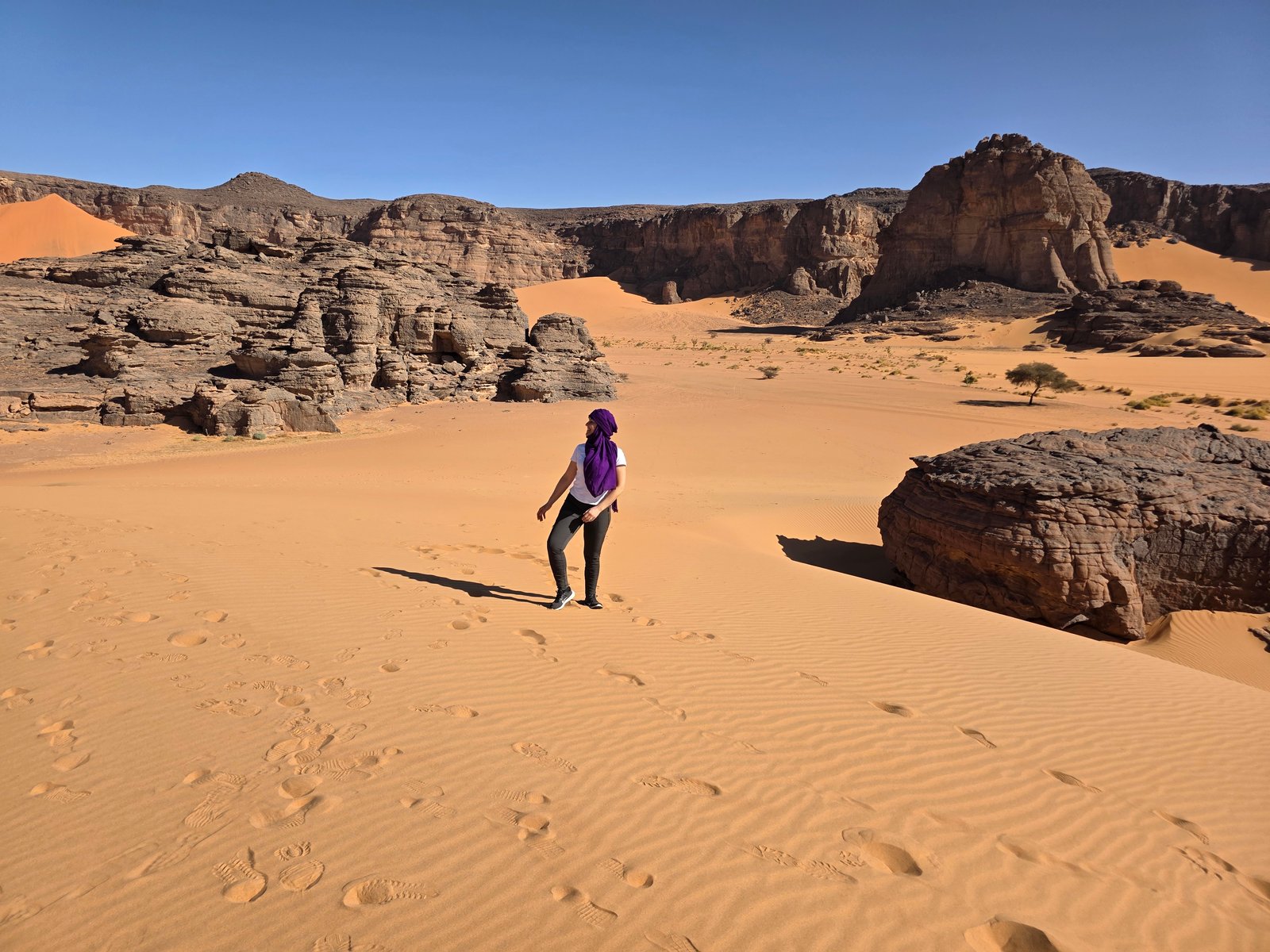
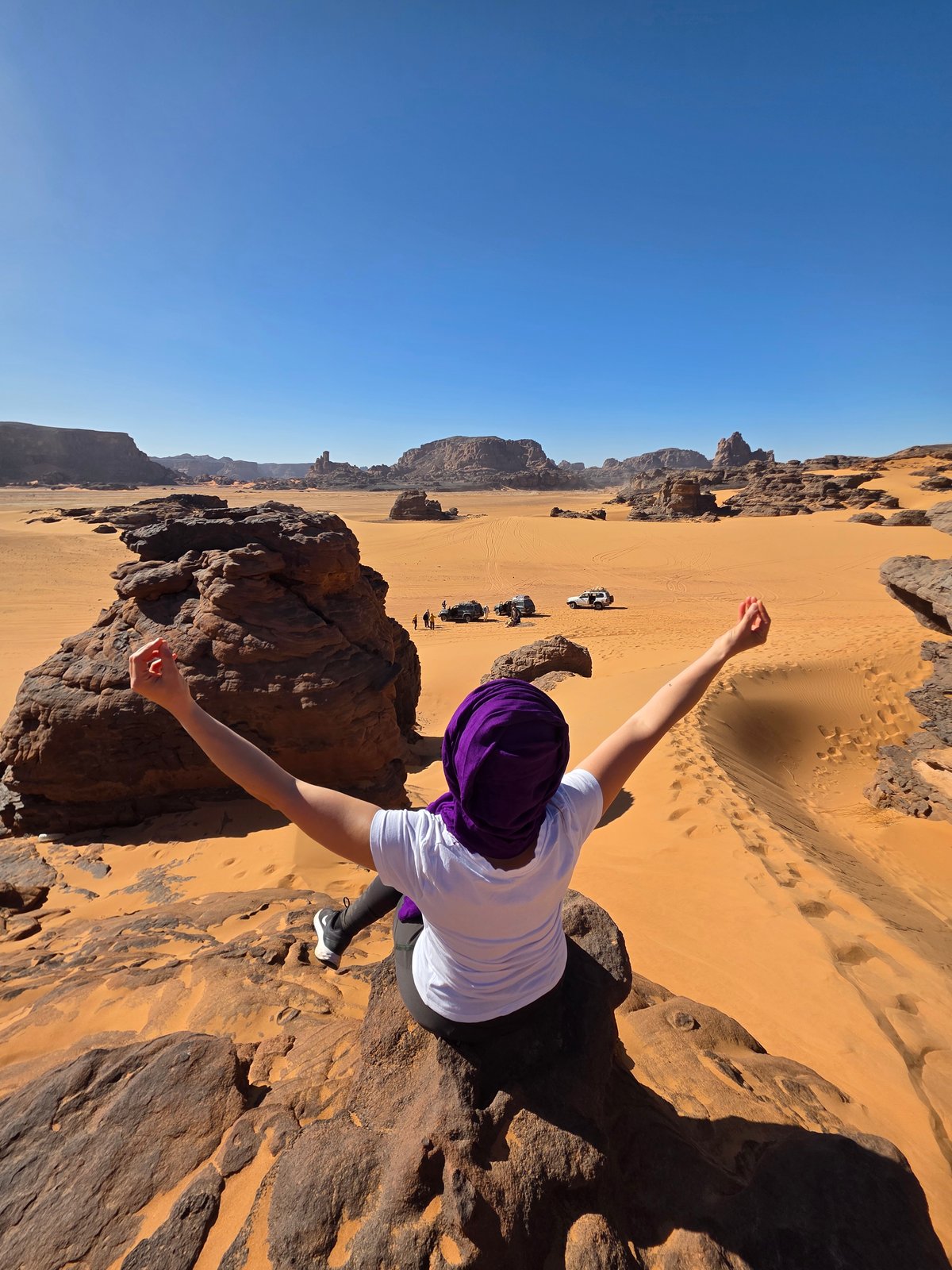
The orange desert, as far as the eye can see · Sculpted by the wind · And arms raised, for no particular reason
A little further, under an overhanging rock, ochre paintings: figures, animals, that it takes the guide's eye to spot.
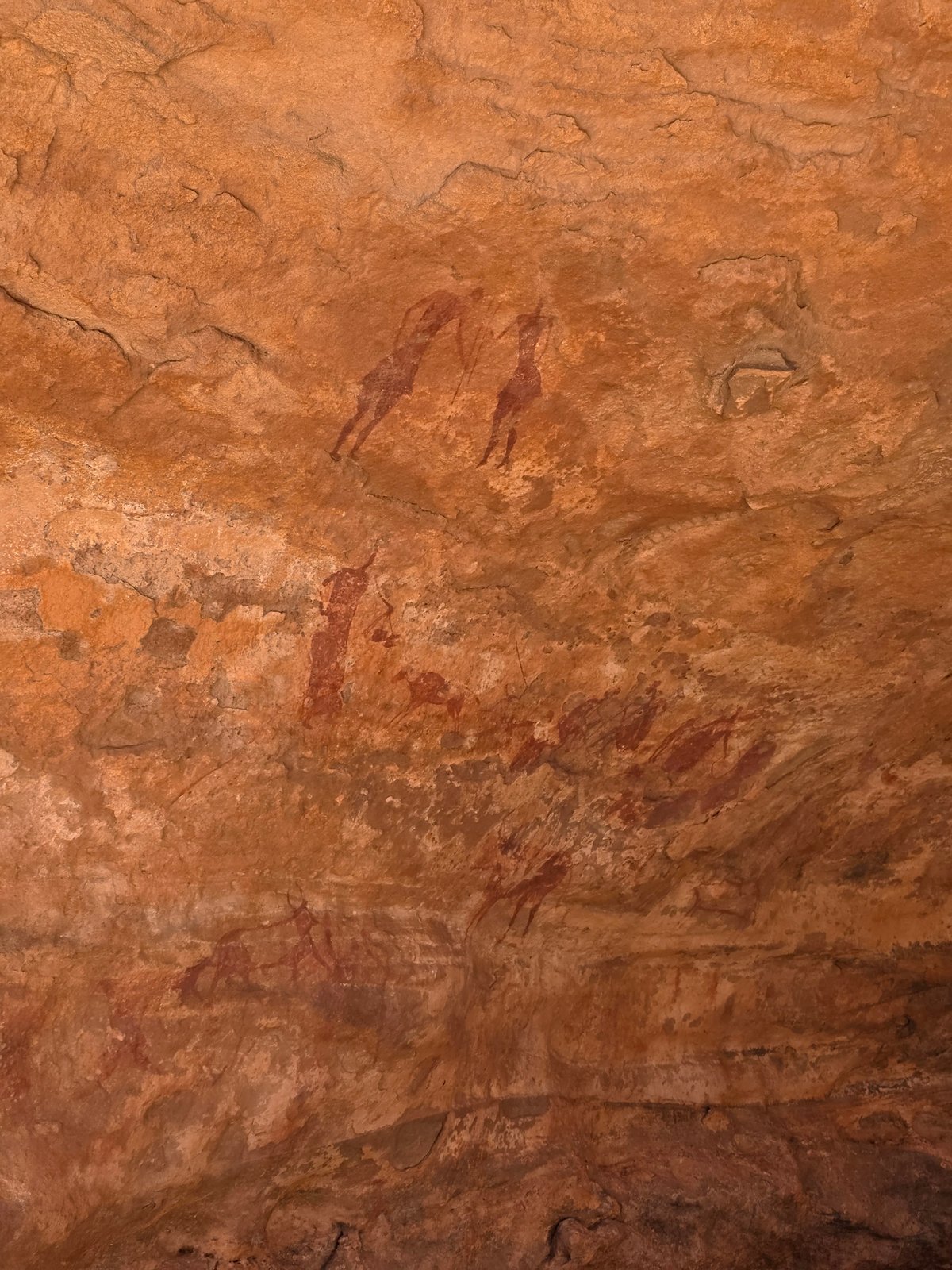
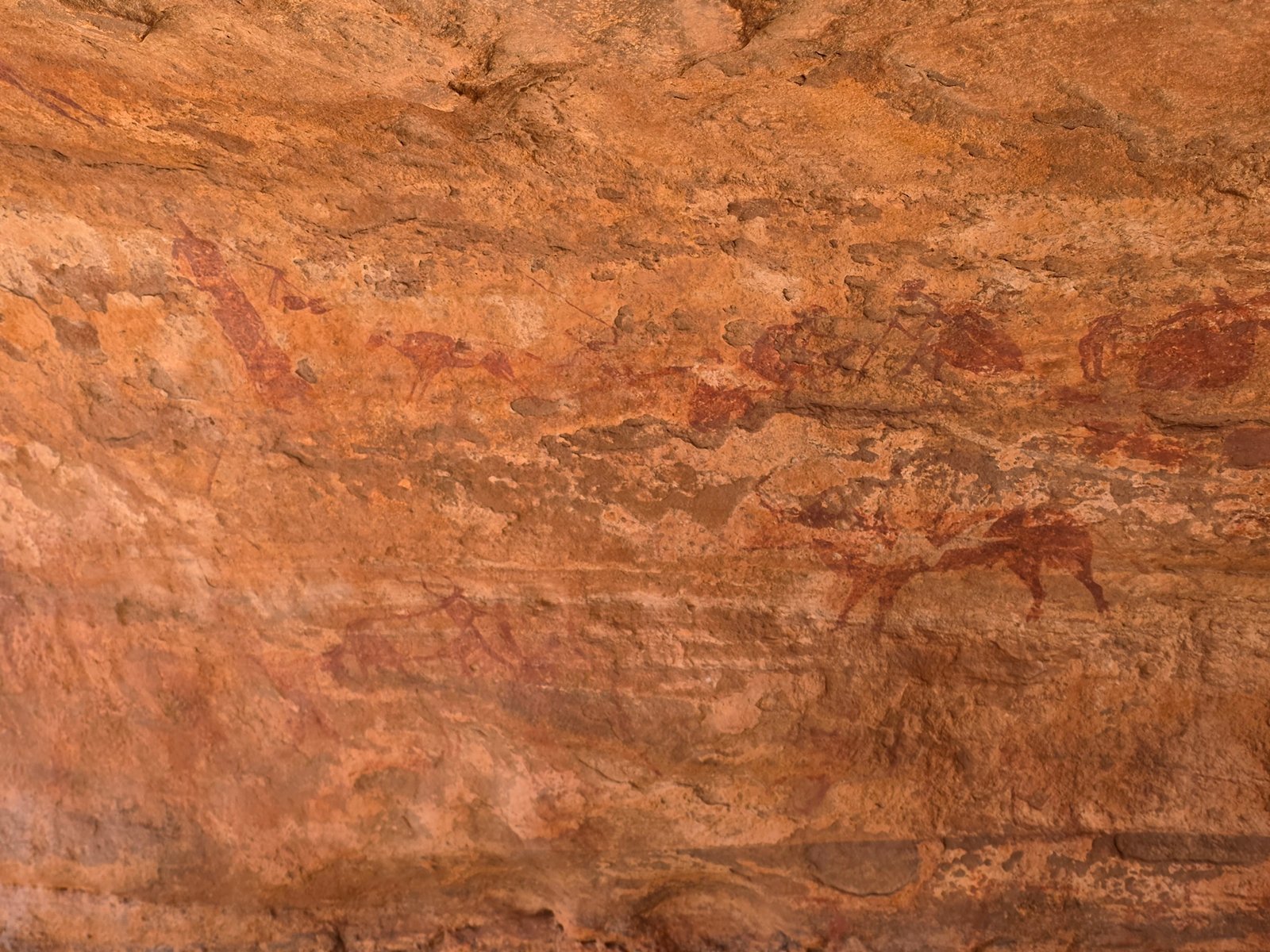
Ochre paintings, hidden under the rock
The rock where we met the most people
Late morning: a huge head-shaped rock, maybe the famous "hedgehog rock" the local guides talk about, though we're not entirely sure, with engravings and a painting on it, and for the first time on the trip, lots and lots of people. Several groups, several 4x4s parked in a star. After days of feeling almost alone in the world, that contrast feels a bit odd. All these people are here for the same thing: the rock's engravings.
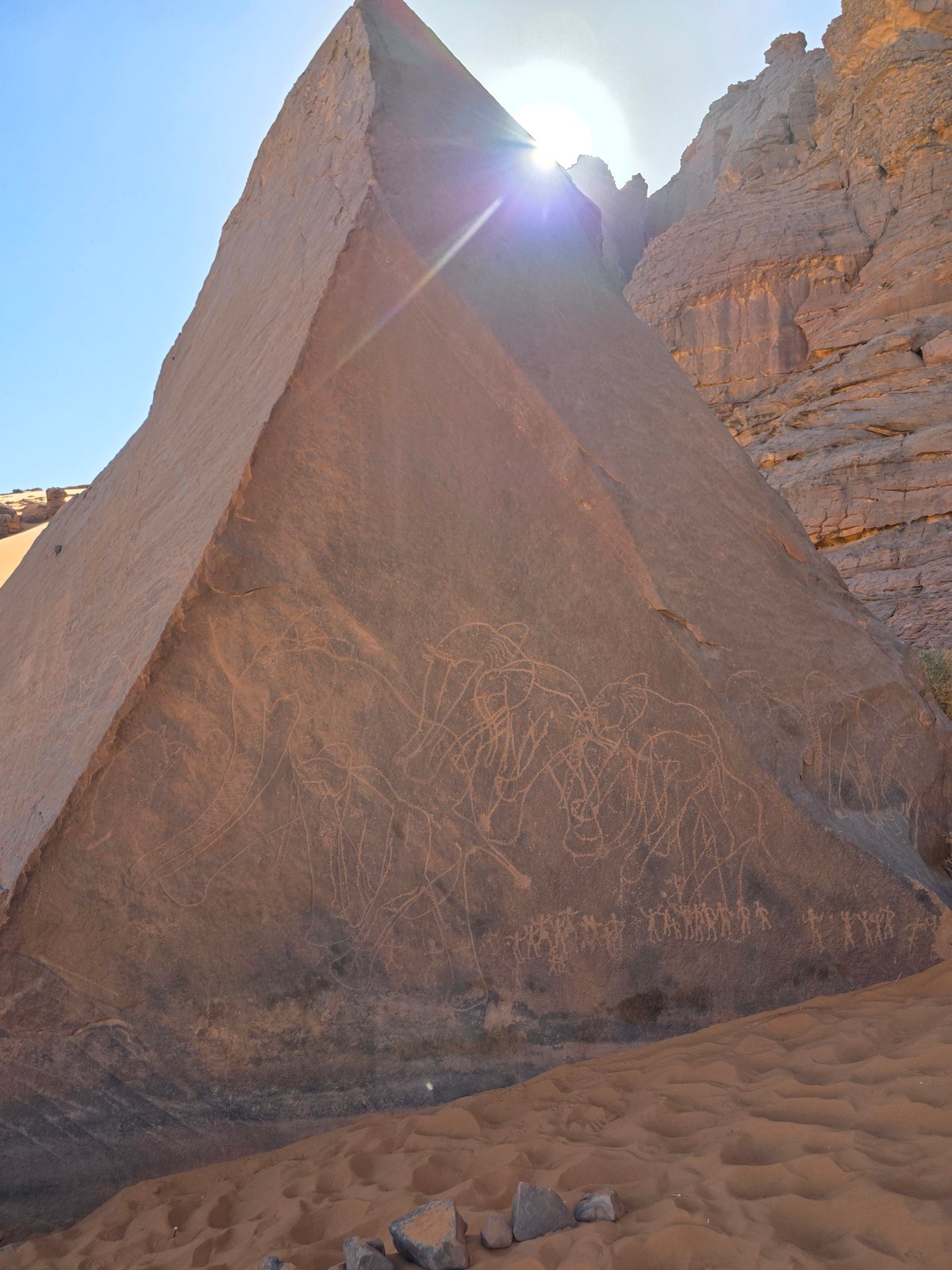
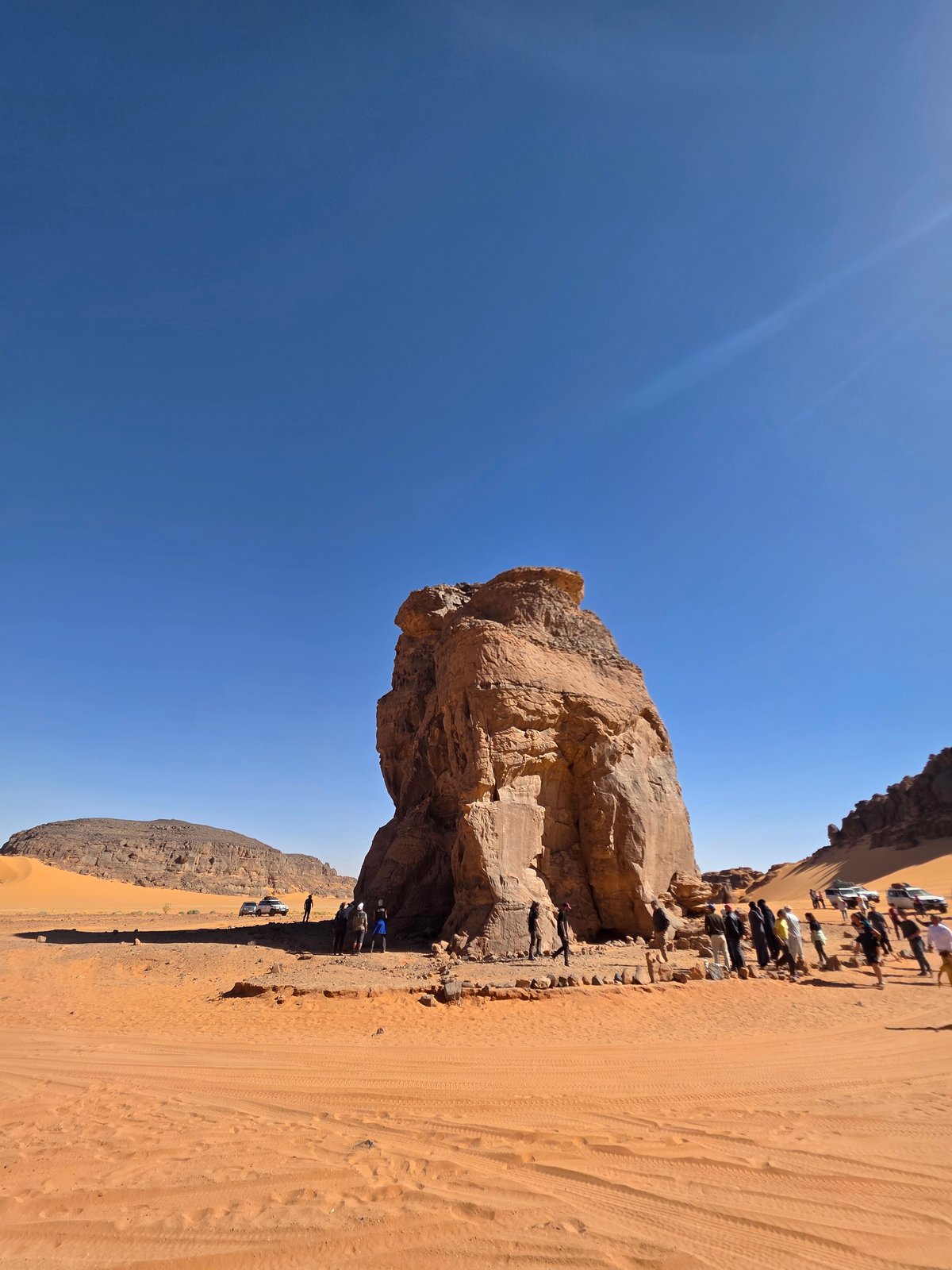
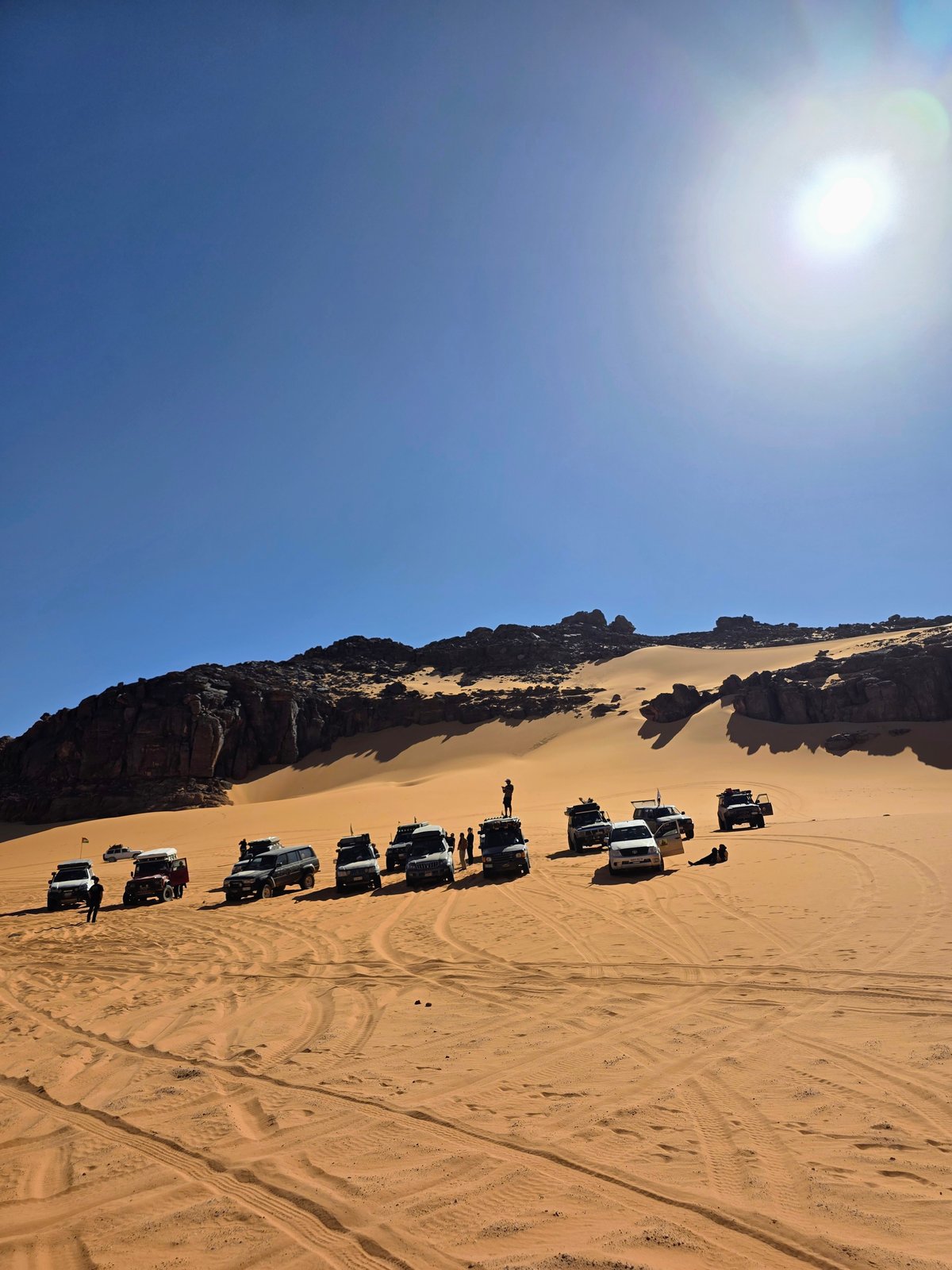
A large engraved slab, against the light · The head rock and its crowd · The 4x4s parked in a star at the foot of the dune
At one of the sites we come across a whole convoy of Italian and Corsican 4x4s, out for some dune bashing. A useful reminder: Djanet doesn't only attract the French-Algerian diaspora (most of our group); you hear every language here, at the end of the world.
Just before noon, another surprise: even the ground is engraved, circles and marks carved right into the slab.
A natural arch rises in the middle of nowhere. The guide tells us it looks like the map of Africa. We nod, politely.
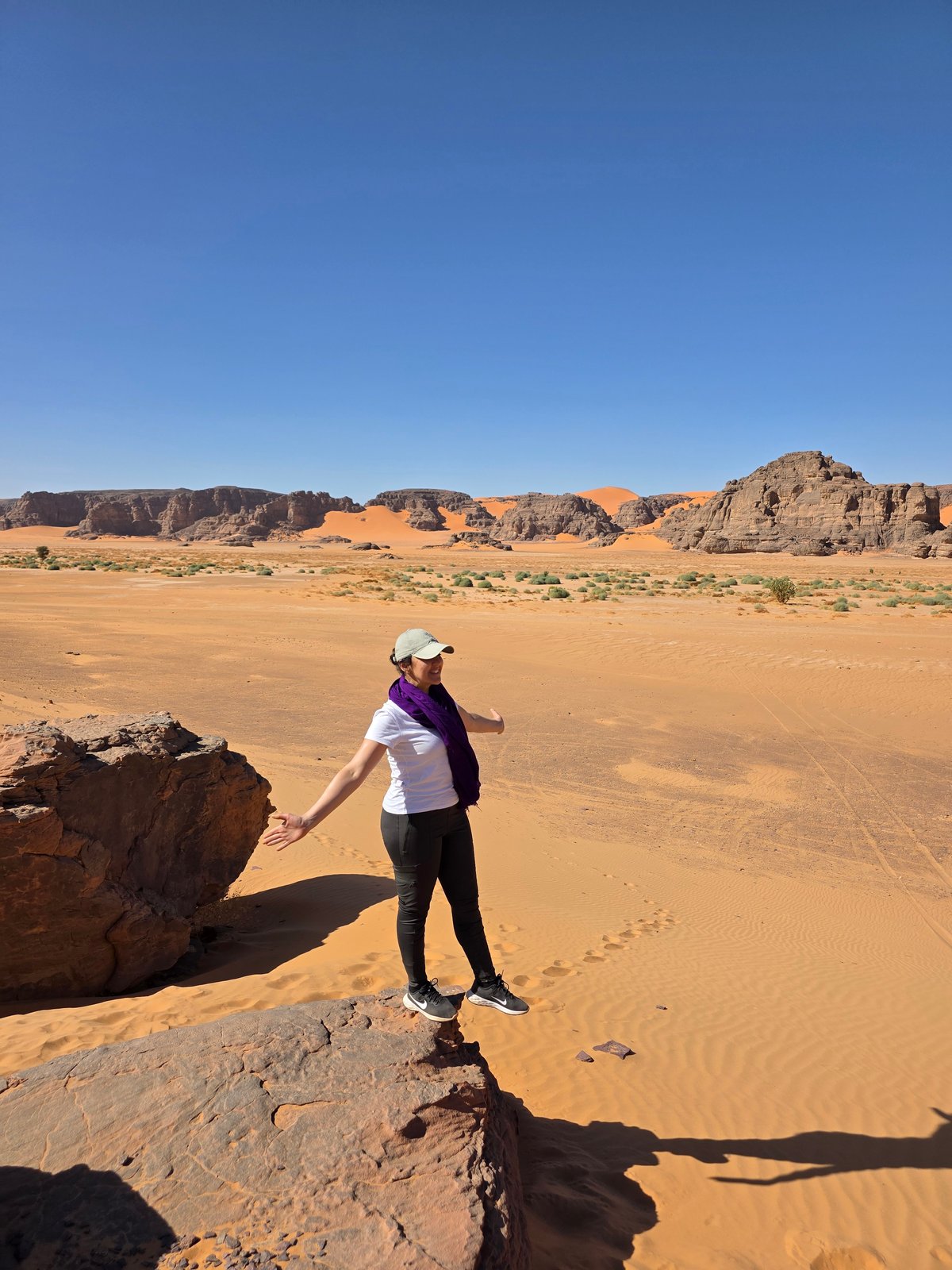
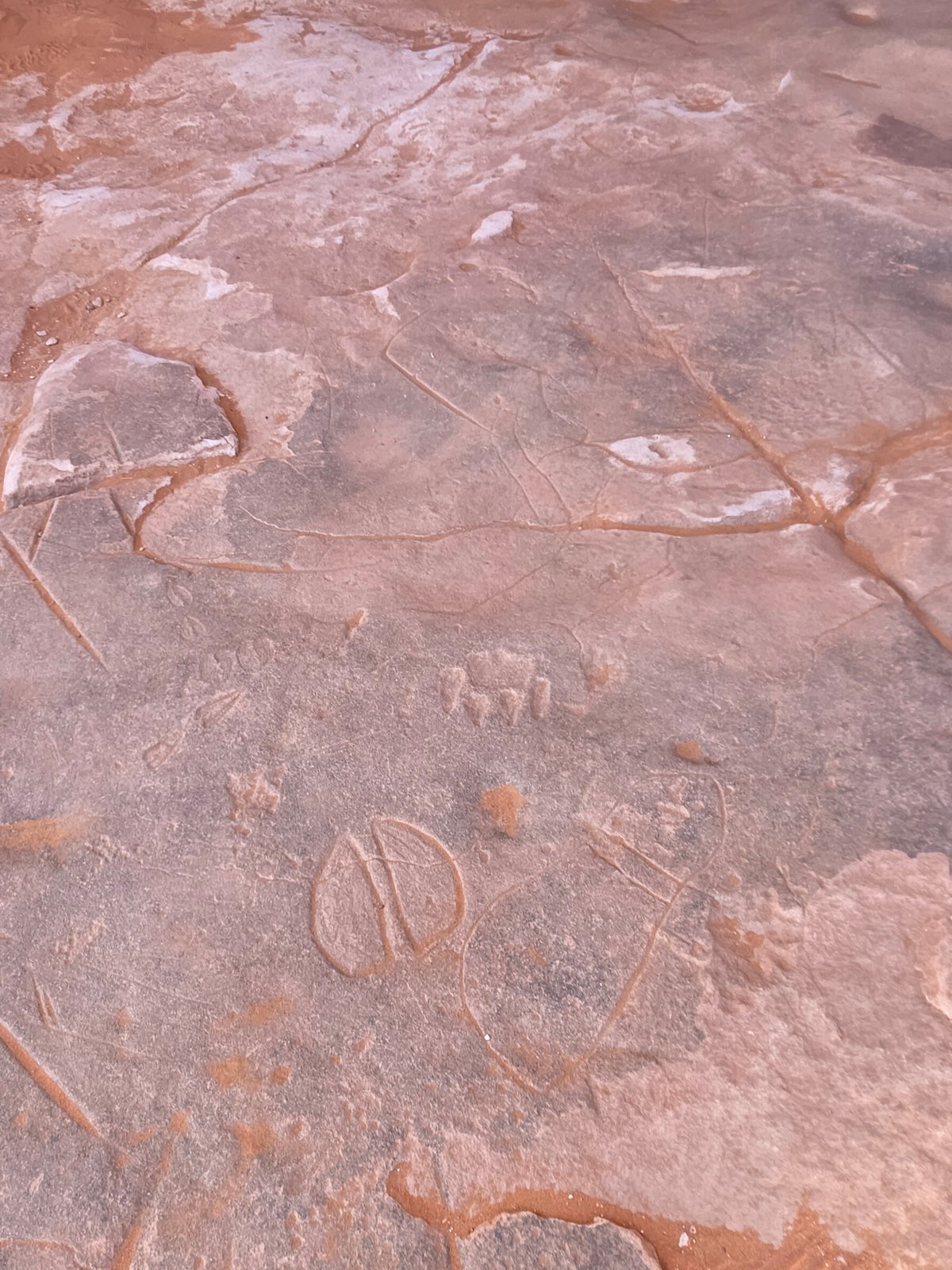
And right next to it, nobody at all · Even the ground is engraved
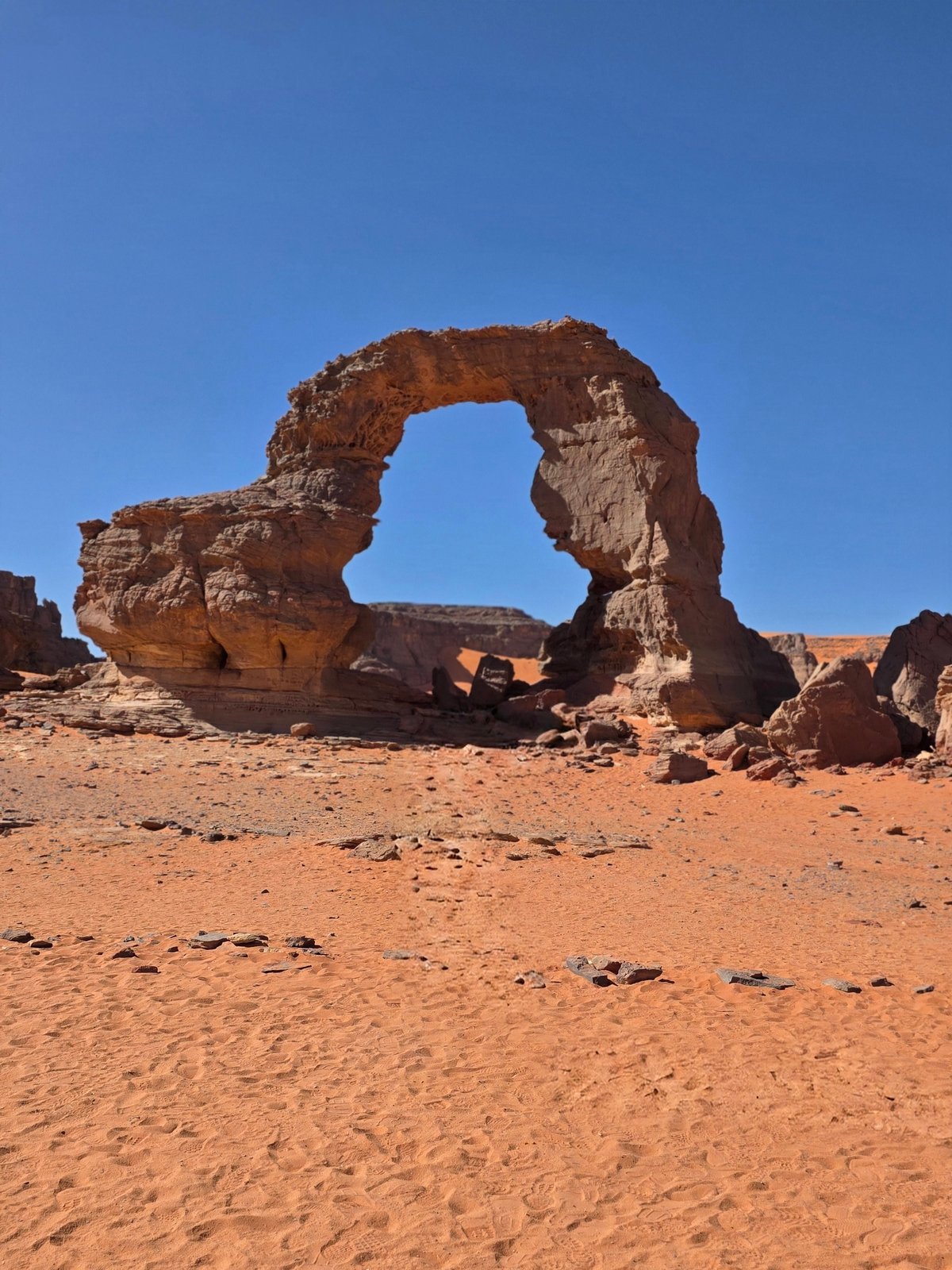
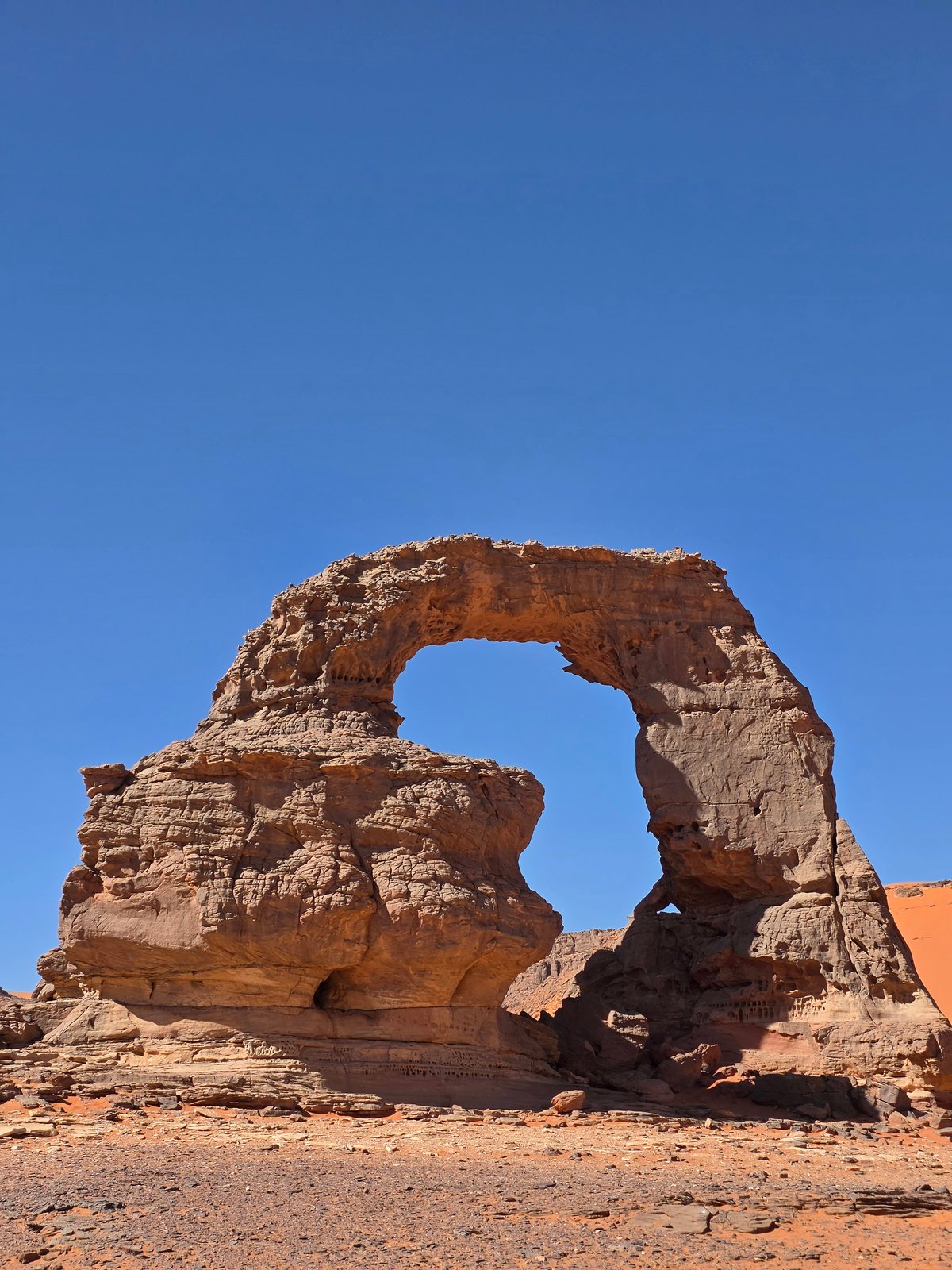
The map of Africa, according to the guide · Up close, we're still nodding
The midday break
An unpretentious photo, for the memory: my shadow stretched out on the orange sand, a foot sticking out of the frame. All around, mushroom-shaped rocks, and sand that gets in everywhere.
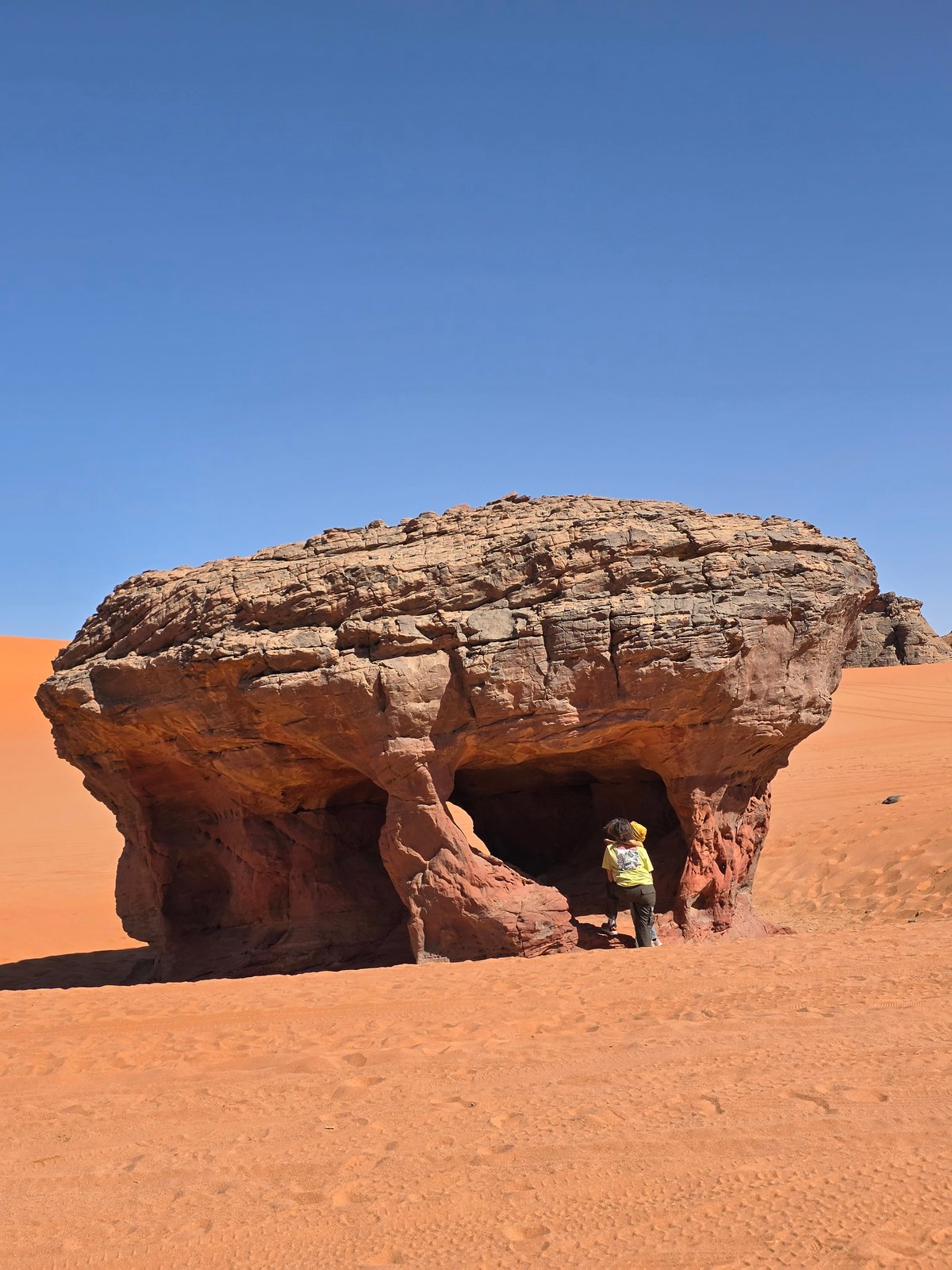
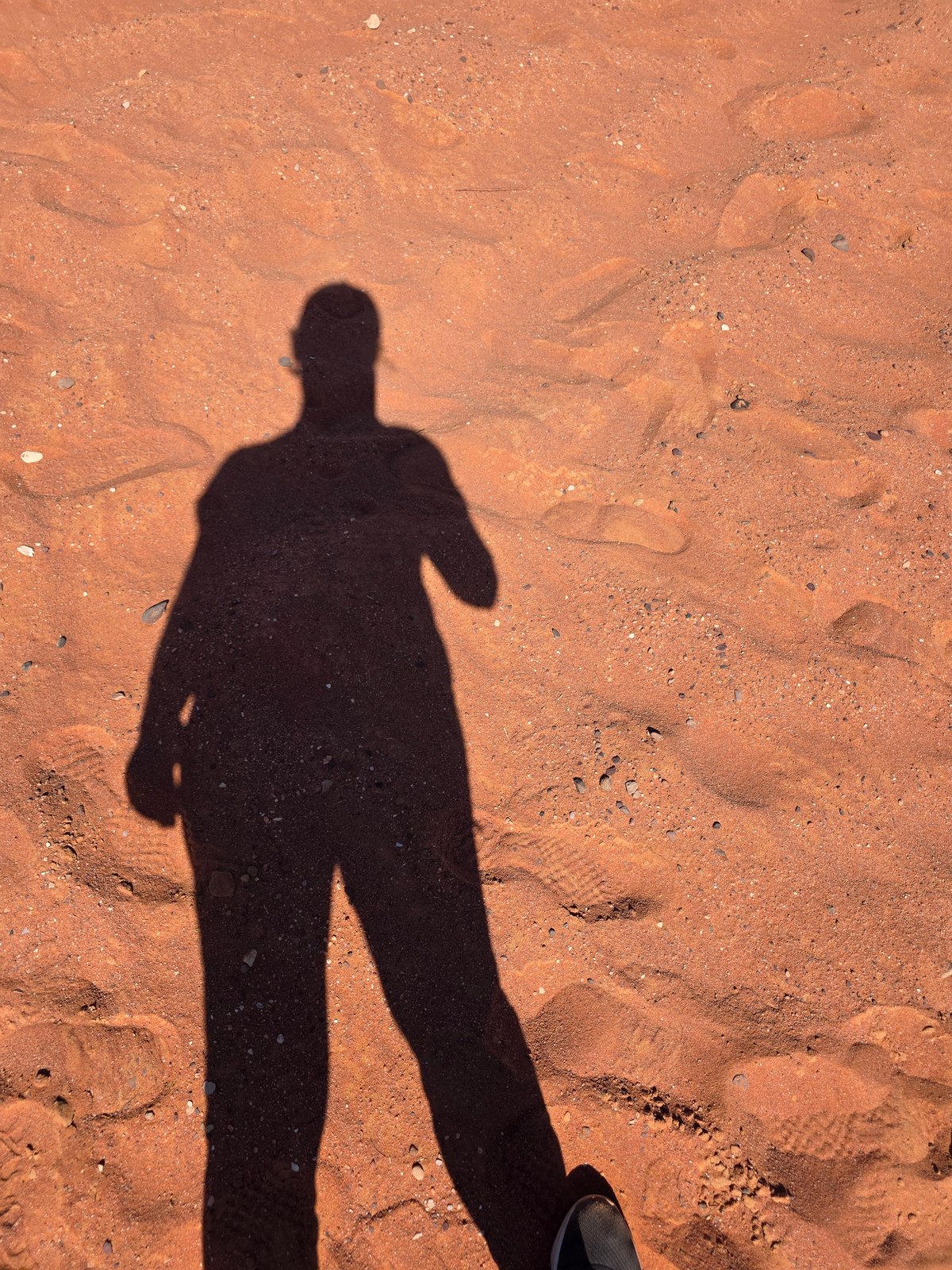
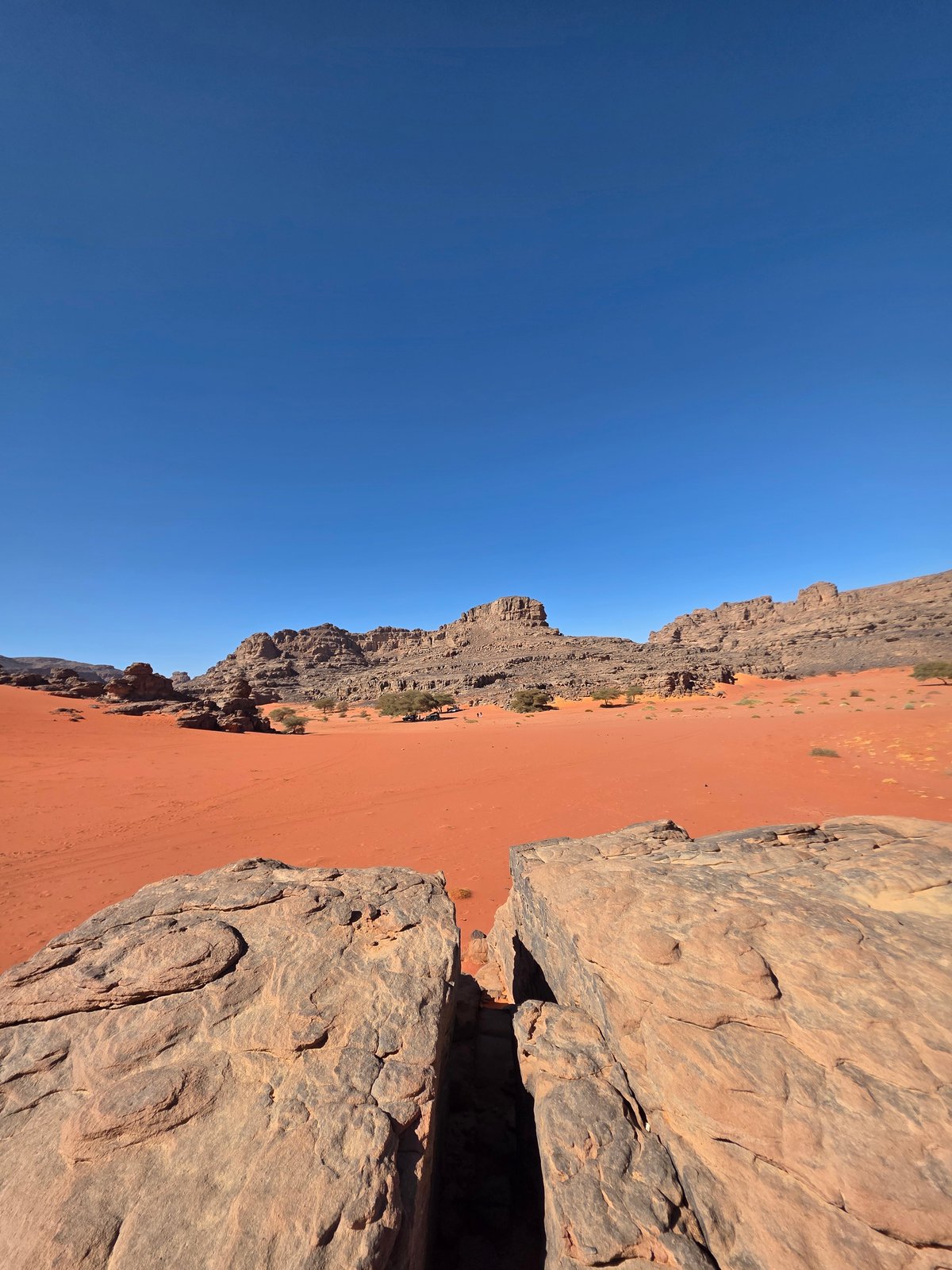
The mushroom rock · My shadow, a foot sticking out · The sand gets in everywhere · The scale, once again
In the afternoon, more paintings
On another wall, more paintings: domesticated animals this time, held on a lead by standing figures. The Sahara changed its face several times before becoming the one we know.
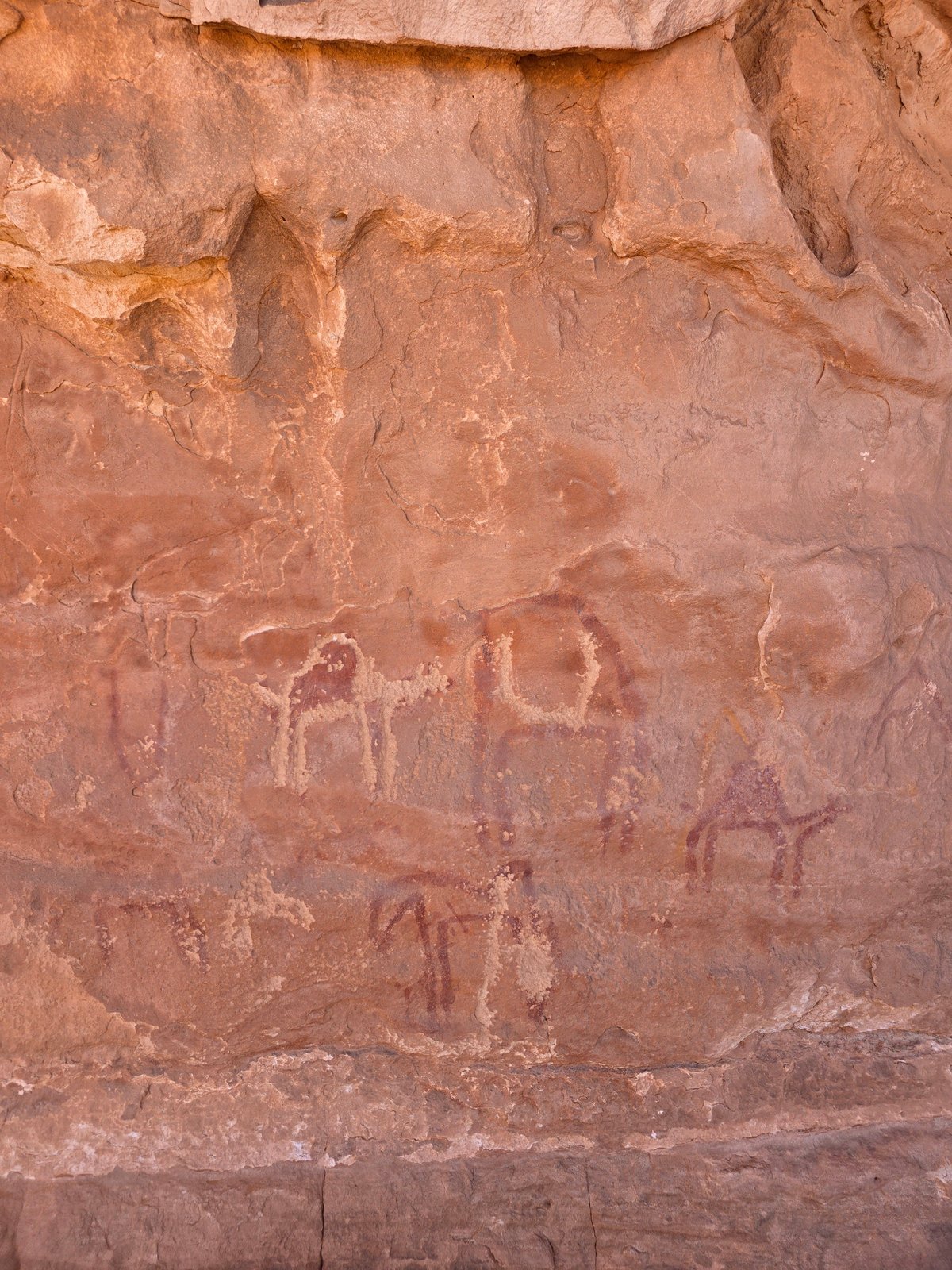
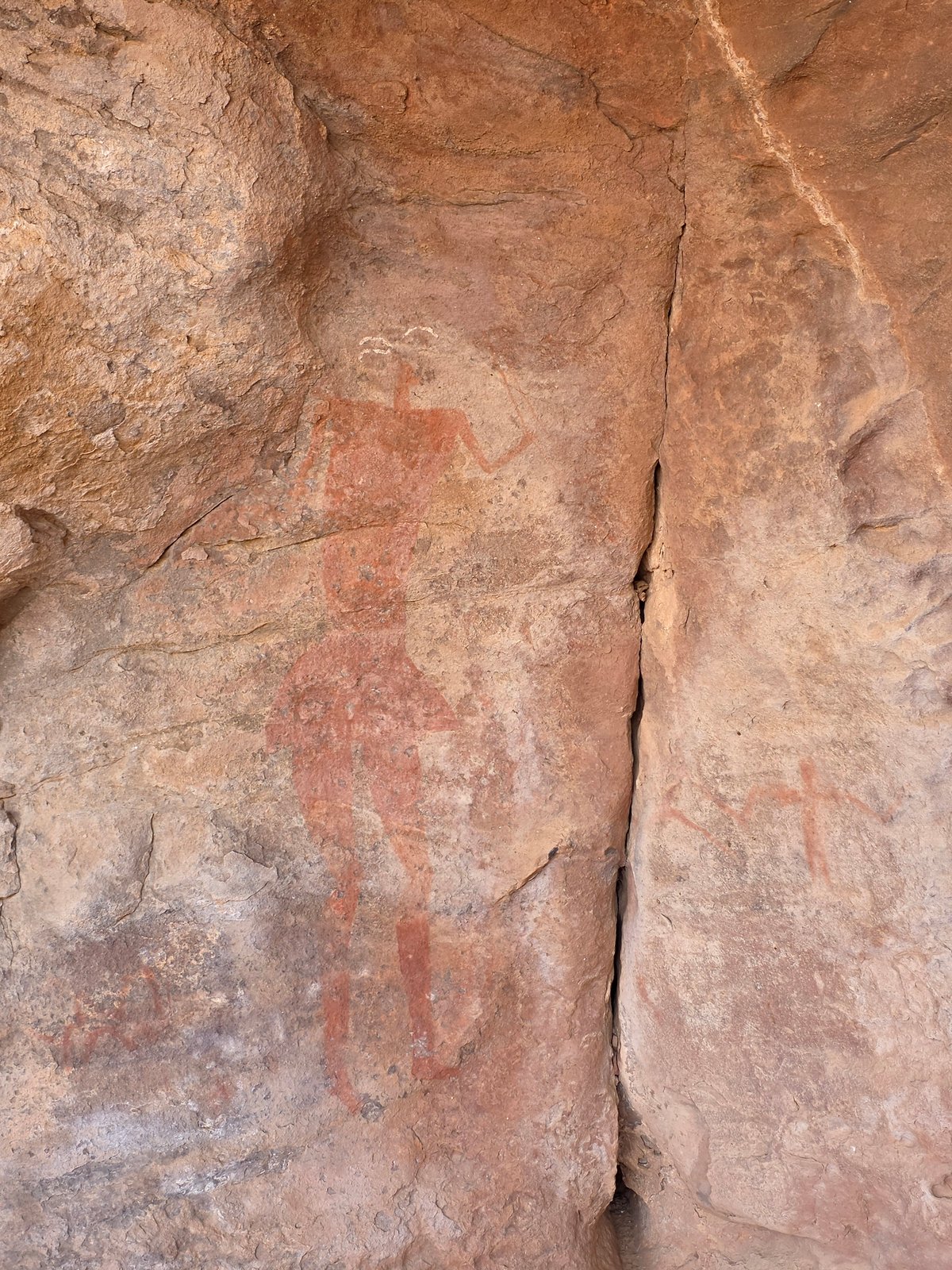
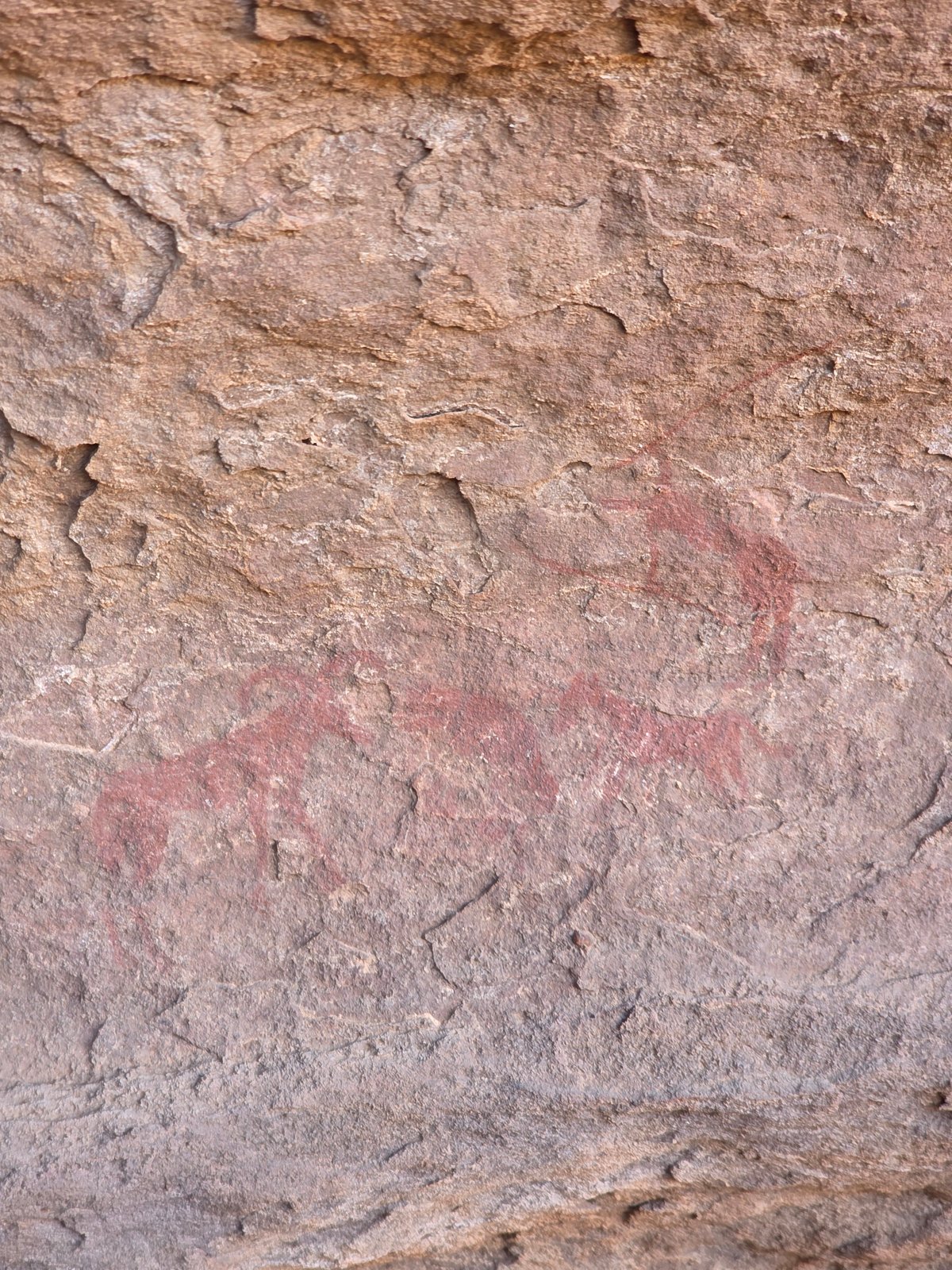
Painted camels · A figure with raised arms · A frieze of animals
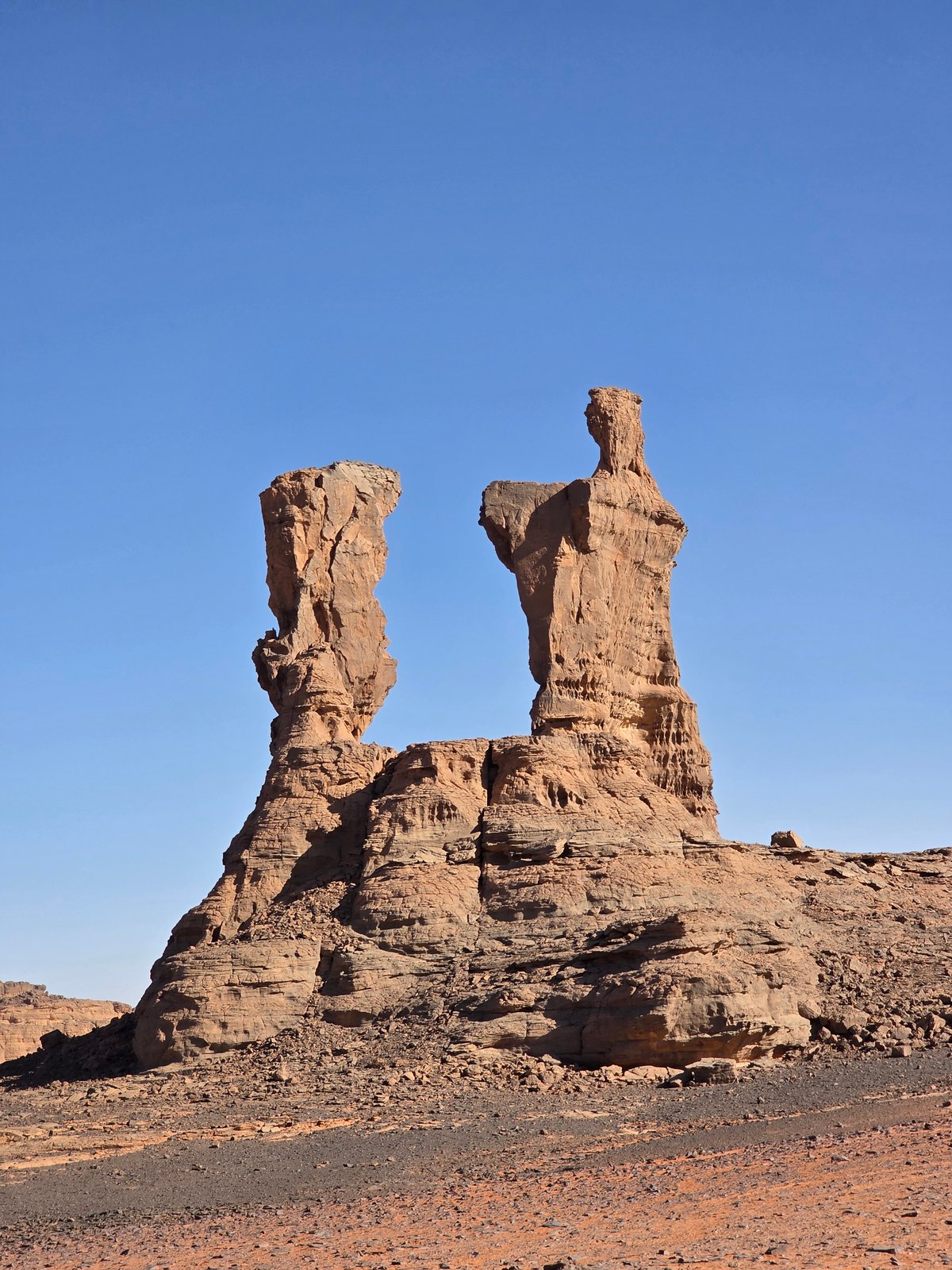
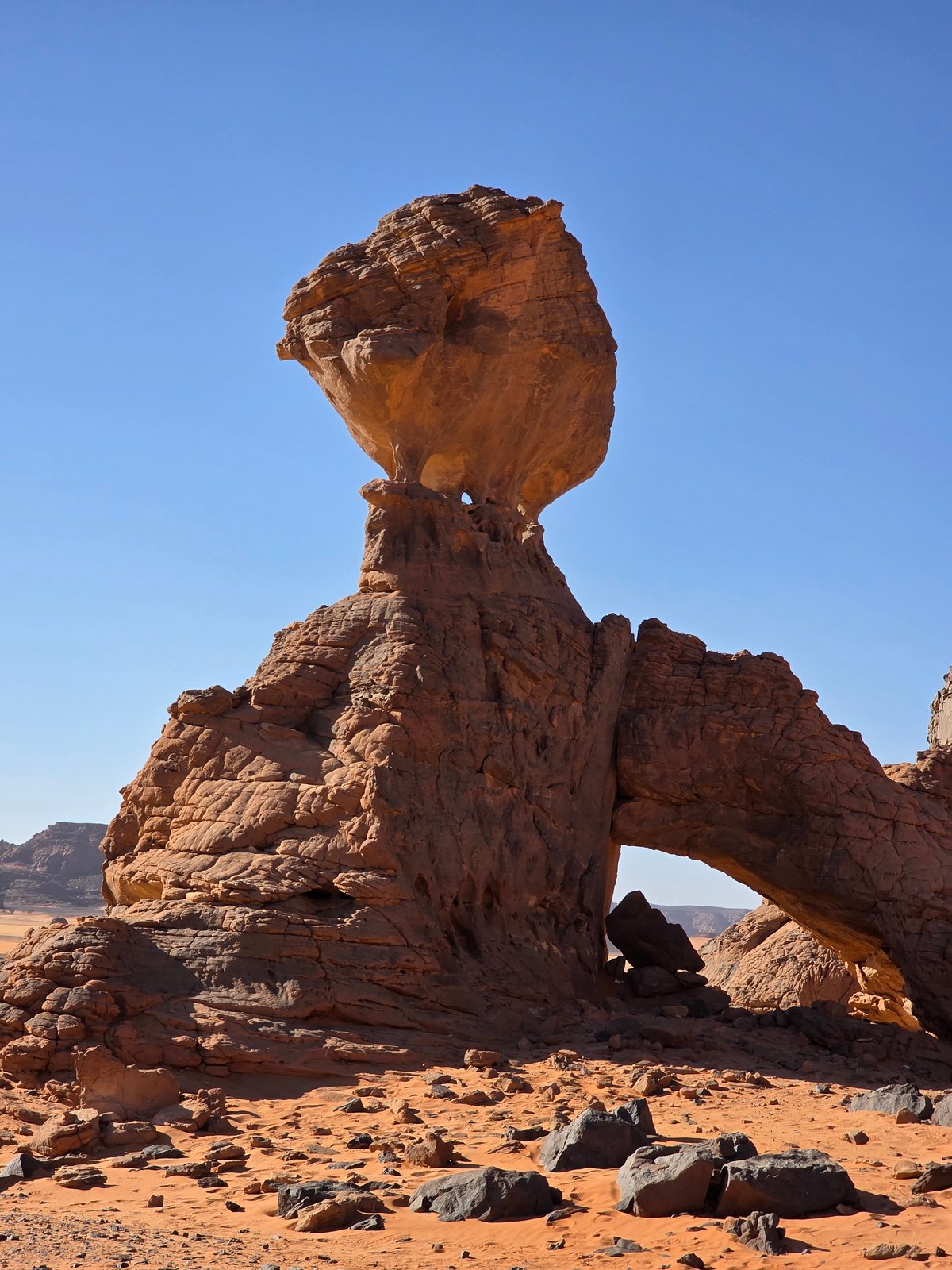
The twin towers · The squirrel (yes, really)
The guides give nicknames to almost every striking rock: a squirrel, a map of Africa, a head. Don't insist on a perfect resemblance: the fun is in the story you're told, not in geometric validation.
Later, the Tuareg show us something else: an orange stone that you rub against another one and that turns into pigment, natural terracotta, applied straight onto the face. The kind of product that costs a fortune for a few grams back home, and here it's lying around on the ground, in abundance. Naturally, all the women in the group started collecting stones.
Before filling your pockets with stones, sand or any other mineral souvenir: Algerian customs are very strict about what you can take out of the desert. Nothing is guaranteed; ask the Tuareg themselves before you leave, they often know what goes through and what doesn't.
Tin Merzouga
The afternoon brings us to the foot of a huge dune amphitheatre: the Tin Merzouga erg and its giant dunes, among the highest in the region. Seen from below, it looks almost reasonable. It isn't.
Tin Merzouga is the erg (the sea of dunes) where the In Djaren wadi, the most important in the Tadrart, flows out. Its dunes are among the highest in the region, and it's a must-see stop on every tour.
Climbing to the top takes a bit of real fitness. The sand slides with every step, especially on the first stretch, the hardest of all. Many in the group gave up before the summit. Take water, allow time, and don't feel guilty if you stop on the way: the view is beautiful at any height.
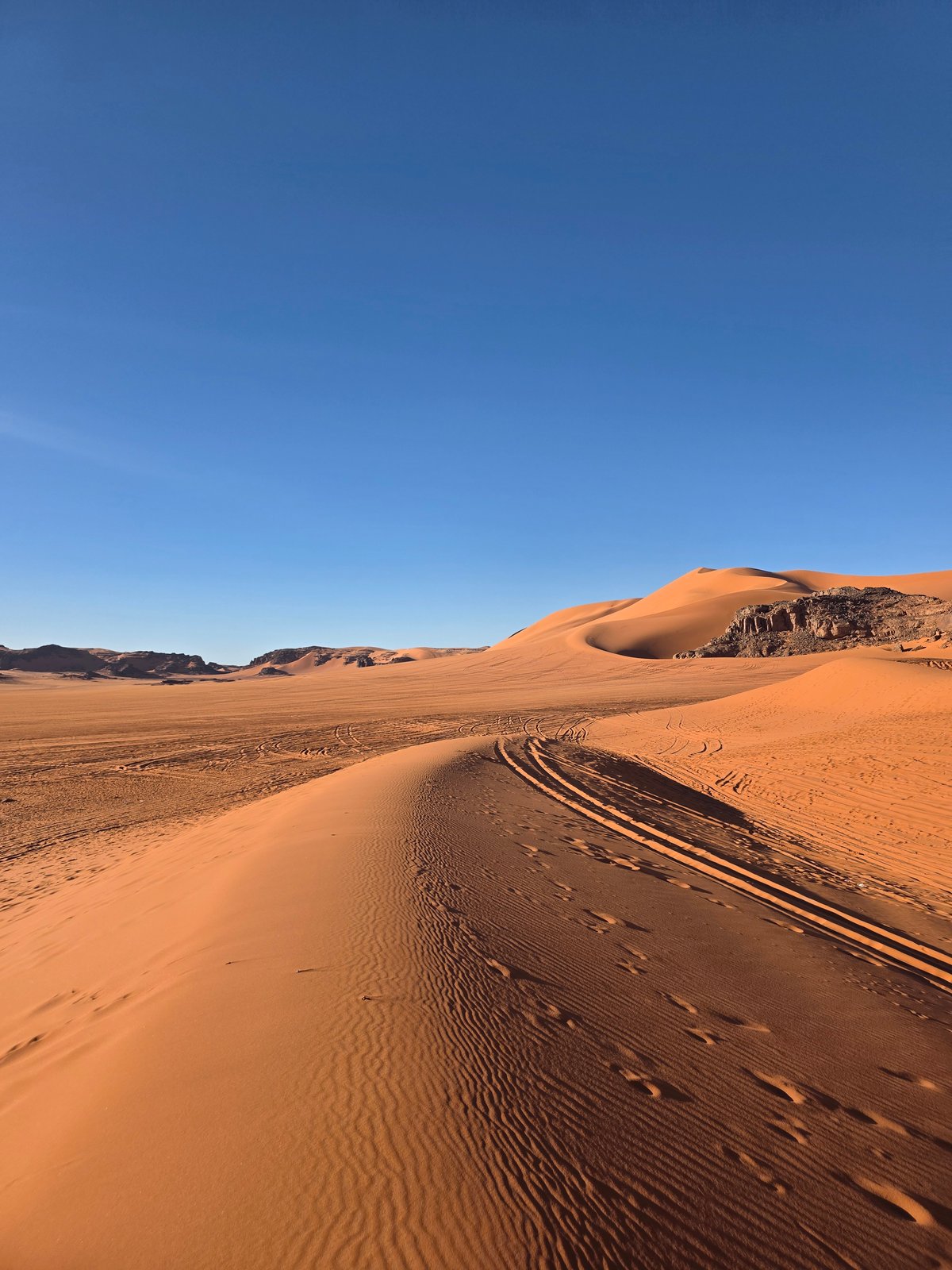
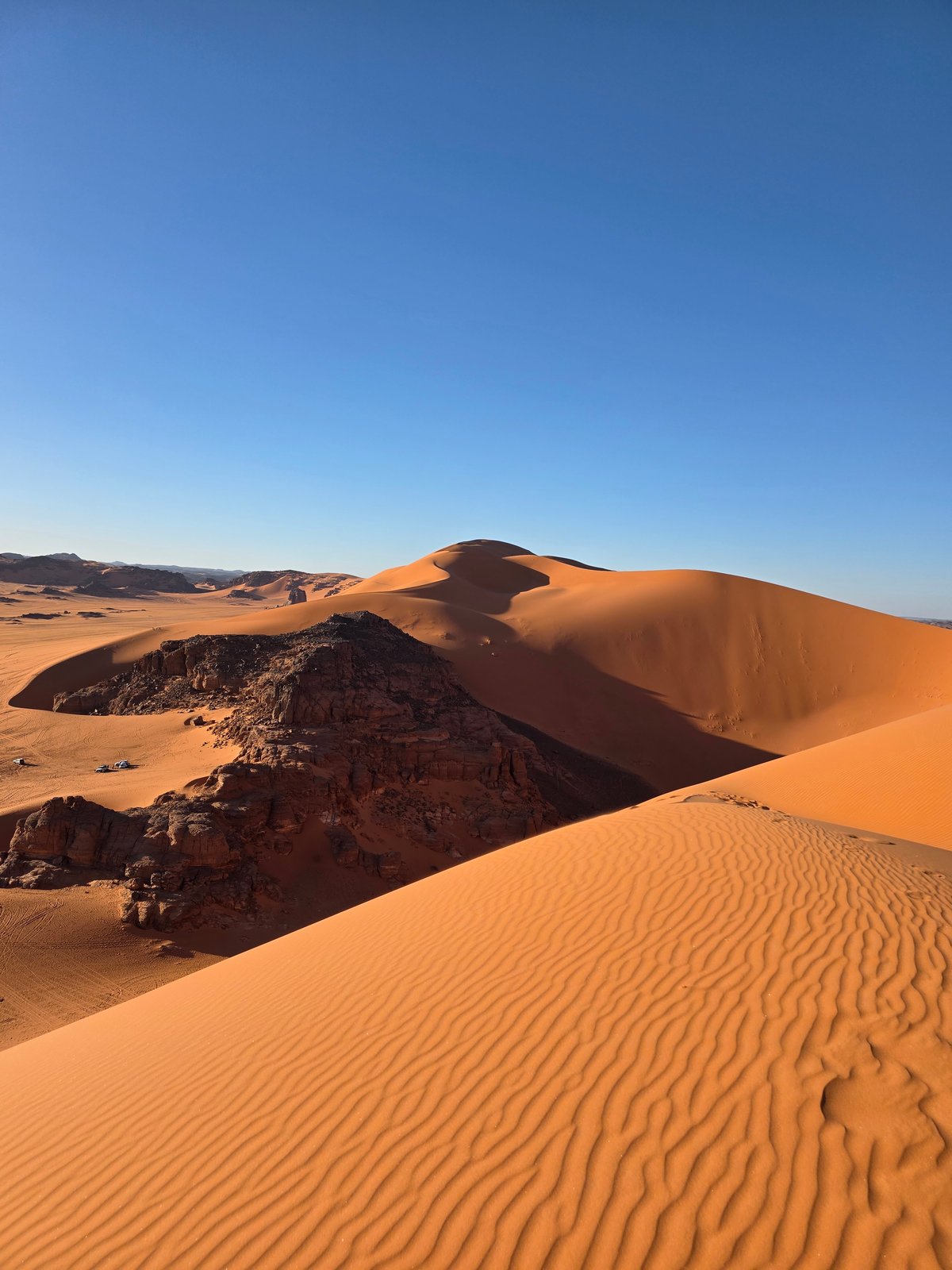
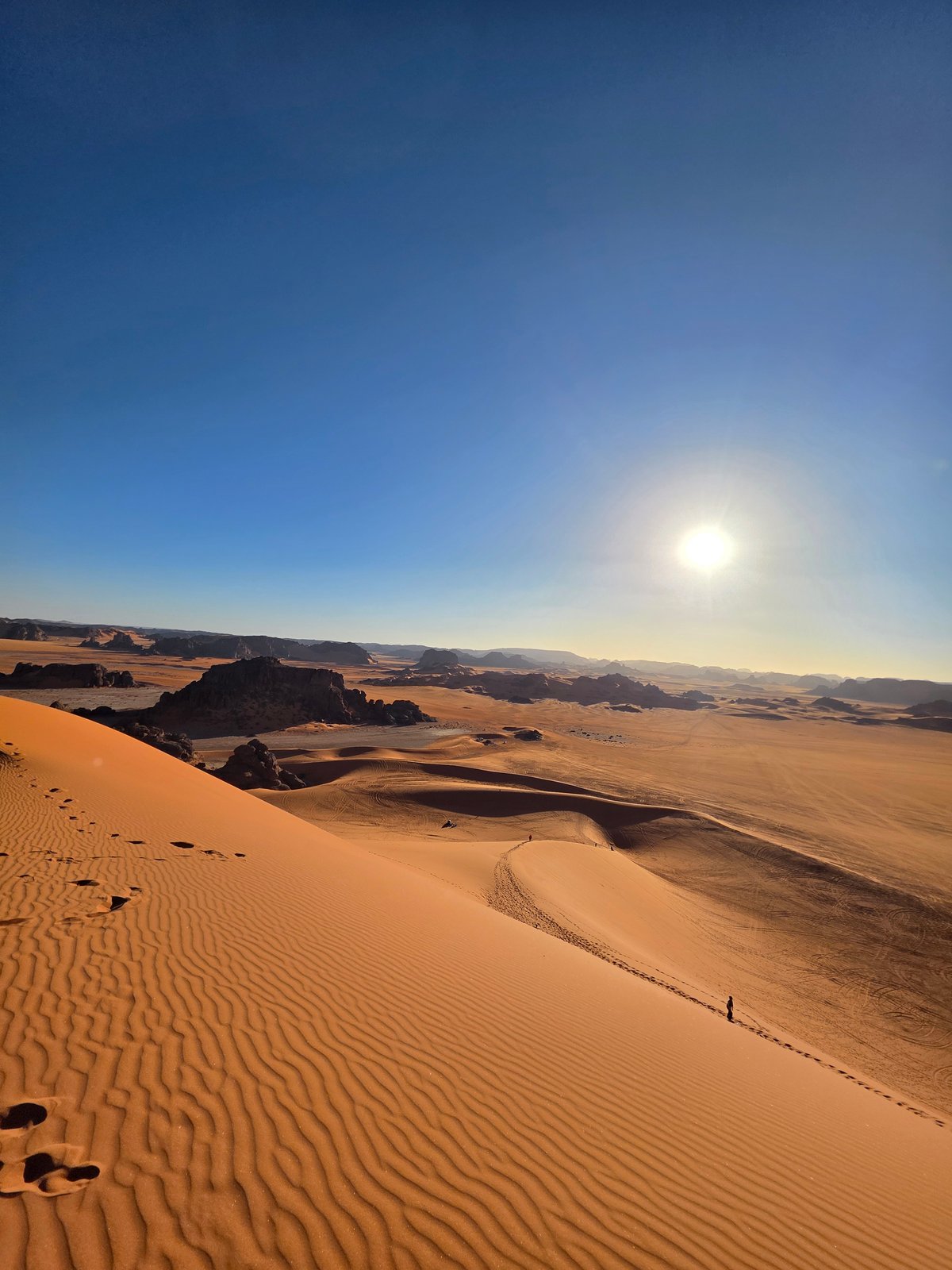
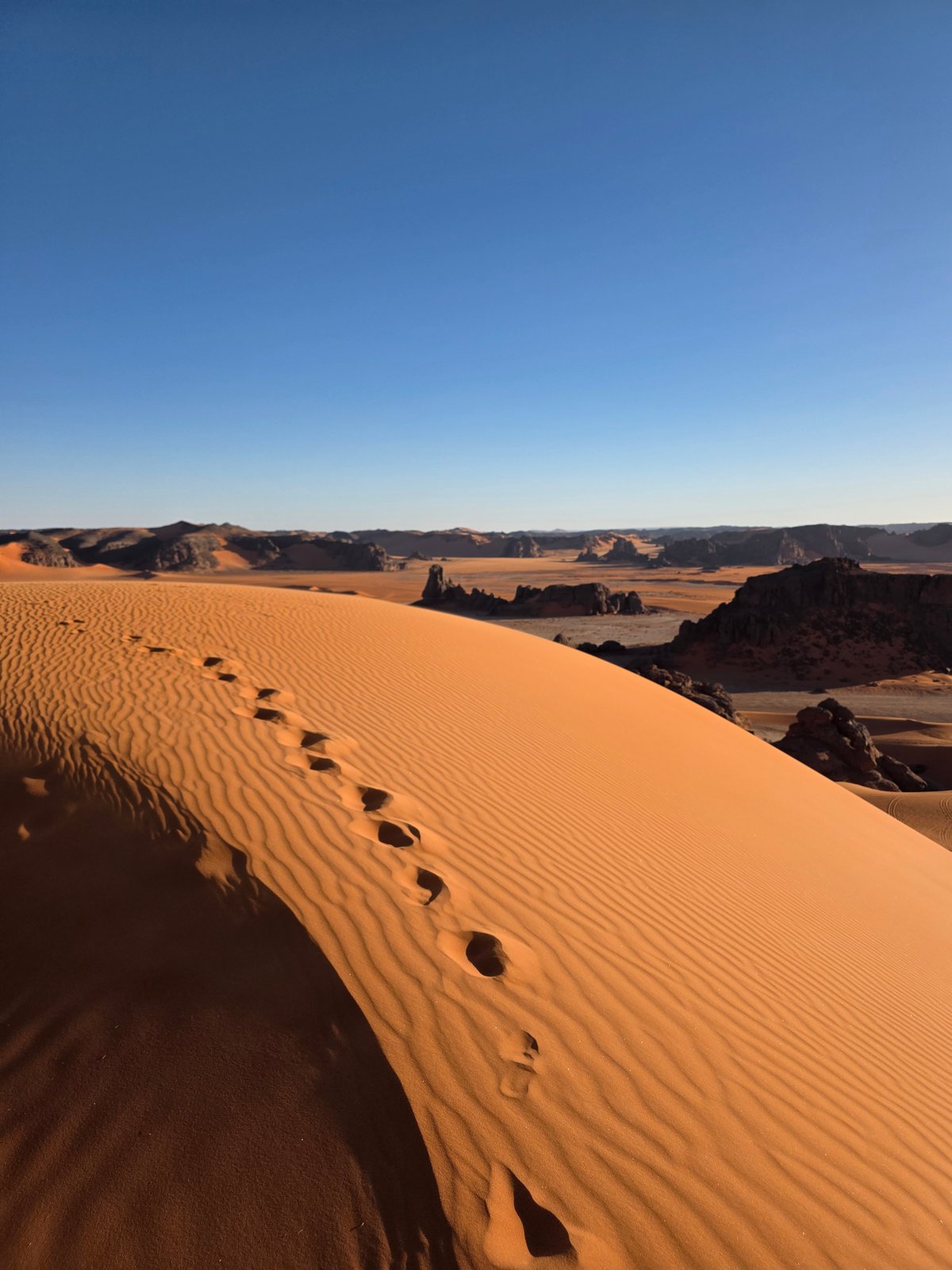
The ridge and its tracks · At the foot of Tin Merzouga · The sun already low · Footsteps on the ridge
Someone in the group had thought of bringing an Algerian flag. Spread out on the crest, with dunes as far as the eye can see behind it, a little wink that says a lot about this group, almost all of them rediscovering their own country.
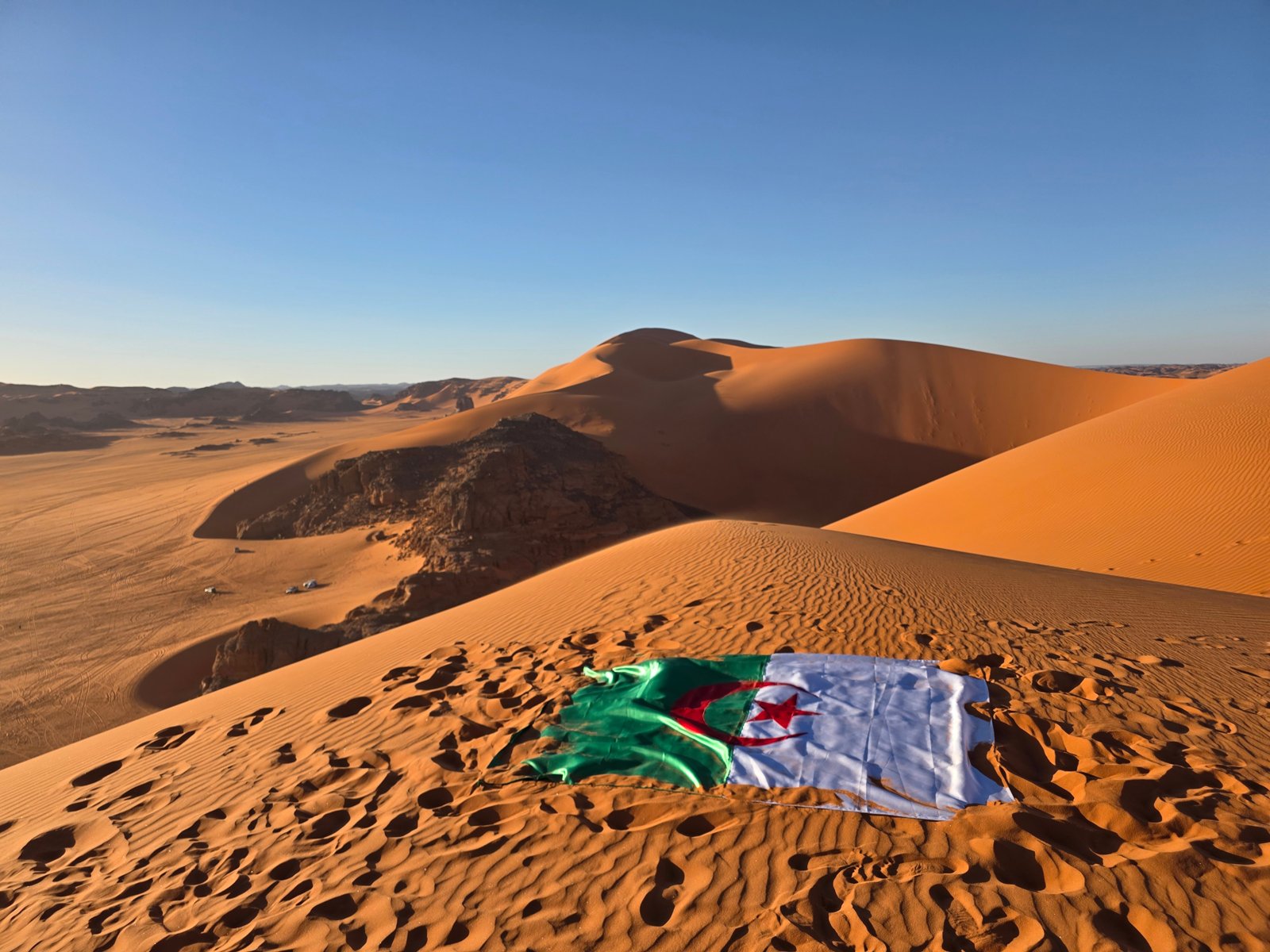
The flag on the crest, and dunes as far as the eye can see
Then the summit. And there, not a word. The sun goes down over miles of red dunes and black rocks, and for a few minutes nothing else exists.
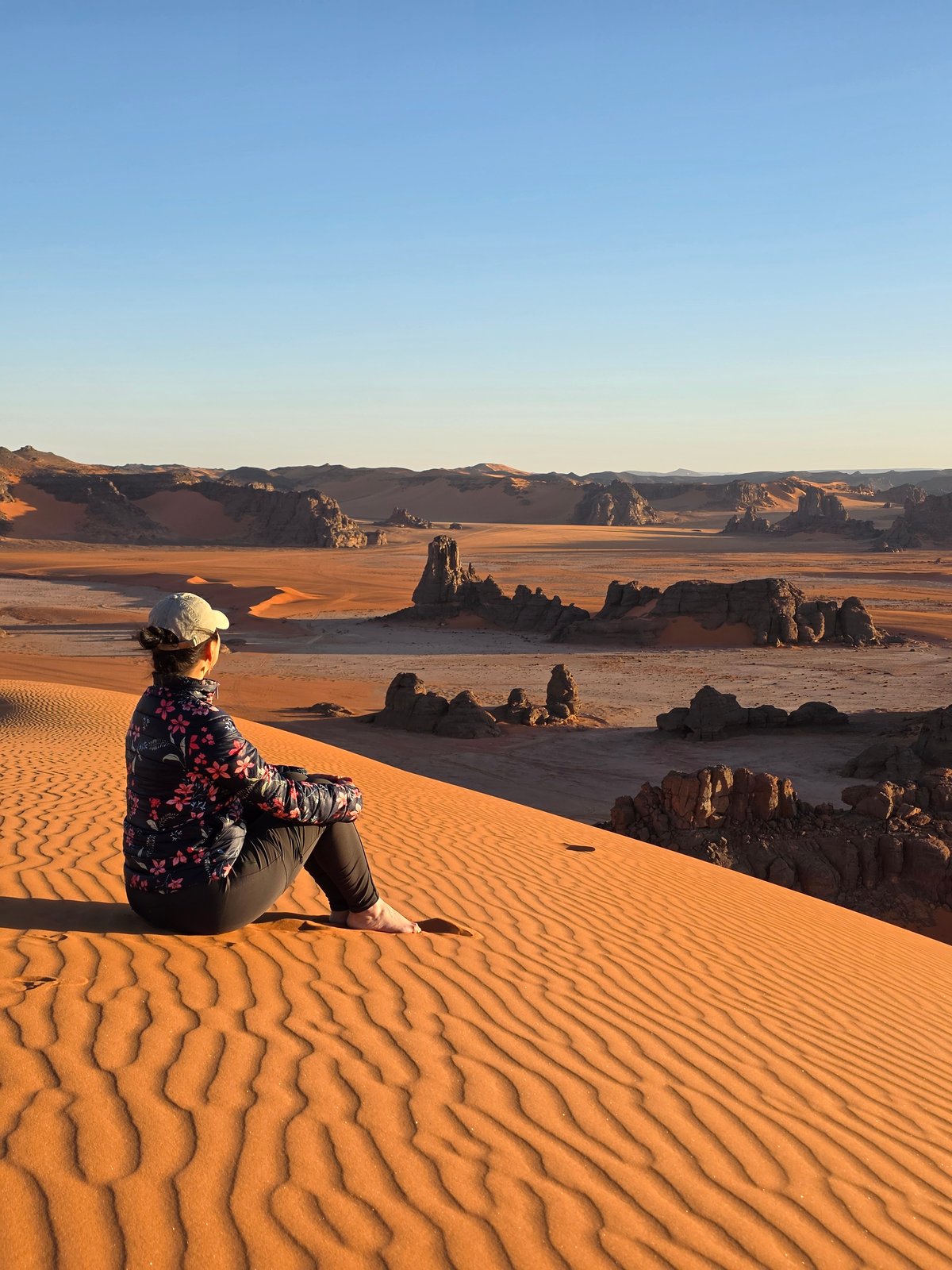
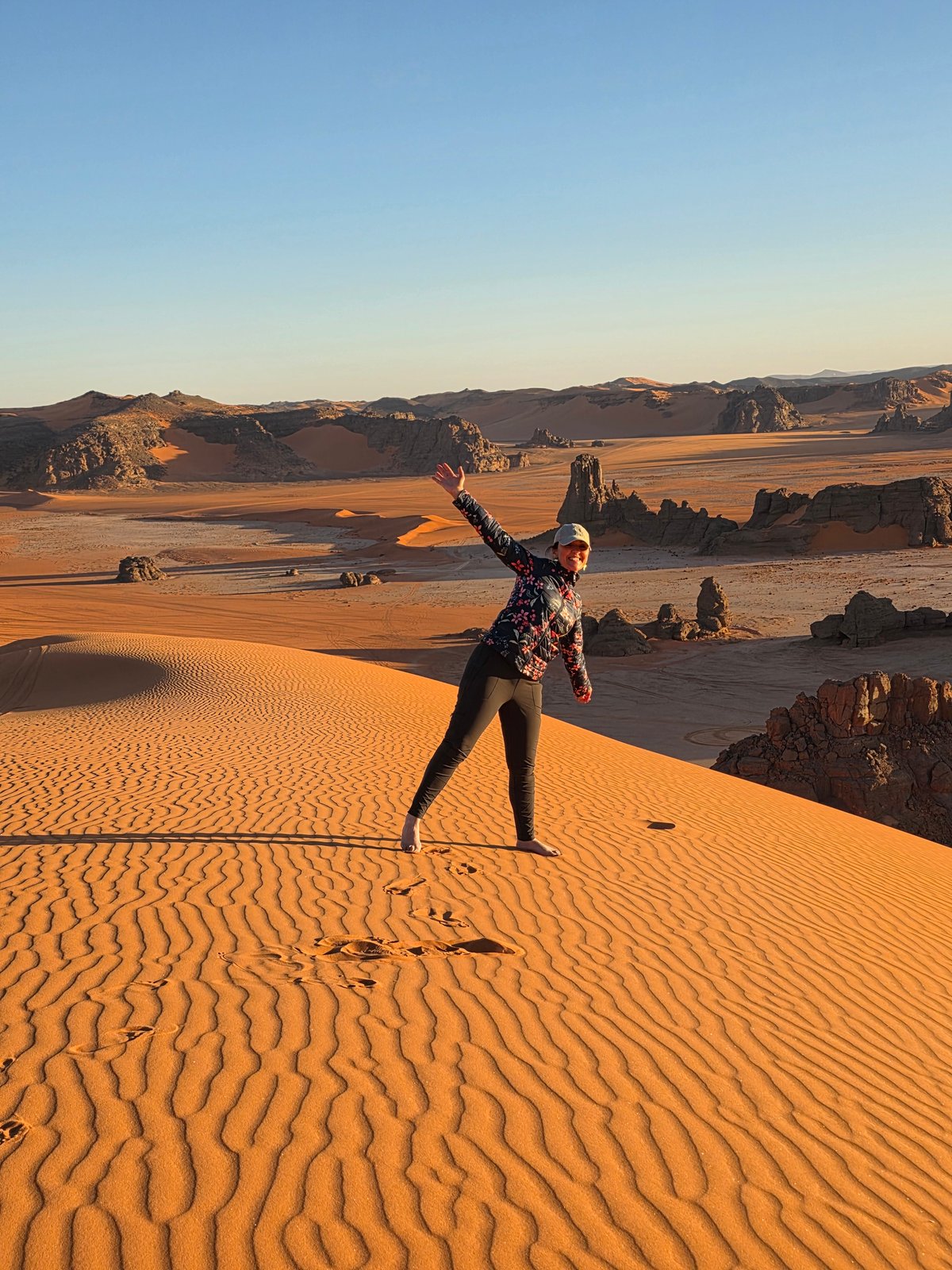
Sitting, facing the desert · Arm raised, at the top
Behind us, others are still climbing, tiny figures on the ridge. A pause, to catch your breath and look back at the way you've come.
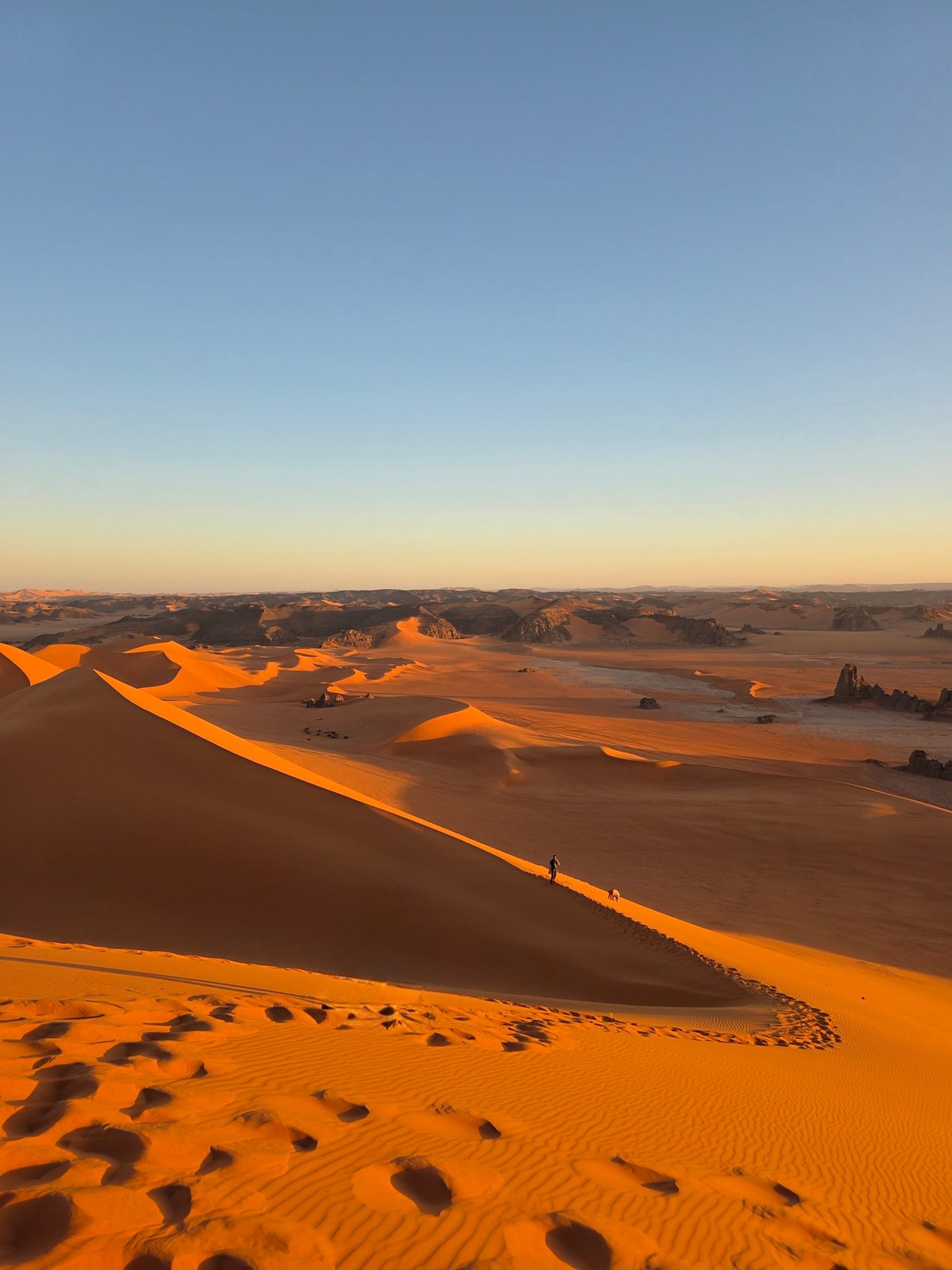
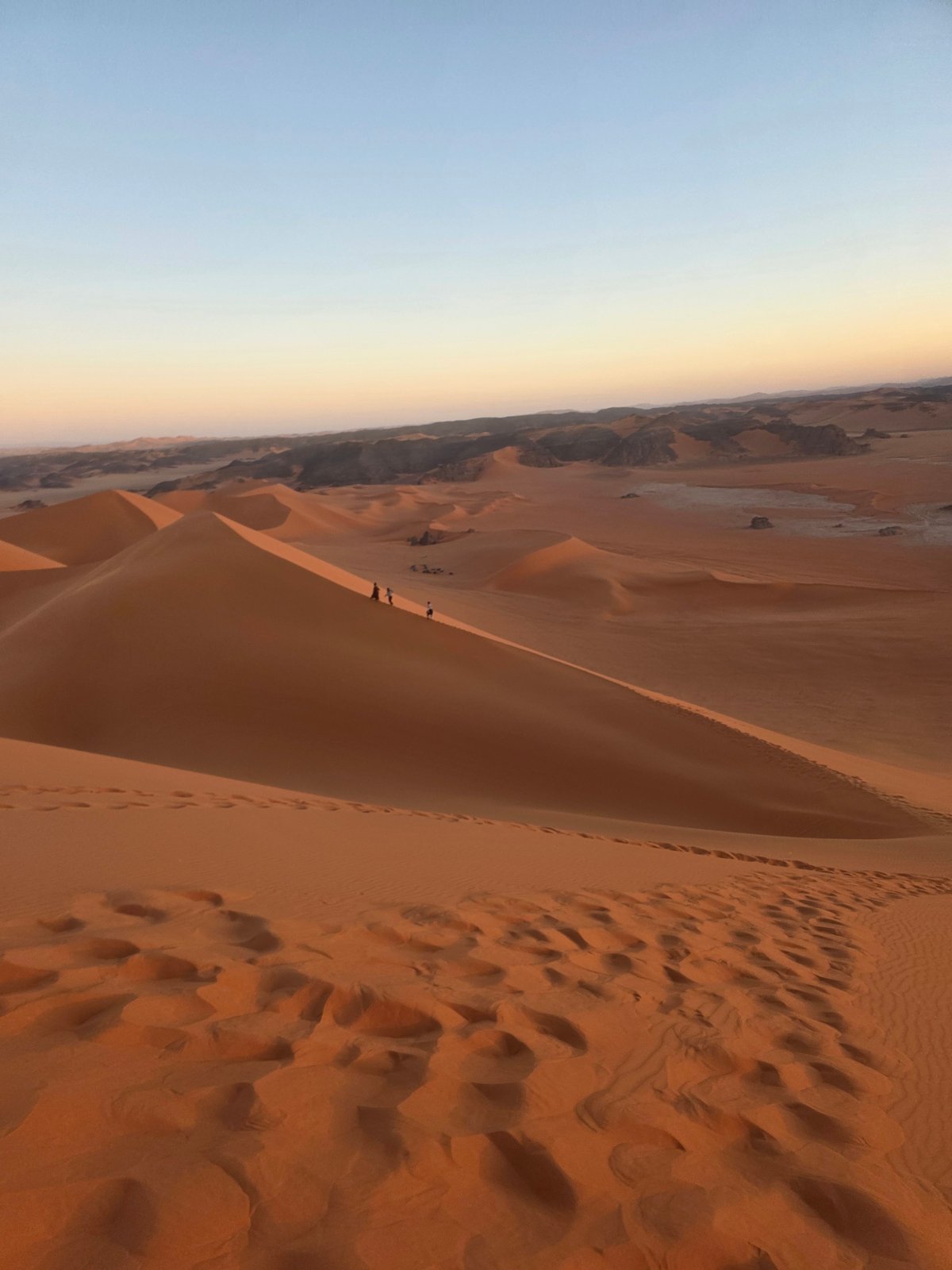
The last ones still climbing · A pause, looking back at the way we came
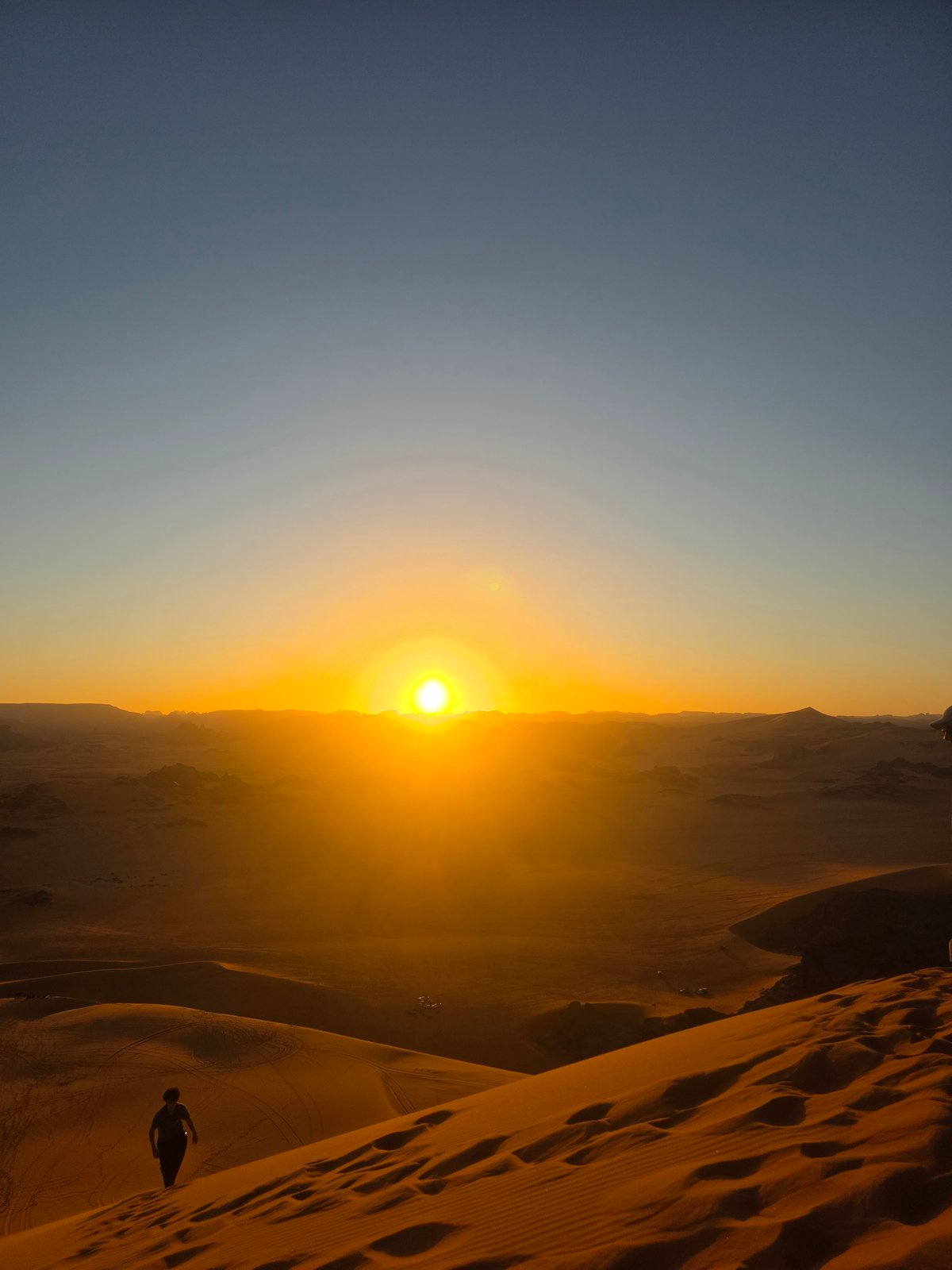
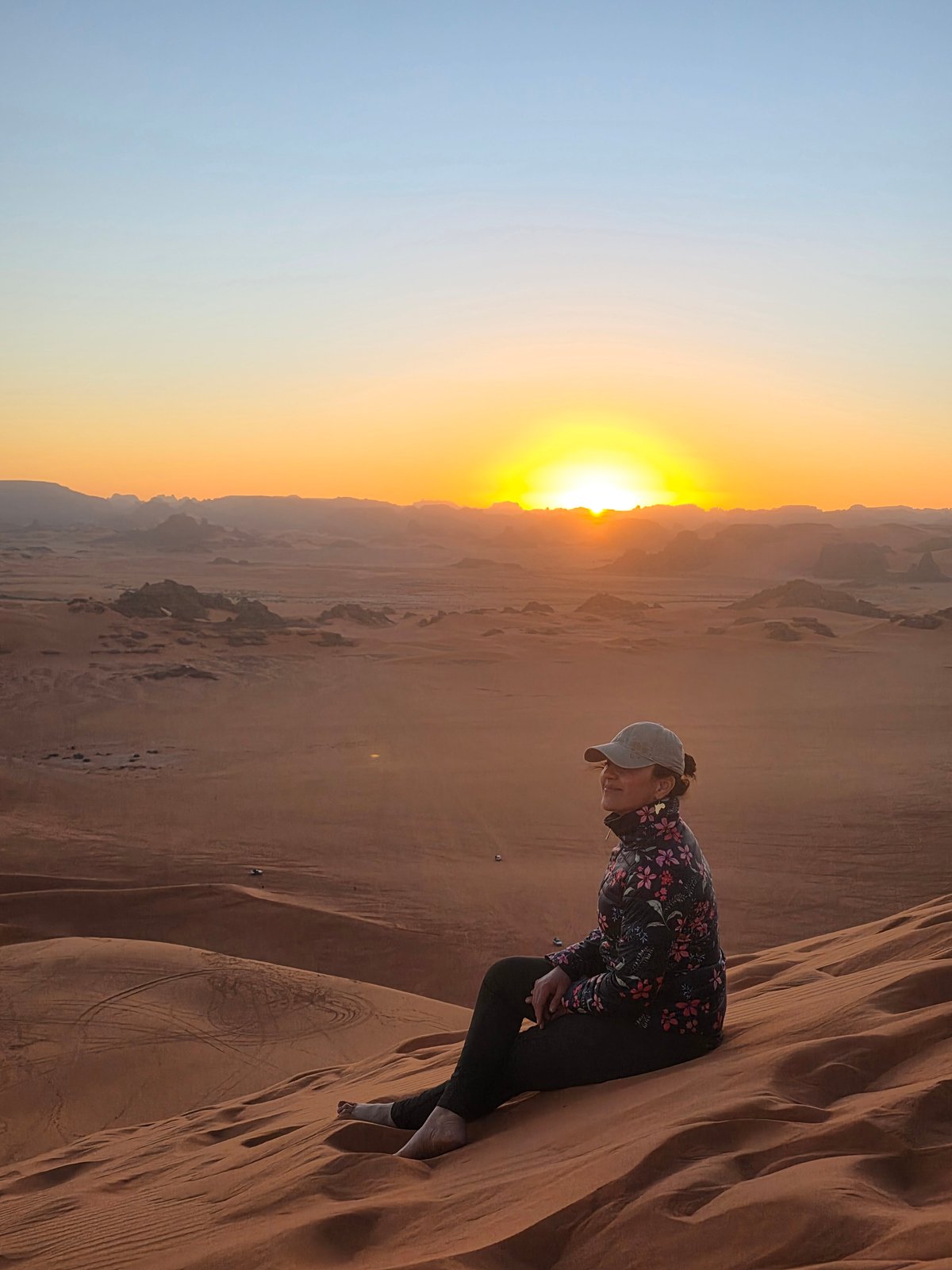
The sun disappears · The summit, at sunset
On the dune, a phone dropped in the sand becomes almost impossible to find. In our group, one person found theirs, another didn't. Wrist strap or zipped pocket, no discussion.
Back to the bivouac at nightfall. Fire, dinner, bed, the same evening ritual as usual, but every day it seems to weigh a little less on our shoulders.